A stillbirth, a rare cancer diagnosis, and a fight for life
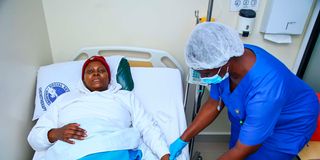
Fihliwe Ngwenya, who has a rare type of cancer called choriocarcinoma, at MP Shah Cancer Centre in Nairobi on August 27.

What you need to know:
- In Afro-Asian countries, the prevalence of choriocarcinoma cancer is estimated as 25-350 in 100, 000 pregnancies.
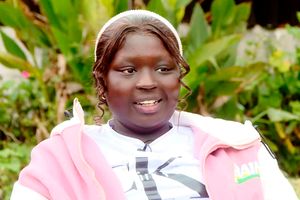
Fihliwe Ngwenya woke up one morning, opened her TikTok and pressed the record button. She hadn't put on anything fancy: a simple heavy cotton grey bathrobe. And then she started speaking. It was a six-minute-long video in which she poured her heart out to strangers. A vulnerable moment that she tells Healthy Nation was the beginning of her acceptance. It was in June this year, exactly five months after getting a cancer diagnosis.
Fihliwe does not take it with triviality when people say that a lot can happen in a year. This year, and the last, have unpacked a series of good tidings and ugly cries that will hopefully end in beauty. It unfolded in phases.
Chapter 1: A wedding in South Africa
Shortly after, she conceived. Months later, she left her country for Kenya, where she would live with her husband. But a few days after ushering in the New Year with the hope of parenting their first child, he died in her womb. Their son’s death wasn’t the only blow: she got a rare cancer diagnosis and has been managing it for the last eight months.
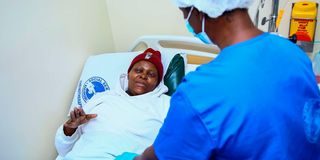
Ngwenya Fihliwe Happiness, a woman who got a rare type of cancer called Choriocarcinoma, is treated in an examination room at MP SHAH Cancer Centre, Nairobi on August 27, 2025.
Fihliwe’s wedding vows manifested on the day that she birthed her son after four days of being in labour. It had only been about a year since she said “I do” to her Kenyan husband, whom she met when she was an English teacher in South Korea. The two were enraptured by love, and after six years of courtship, they got married.
The two, just like the vows they took at the altar, have stuck by each other in literal sickness and in health.
“We were just really excited about starting our family and the prospects of life here in Kenya. Soon after I got married, I learned that we were expecting a baby, ” she tells Healthy Nation.
Her pregnancy journey, she tells us, was beautiful. The two lovebirds were excited to welcome their first child.
“We planned, we wished, we dreamed,” she says.
She strictly went for her prenatal checkups and at any slight sign of an illness, even a cough, would result in her husband taking her to hospital.
In the last week of pregnancy, the doctor confirmed to her that her baby was healthy and they were happy to see the unborn child through an ultrasound machine. “He was big, and tall. His father was excited and even said that he couldn’t wait to have an heir of his throne,” she shares.
From that last scan, her doctor advised her to go back to the hospital a week after. That was on January 20, 2025. Before her due date, she started feeling a movement that was unfamiliar. It was on January 17. Together with her husband, they tried a previous trick that had worked when they felt something was off. They took a walk. Nothing changed.
At some point, she felt some sort of stiffness but with tiny movements. She hoped that the morning would be different. The little growing boy had always been pumped up when his mother took breakfast. This time, his stillness was loud. That is when she decided it was time to go to hospital. They went to the nearest facility because it was an emergency. At the hospital, a sonographer used a doppler to try and get the baby’s heartbeat.
“They didn’t get anything,” she says.
Since that hospital did not have an ultrasound machine, the couple was referred to a different hospital. That is when they opted to go to their usual hospital. Again, just like in the previous hospital, a sonographer assessed her using a doppler and they still did not pick a heartbeat. In her telling, it was the longest 13 minutes of her life.
When they were told to go for an ultrasound, fear had already been planted in them, but they still had some faith. Some maybes. Some what-ifs. “We just thought it could be that their machine was not working,” she says.
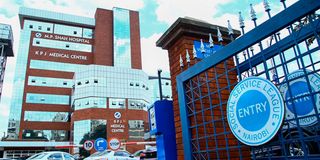
MP SHAH Medical Centre, Nairobi pictured on August 27, 2025.
During the ultrasound, he remembers the sonographer being unusually silent. That he just kept moving his transducer (the handheld device used mostly for pregnancy scan), from all angles to check if he could pick up anything. “He was silent for the longest time, just dead silent,” she remembers.
“For us, that was kind of an indicator that something definitely was wrong and he was just worried about breaking the news to us that our son had passed,” she adds.
Chapter 2: Doctor's confirmation
The sonographer did not immediately respond to their questions. He, in fact, told them that it’s only a doctor that would help in breaking down the details of the report.
The doctor came and confirmed to them their worst fear. Their son had no heartbeat. “It felt like the world stopped for a minute because our lives pretty much revolved around planning for his coming and what we were going to do after,” Fihliwe says.
“In that moment we were devastated, we were shattered.”
As if being told that their child being dead was not enough, she had to endure the agony of a vaginal delivery since a caesarean section is not advisable for a case like hers.
She was given a pill at around 7am that would help in inducing labour but six hours later, there was no progress. They tried another method when the pill failed to help her cervix dilate. They gave her a gel, but she still did not feel any contractions.
The gel, she was explained to, had to have an eight-hour window with two administrations and in between those, she should be able to feel contractions. Still, there was nothing.
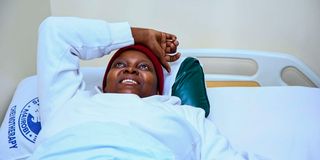
Ngwenya Fihliwe Happiness, a woman who got a rare type of cancer called Choriocarcinoma, is treated in an examination room at MP SHAH Cancer Centre, Nairobi on August 27, 2025.
“Eight hours after they administered the gel again, there was nothing. No contraction, no pain, nothing,” she recalls. Almost 24 hours later, she had dilated for only one cm, so they had to try a different option since they had surpassed the maximum number of gel applications with the hope of stimulating labour.
The next option was oxytocin, which is also used to induce contractions.
“I was told that it was stronger and that I should expect intense contractions,” she says. Even though the nurses had told her that she would get only two doses of oxytocin, she was given three but her body did not react as they hoped it would. “By this time, everyone was worried. My family was calling from South Africa,” she says.
The third administration only managed to give her about four cm of dilation. “It was hours of just agony and pain, and no delivery, he wasn't coming.”
At some point, a nurse told her that since she was struggling to dilate, they would have her get a membrane sweep –physically trying to induce labour. She forewarned her that it’s a painful process.
“It was really painful,” she says. After the nurse did that, her labour was able to progress from about four cm to between five and six cm, and then stalled for hours.
Eventually, everything concluded on a Tuesday. The two started the process on a Saturday.
“It felt like a relief, that I was finally coming to an end of everything. At the same time, I was scared to meet him knowing that he had died. I was still also hopeful that maybe there was a mistake somewhere,” she tells Healthy Nation.
“He wasn't alive, just like they had said, but I was just happy to see him, to see that I had birthed a human being, and he was handsome, and I loved seeing his face, he had my nose and everything,” Fihliwe adds.
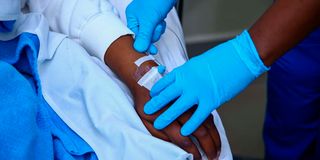
Ngwenya Fihliwe Happiness, a woman who got a rare type of cancer called Choriocarcinoma, is treated in an examination room at MP SHAH Cancer Centre, Nairobi on August 27, 2025.
The doctor told her that she was still going to feel some contractions and she would have to deliver a placenta.
They waited for a few minutes, but the placenta did not come out. The doctor then resorted to extracting the placenta using her hand. There was nothing to question at that point, and so they concluded the delivery process. “We spent some time with our son, sang songs to him, and just prayed,” she says.
Fihliwe sang her favourite hymn: Great is thy Faithfulness.
“I was grateful to God for the experience, I was grateful to God for the chance to mother him, to carry him to that point, and then also in my head, I was thinking, I was not going to have a chance to really sing to him and carry him beyond the few minutes that we were given with him.”
After that, his funeral preparations started. Everything happened so fast. They laid him to rest at Langata Cemetery in Nairobi. They had named him, and even had his birth certificate. His name was Lunzulu Jabali, Odongo.
At that point, everything was seemingly concluded. She was just told of some expectations like bleeding but one that would die down after some time. “During that time, I was still very sickly and weak, especially my knees, I couldn't stand up on my own, I had had a perineal tear, and the stitching also was a nightmare.”
The bleeding died down a little bit in the third week after delivery, and then picked up in the fourth week. The couple went to the hospital on the fifth week even though they had been asked to come after six weeks.
When she was checked, she was given a resounding assurance that everything was going on well in her body. They went home after that visit and a week after that, her body changed, again. “I started cramping, and then it proceeded to become bleeding. Heavy bleeding,”
She went back to the hospital and the first thing that was taken was a blood test. One which showed that her Beta-HCG hormones (pregnancy hormones) were elevated. “The value was 624,000, which is extremely abnormal for any pregnant woman at any point, according to the doctor,” she says.
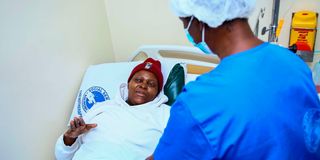
Ngwenya Fihliwe Happiness, a woman who got a rare type of cancer called Choriocarcinoma, is treated in an examination room at MP SHAH Cancer Centre, Nairobi on August 27, 2025.
She went for a scan and she remembers the sonographer taking time checking, and then he told her that he had seen some retained products of the placenta within her uterus. He also noticed that her uterus had grown bigger than usual.
At that point, they hoped that there was nothing more to that. They hoped that it was just the retained products of the placenta. “Our attitude at that point was already just off,” she recalls.
That is when she learnt that there was a mass of about 11.5 centimetres that was seen during the ultrasound.
The idea, at first, was to remove whatever it is they were seeing inside the uterus using a vacuum, just like they do when someone has had a miscarriage. She says that most doctors were hesitant to do the procedure because of the elevated pregnancy hormones. “At first, they told me that they thought it was GTD, which is a gestational trophoblastic disease.”
This is a disease of the uterus where the cells grow abnormally. Another doctor came and recommended doing a surgery called a hysteroscopy, where she was going to remove the contents of her uterus, with the assistance of a camera during the surgery.
After the operation, another doctor, again, came and gave them a positive post-surgery debrief.
“We were celebrating at that point because it was our biggest fear that something more was going on,” she says.
“We were now looking forward to starting the recovery process and continuing with the grieving process,” she adds. A few days after that, she got a call from the doctor who performed the surgery asking her when she was scheduled for her next checkup. She responded and the doctor now told her that she needed to discuss with her about the results of the biopsy they had taken. She didn’t know anything about a biopsy that had been taken.
On her scheduled date, she texted her doctor who responded via a text message, asking her to go directly to the cancer centre. “From reading that message, everything just went dark during the day. It felt like she (the doctor) was confirming to me that I had cancer. I felt like it was not the best way to handle the situation,” she says.
She went to the hospital and her cancer was finally confirmed to be choriocarcinoma. This is a rare type of cancer that mostly affects pregnant women.
“I didn’t hear most of what the doctor said at that moment because my mind just blanked out. I was in denial. I felt like it was a cover-up for whatever happened with the placenta,” she says.
Chapter 3: A rare cancer diagnosis
The couple went to a different hospital to get a second opinion. The facility, too, confirmed that all indicators proves that her prognosis was cancer. At that point, she really wanted to go back home to South Africa.
“When they tell you that you have cancer, it instantly feels like a ticking time bomb. Even the simplest of things feel like; could this be the end? I am dying?” She asked.
Since March, Fihliwe has been on chemotherapy. By the time we were doing the interview, she was on her sixth cycle of chemo. In the last week of August when we visited her during her last cycle, she looked upbeat. She had just received positive results from her doctor. “I have lost my hair; at some point I lost confidence and faith…wondering whether God was hearing my prayers. The first thing I am going to do at the end of it all is to book a flight. I haven’t seen my family since last September. I want them to just tell me that it is okay,” she adds.
In her journey, she has learnt that people are scared of cancer, and when someone is diagnosed with the disease, they are treated differently.
“There is just some hopelessness from a lot of people. They think in the line of death. It’s more positive in the hospital,” she says. “You can be a cancer patient and still lead a normal life,” she adds. Fihliwe tells Healthy Nation that her doctor’s positive review during her 7th cycle gave her hope. He told her that she would soon be transitioning to a period of monitoring the cancer in the next six months. “My cancer markers gave him (the doctor) confidence that we could possibly be in remission. It is so surreal. My body was already battered and bruised by chemotherapy. I am confident that God will surely grant me full recovery soon,” says Fihliwe.
The rare cancer that develops during pregnancy
What is choriocarcinoma?
This tumour develops from cells of placenta during pregnancy. Similar cells can be identified in other organs as well. Though it is a rare tumour, it is aggressive in nature, and potentially curable.
Do we have any known causes of this type of cancer?
Cells of placenta are called Trophoblasts. Abnormal proliferation of such cells result in choriocarcinoma. About 50 per cent of people with choriocarcinoma had a molar pregnancy - when fluid-filled sacs or tumours develop inside your uterus instead of a placenta.
How is it diagnosed?
It is mostly diagnosed through imaging studies like ultrasound, MRI or CT scans and high levels of a marker in blood called beta HCG.
Can this type of cancer, if it goes unnoticed during pregnancy, affect a foetus, and how?
Rarely can a foetus grow with an existing choriocarcinoma, but as soon as cancer is detected, the next step is termination of pregnancy. Most of choriocarcinomas are associated with abnormal pregnancy like vesicular mole or hydatidiform mole.
This is a rare type of cancer, do we know what predisposes one to get it? What is its prevalence?
In Afro-Asian countries, the prevalence is estimated as 25-350 in 100, 000 pregnancies. Molar pregnancy (most common), ectopic pregnancy, advanced age of mother, blood groups A and AB, history of miscarriages are considered as predisposing factors.
What makes it different from the other types of cancer
Early spread of disease is the most important feature of choriocarcinoma I noticed when doing my research that people online mostly said they were diagnosed with this type of cancer after a stillbirth. Is this the case and have you also made this observation in line of duty? Of course, it has a tendency to occur in women bearing ectopic pregnancy (pregnancy outside the uterus). Also, when we investigate the reason for multiple abortions, the possibility of this disease also surfaces out.
Fihliwe mentioned that she had to wait for contractions to happen even though her child’s heartbeat had stopped...is this the standard procedure?
That is correct. A Caesarean section is not a recommended procedure in view of severe bleeding and possible dissemination of cancer, rather it is preferred to wait for normal delivery.
What is the treatment plan once someone is diagnosed?
Termination of pregnancy, chemotherapy and regular follow-up. Occasionally, a removal of the uterus (hysterectomy) may be required in advanced cases.
What is the recovery rate for this type of cancer?
Almost 100 per cent in low-risk cases, 90-95 per cent in high-risk cases.
— Dr Vijay Narayanan is a radiation oncologist