Africa witnesses solar surge as installations jump by 54pc
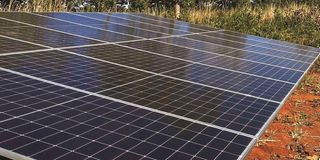
Solar power offers users greater energy independence by reducing reliance on power distributors whose supply is often unreliable.

What you need to know:
- This rapid acceleration is no longer confined to a few leading markets. While established players remain dominant—South Africa added 1.6 GW, Nigeria 803 MW, and Egypt 500 MW—the landscape is diversifying.
- In 2025, the number of countries installing more than 100 MW annually doubled from four to eight.
Africa has entered a transformative chapter in its energy evolution, with clean power now emerging as a stronger driver of economic growth than traditional fossil fuels. According to the latest “Africa Market Outlook for Solar PV” by the Global Solar Council, the continent added approximately 4.5 gigawatts (GW) of new solar capacity in 2025, a historic milestone.
This figure represents a staggering 54 per cent increase over the previous year, signalling that Africa’s vast solar potential is finally being unlocked through aggressive deployment.
Sonia Dunlop, CEO of the Global Solar Council, hailed solar technology as the “hope of Africa,” stating that solar paired with battery storage is uniquely positioned to deliver energy access, sustainable development, and resilience to natural disasters.
This rapid acceleration is no longer confined to a few leading markets. While established players remain dominant—South Africa added 1.6 GW, Nigeria 803 MW, and Egypt 500 MW—the landscape is diversifying. In 2025, the number of countries installing more than 100 MW annually doubled from four to eight.
Notable growth was seen in Algeria (400 MW), Morocco (204 MW), and Zambia (139 MW), indicating that solar is becoming the default choice for energy security across more mid-sized economies such as Tunisia and Botswana.
Perhaps the most revealing indicator of this boom lies in a massive import mismatch, suggesting the market is expanding even faster than official project registries show. In 2025, Africa imported a record 18.2 GW of solar modules. For perspective, total utility-scale solar deployment for 2026 and 2027 combined is projected at only 14.3 GW. This means that a single year's imports have already exceeded two years of planned large-scale projects.
The discrepancy highlights a major, underreported surge in private-sector activity, driven particularly by rooftop, commercial, and industrial installations that often bypass traditional tracking systems.
This highlights a dual transition: a government-led shift centered on utility-scale projects and a privately financed transition driven by households and businesses. Damilola Ogunbiyi, CEO and Special Representative of the UN Secretary-General for Sustainable Energy for All, emphasised that with Africa’s energy demand expected to grow eightfold by 2050, solar power paired with battery storage is critical for affordable electricity.
She noted, however, that while the continent holds 60 per cent of the world’s best solar resources, more must be done to attract investment through mechanisms that "spur public, private, and philanthropic financing."
Despite the momentum, a significant misalignment exists between the market's growth and its funding. Approximately 82 per cent of clean energy finance in Africa still stems from public and development sources geared toward massive utility plants. This capital structure is poorly suited to the current distributed boom, which requires smaller ticket sizes and local-currency financing.
Also read: Solar: The invisible burden of going green
Furthermore, the cost of capital remains a binding constraint, with interest rates in African markets remaining three to five times higher than in developed economies. This creates a paradox where solar is the cheapest technology available, yet the most expensive to finance.
The 18.2 GW import figure calls for a decentralised energy revolution. It suggests that while state-led grid projects struggle with financing and infrastructure, the private sector is voting with its feet, importing hardware at a rate that far outpaces official planning.
This move toward distributed solar plus storage represents a grassroots effort to ensure reliability amid grid constraints. For this to scale into a continental 300 GW reality by 2030, the focus must shift from capacity targets to system readiness, including national storage strategies and improved grid transparency.