Bamboo's resilience: How a community-led project in Kinale is restoring forests and water sources
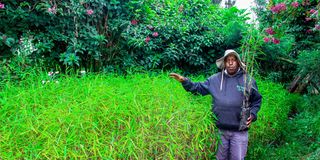
Daniel Waruathe stands next to his bamboo seedlings at his home in Kinale, Kiambu County.

What you need to know:
- What began as a small community effort has grown into a model demonstrating how locals can safeguard water sources and bodies, restore forests, and earn a living simultaneously.
On the misty slopes of Kinale Forest, Daniel Waruathe bends low over tiny bamboo shoots, pressing each one carefully into the damp earth. The scent of wet soil rises, mingling with the crisp morning air as leaves rustle gently around him. Each shoot is more than a plant—it is a lifeline for water sources and bodies, and the thousands of communities that depend on them.
What began as a small community effort has evolved into a model demonstrating how locals can simultaneously safeguard water sources, restore forests, and earn a living. Community members, including Daniel, plant bamboo along degraded slopes and riverbanks, their hands moving steadily through the cool mist.
"These efforts are gradually increasing forest cover while stabilising soil and improving local air quality," says Robert Ngotho, a forest manager at Kinale Forest.
This grassroots initiative has received backing from the Kiambu County Government through its Department of Natural Resources and Forestry. David Kuria, Kiambu County Environment Chief, emphasises the importance of linking training, technical guidance, and economic support.
"Through these efforts, community members can turn conservation into real, tangible gains," he explains.
Samwel Kiarie, the county’s Forestry and Natural Resources executive, adds: "Engaging the community is key. When people understand the issues affecting their water sources, they actively participate and help find solutions."
Gilbert Mungai, chairman of Water Resources Management in Kinale, echoes this sentiment: "Local participation is the most effective way to manage our water sources sustainably."
Both officials stress that combining government support with community engagement is essential for long-term conservation, hoping the Kinale model can inspire similar initiatives across Kenya.
In 2012, Daniel, secretary of the Kinale Community Forest Association, began cultivating bamboo seedlings to restore degraded watersheds. Most seedlings are planted along riverbanks and streams, revitalising local ecosystems. These water sources feed communities across Kiambu and downstream areas, including Nairobi, providing water for domestic use, irrigation, and livestock.
"Bamboo acts as a natural filter, preventing soil erosion and capturing airborne pollutants," Daniel explains.
Beyond environmental benefits, bamboo cultivation provides communities with income and a sustainable alternative to timber. Over 2,600 local residents now participate in bamboo cultivation and forest restoration, transforming conservation into both a livelihood and an environmental stewardship initiative.
Empowering women through clean water
Women in Kinale have gained both income and access to clean water through the bamboo initiative. Restored water sources now provide safe water for drinking, cooking, and farming, eliminating long walks to distant sources.
Elizabeth Waweru, a mother of four, shares her experience: "Before the water sources were restored, we struggled with dirty water. Now, our children drink clean water, and our land stays fertile."
Planting bamboo and selling seedlings has become an avenue for economic empowerment, ensuring families have reliable access to safe water. Local women benefit from county-supported training programmes that strengthen water conservation efforts. Guided by David Kuria, these programmes ensure that restored water sources are maintained through education, forest stewardship, and sustainable livelihood development.
Bamboo thrives in highland environments and comes in varieties suited for conservation, landscaping, and timber production. Seedlings take one to two years in nurseries before they're ready for planting, and another four to five years to mature for harvesting. Its fast growth allows it to act as a carbon sink and stabilise soil in erosion-prone areas, making it a key tool for climate adaptation and mitigation.
A Plant with ancient roots
Originating in Asia, primarily in China, India, and Southeast Asia, bamboo has provided construction materials, furniture, tools, paper, and traditional medicine for thousands of years. Ancient Chinese records over 2,500 years old highlight bamboo's role in irrigation, architecture, and culture, symbolising resilience and longevity.
Its rapid growth made it indispensable across Asia before spreading to Japan, Korea, and the Pacific Islands. Bamboo arrived in Africa in the late 19th and early 20th centuries, thriving today in East African highlands where it restores degraded land, stabilises soil, and protects watersheds. Communities harness bamboo for environmental restoration and livelihoods, echoing its traditional Asian role while combating deforestation, soil erosion, and climate change.
Initially offered space in Kinale Forest by the Kenya Forestry Service, Daniel and the Kinale CFA chose to grow seedlings on their own land to prevent theft. Today, he personally tends over 4,000 seedlings, most planted along riverbanks and streams. Community participation has expanded the effort as locals help plant bamboo in critical watershed areas, strengthening both forests and water systems.
Kiambu County and organisations including the East Africa Wildlife Society, KENHA, and KERA SACDEP regularly purchase seedlings, creating a growing market.
"Selling seedlings help me pay school fees while keeping my land forested," says Elizabeth. "We're seeing real benefits from planting bamboo along water sources—it helps both my family and the environment."
The county's training and seedling programme under Mr Kuria's guidance further strengthen this market, ensuring sustainable forest stewardship. Linking environmental restoration with economic opportunities fosters long-term engagement and ownership among locals.
The Kinale approach could be replicated in other highland regions, supporting wider forest conservation and watershed protection across Kenya. Daniel's model shows how community-led bamboo cultivation can restore forests, improve water quality and air, and generate livelihoods.
Kiambu officials stress that collaboration between government, community, and local institutions is key. "Although resources are limited, we hope such initiatives can inspire other counties to adopt similar strategies for clean, accessible water," says Mr Kiarie.