Be wary of the silent killer that strikes out of nowhere
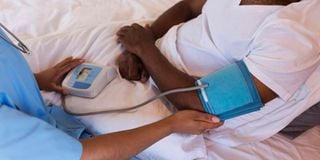
High blood pressure often has no symptoms.
What you need to know:
- More than three quarters of people with hypertension have no symptoms and hence are unaware.
- Further, at 50 years of age, about 50 per cent of people have elevated blood pressure. For this reason, people ought to have their blood pressure checked whether they feel unwell or not.
By Dr Lois Wagana-Muriithi
John woke up early one Thursday morning, a typical busy week, and felt the pressure.
At 50, he was doing well in life and was at the peak of his career. He was focused, goal-oriented and amazing at leading teams to meet and often surpass their objectives. An asset par excellence to his organisation.
John had this nagging feeling that he was overworking. He promised himself that he would mentor his juniors to increasingly assume some of his responsibilities that could be delegated; that he would make more time for his family.
Exercise had slowly taken the back burner; he hardly had any time anymore. The weight around the midriff had begun to tell.
A sudden bang brought John’s personal assistant to his office. He found him on the ground, semi-seated with his back against the front of his desk, an expressionless look on his face. His mouth had turned to the left. He stared blankly and could not speak but could only move his left arm.
John had suffered a stroke.
One week later, a nurse wheeled John from his ward into a small meeting room. He was glad to see his wife and two sons.
He could speak several words now and his recovery was remarkable, but he still had a long way to go.
Dr Mambo had asked to meet them. John had unanswered questions. What had caused the stroke? How was it that he had been perfectly fine one minute and then incapacitated the next? His mother had suffered a stroke at the age of 80. Was there any correlation? He had smoked until about six months prior to this event. He took alcohol three times a week but each time it was excessive.
The doctor confirmed to John that he had suffered a stroke. His blood pressure had been extremely high, at 230/128 mmHg, which had caused one of the blood vessels in his brain to break. He was fortunate to have survived.
The doctor explained that hypertension develops when the force of blood in the arteries that transport blood from the heart to the body’s organs is high, which is harmful to them. Normal blood pressure is below 120/80 mmHg and any pressure at and above 140/90 is high. Persons who have stressful lifestyles, do not exercise, smokers, people who take excessive alcohol and those with a family history of hypertension, stroke, diabetes and heart attacks are at a higher risk
More than three quarters of people with hypertension have no symptoms and hence are unaware. Further, at 50 years of age, about 50 per cent of people have elevated blood pressure. For this reason, people ought to have their blood pressure checked whether they feel unwell or not. Had John’s blood pressure been detected and properly treated earlier, this stroke would have been avoided.
His treatment would be life-long. He would need to reduce his salt intake and reduce his weight by about 10 per cent for a start.
John prayed that his speech would fully return so that he would be able to communicate with ease. Although he did not know whether he would be able to return to his work or not, he was grateful to be alive.
This imaginary story paints a picture of what we often see in hospitals because of hypertension. We urge people to have their blood pressure checked for early detection and treatment to prevent complications.
Dr Lois Wagana-Muriithi is a consultant physician-cardiologist