Choosing screening over silence: Women in Homa Bay rewrite cancer survival story
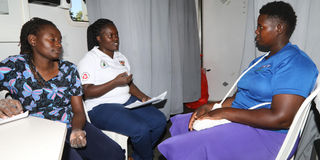
Cynthia Ougo (left) and Lucy Omollo takes Mary Adhiambo (right) through guidance and counselling before conducting breast and cervical cancer screening during an outreach at Oriang’ in Rachuonyo West, Homa Bay County, on March 12, 2026. Health workers use a mobile clinic to reach women from remote villages with cancer screening services.

What you need to know:
- Mobile cancer clinics eliminate cost barriers, bringing screening services directly to underserved rural women communities.
- Community outreach and education help overcome fear, myths, and resistance to lifesaving cancer screening services.
Christine Akinyi was supposed to be at a mortuary on March 12, 2026. Her co-wife's body was being prepared for burial the following day and her presence was expected. Instead, she walked to Oriang Trading Centre in Koyoo East, Kakdhimu, Rachuonyo West, and joined a queue of women waiting to be screened for breast and cervical cancer.
She had been thinking about it for a long time. The co-wife she was about to bury had died of throat cancer. Another member of her family had died of breast cancer in 2024. The disease had been circling her world for years, taking people she loved, and she had never once found out whether it was circling her too.
The reason was simple: cancer screening in Homa Bay is available at the county referral hospital in Homa Bay Town, and getting there to and fro from her village costs up to Sh800 in transport. For a woman from a vulnerable household, that is not a small sum. It is a decision. And more often than not, the decision is to stay home.
But on that Wednesday, a mobile clinic came to her. Two trucks from Aga Khan Hospital in Kisumu, deployed under the East African Comprehensive Women Cancer Project, had set up base at her trading centre. There was no transport cost. There was no long journey. There was only the queue, the counselling, and the test.
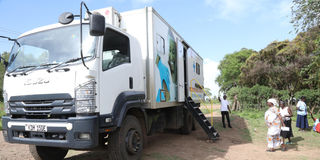
A mobile clinic used for cancer screening during an outreach at Oriang’ in Rachuonyo West, Homa Bay County, on March 12, 2026.
“I had never been screened for cancer in my life,” Christine, 35, says. “I had heard different stories about how the process was. Some women claimed it was painful, making others develop a phobia for it.”
She went anyway. And when it was done, she walked back to her village and started calling her neighbours.
Bringing the service to the door
One hundred and sixty women were screened at Oriang that day. Among them was Mary Adhiambo, 24, a mother of three, who had been screened once before during a similar exercise in 2024. The first time, she was afraid. The second time, she came back voluntarily and is now willing to encourage others. “After going through the process, I developed confidence and I can encourage other women to go for screening,” she says.
Their experiences reflect what project leaders and health officials in Homa Bay say is a fundamental shift in how cancer services are reaching women. The mobile clinic model, operated by Aga Khan Hospital under the East African Comprehensive Women Cancer Project, deploys two trucks that move through Homa Bay from Monday to Friday, 8am to 5pm, targeting women of reproductive age for breast and cervical cancer screening.
Each truck has a daily target of at least 150 women. The team, working alongside county health officials, plans routes and sites, prioritising areas where women have historically had no access to screening services. Since August last year, the trucks have covered every sub-county and are working towards reaching every ward and ultimately every village.
Project Manager Kennedy Mulama says the challenge in Homa Bay is not only about cost. It is also about geography. On the islands in Lake Victoria, referral cases can take hours or days because there are no water ambulances. Patients board ferries, water buses, or fishing canoes to reach the mainland.
To bridge that gap, one of the trucks is placed on a ferry and taken across the lake so that island communities can access cancer screening without crossing the water themselves. “The trucks have been instrumental. We have seen many people, who have been having challenges accessing cancer services, come to us,” Kennedy says.
How screening works
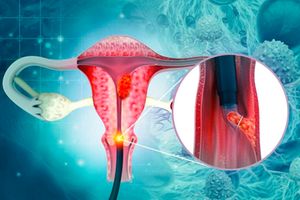
At the centre of the mobile clinic's work is a method called Visual Inspection with Acetic Acid, known as VIA. It is a cost-effective cervical cancer screening approach that works well in low-resource settings. During the test, acetic acid is applied to the cervix. A positive result, shown by the appearance of white lesions, indicates precancerous changes or early-stage cancer requiring treatment or further evaluation.
Cases where VIA covers less than 75 per cent of the affected area are treated on the spot using thermal ablation, a procedure that uses a metallic probe heated to 100 degrees Celsius to destroy abnormal tissue on the cervix. Cases requiring further investigation are referred to the county hospital.
For breast cancer, women under 40 are referred for ultrasound. Those above 40 are sent for mammograms. Lucy Omollo, the project nurse in charge of one of the trucks, is clear about the fears that keep women away. “Some women believe the screening is painful. Others ask for incentives in the form of money, which is never the case. The screening has no pain. Early screening ensures treatment for positive cases starts early,” she says.
Before any examination, every woman goes through counselling. She is told about the dangers of late cancer detection and taught how to regularly check her own body for changes, making it easier to spot warning signs between screenings. Adolescent girls attending the outreach are also vaccinated against human papillomavirus, adding a preventive layer to the programme's work in communities.
Role of community health promoters
Getting women to show up is a challenge. Community health promoters are central to that work. A week before each outreach, they move through villages engaging women, explaining what screening involves, and countering the myths and fears that have kept many away for years.
Consolata Auma, a community health promoter attached to Okiki Amayo Hospital, was part of the mobilisation effort in Koyoo East on March 12. She is familiar with resistance. “Some women do not want to cooperate. They claim to be busy. Those who do not want to go for screening give an excuse of going to cultivate crops,” she says.
The conversations community health promoters have with women before outreach days are not simply logistical. They are slow, persistent work of changing minds and allaying fears built up over years of misinformation and silence around cancer.
Gaps that remain
Homa Bay County Cancer Control coordinator Collins Nyonje says the mobile clinic programme has significantly expanded the reach of screening services, particularly in areas where women had never been screened before. But he is honest about how far there is still to go.
The county is working towards the World Health Organization's 90-70-90 targets for cervical cancer elimination by 2030; 90 per cent of girls fully vaccinated with the HPV vaccine by age 15; 70 per cent of women screened with a high-performance test by ages 35 and 45; and 90 per cent of women with pre-cancer or invasive cancer receiving treatment.
“Cancer screening is at 81 per cent with 35 per cent HPV vaccination. We need to do more because we need to reach every woman. We still have gaps in treatment as it covers only 49 per cent. We need to cover the 90-70-90 strategy,” Collins says.
The treatment gap is the most urgent. Screening without treatment is a diagnosis without a solution. Women who test positive and cannot access treatment face a different kind of cruelty: knowing what is wrong but being unable to fix it. Closing that gap will require investment in the cancer centre at Homa Bay County Referral Hospital, which the project is currently supporting, and in the referral systems that move women from a positive VIA result to a treated one.
For now, the trucks keep moving. Ward by ward, village by village, trading centre by trading centre. And women like Christine, who chose a cancer test over a funeral viewing and found out she was safe, are going home and calling their neighbours. That, in the end, is how the numbers change.