Climate change taking a toll on youth mental health, study finds
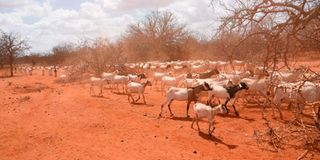
Livestock searching for pasture. Kenya has received a Sh519 million boost to reshape economic prospects in the arid and semi-arid lands.

What you need to know:
- In terms of gender variations, girls registered a higher likelihood of showing anxiety symptoms, mostly triggered by worrying about domestic violence and household stress that could potentially result from environmental disasters.
A new study has linked climate hazards and the emerging crisis in psychological health among young people, particularly in low-resource settings such as Kenya.
Extreme weather events, as highlighted by a team of researchers at Stanford University’s Schools of Sustainability, Medicine and Law, impact life decisions and the mental state of the youth.
Vulnerable regions
The study titled Adolescents' psychological health, temporal discounting, and climate distress under increased flood exposure in Bangladesh: A mixed methods cross-sectional study was published last month.
The survey enrolled 1,200 adolescents aged 15-18 years drawn from low-income families in Barisal (a high flood risk region) and Dhaka (a low flood risk region) in Bangladesh.
Young people from across the regions were also engaged in discussions through 16 focus groups in the five-month survey between August and December 2023.
“Chronic exposure to climate stress disproportionately affects low-income households; however, the psychological health and climate distress levels of climate-vulnerable adolescents in low-resource settings have rarely been explored,” the report read.
Researchers investigated the association between increased flood exposure and adolescent psychological health, climate distress, and long-term planning capacity (temporal discounting).
Adolescents living under higher flood exposure (Barisal) had significantly greater odds of anxiety symptoms and depressive symptoms relative to those under low exposure in Dhaka, researchers explained.
The study published in The Lancet Planetary Health journal indicated that” adolescents experiencing anxiety symptoms were more likely to exhibit temporal discounting.”
Girls are at a higher risk
In terms of gender variations, girls registered a higher likelihood of showing anxiety symptoms, mostly triggered by worrying about domestic violence and household stress that could potentially result from environmental disasters.
The study's lead, Liza Goldberg, says “fears around climate change could be a key factor in everyday health that could impair the youth’s zeal for life.”
"We were shocked by the rates of climate distress we observed, particularly the feeling that environmental changes are derailing young people’s sense of purpose and possibility.”
According to the Earth Systems Programme 2024 graduate, the findings amplify the voices of frontline adolescents, a group whose health outcomes and perspectives are rarely communicated and investigated.
Professor Gabrielle Wong-Parodi held that,” This is about more than mental health.”
While emerging research has identified positive associations between repeated, long-term extreme weather event exposure and anxiety and depressive symptoms, the researchers did not identify any studies in low and middle-income countries that investigated those links among adolescents.
“Although studies in low-income, middle-income and high-income nations have reported a growing prevalence of adolescent climate anxiety, few have investigated this phenomenon among climate-vulnerable adolescents living in low-resource settings,” experts say.
The turning point study is the first to explore the relationship between climate-vulnerable settings and among adolescents.
A few previous studies have investigated the role of poor mental health in temporal discounting among low-income households.
A strong link was found between the tendency to avoid long-term planning in favour of short-term decisions (temporal discounting) and anxiety signs across the subjects.
Experts are calling for mental health interventions that are not only community-centred but, most importantly, tailored for young people informed by their lived experience.
This includes climate resilience mechanisms that are gender-sensitive
like programs that protect economic and educational opportunities for girls during and after climate disasters.