Duale to Kenyans in DR Congo: Come home, but don’t bring Ebola

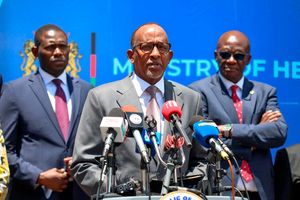
Health Cabinet Secretary Aden Duale addresses the media on Ebola at Afya House, Nairobi, on November 11, 2026.

Kenyans living or working in the Democratic Republic of Congo who want to return home for the festive season will soon get official guidance on how to do so safely, as Kenya moves to keep out an Ebola outbreak that is still active in the central African country.
Health Cabinet Secretary Aden Duale said on Wednesday that the Ministry of Foreign Affairs will issue a travel advisory in the next few days. He said Kenyans in DR Congo are welcome to come home, but must take care not to bring the virus with them.
"The outbreak continues in the DR Congo, and so the risk of importation is still real. For Kenyans living or working in DR Congo who wish to return home for festivities, you are welcome, but ensure you return safely and do not return the virus with you," he said.
The warning came as Kenya reached a turning point in its own outbreak. CS Duale said the last patient being treated for the Bundibugyo strain of Ebola was discharged on Wednesday, healthy and free of the virus. The last 11 contacts in quarantine have also gone home after completing their monitoring.
"Today marks 37 days since Kenya confirmed its first case of Ebola. Today, the last patient under treatment for Ebola Bundibugyo has been discharged...And for the first time since Ebola was announced, Kenya has no patient under treatment or quarantine," he said.
42-day countdown

Health Cabinet Secretary Aden Duale addresses the media on Ebola at Afya House, Nairobi, on November 11, 2026.
Kenya now begins a 42-day countdown to the end of the outbreak. CS Duale said the period is twice the longest incubation period of the virus.
"Tomorrow marks day one of the 42 days to the end of this outbreak. If no case is recorded within that period, Kenya will officially be declared free of Ebola on December 23," he said.
Surveillance will continue in all health facilities across the country, and screening will continue at all ports of entry. Survivors will keep receiving follow-up care, he said.
Call to review travel restrictions on Kenya
CS Duale also used the briefing to call out countries that imposed travel and visa restrictions on Kenyans, arguing that the country should not be penalised for reporting progress on the outbreak openly.
They include Saudi Arabia, which on October 30 suspended travel by Saudi citizens to Kenya and stopped issuing visas to people arriving from Kenya. It also barred entry to travellers arriving directly from Kenya, or transiting through third countries, if they had stayed in Kenya or any other country with an active Ebola outbreak in the 21 days before arriving in the Kingdom.
"As of today, Kenya has no Ebola case. Travel restrictions to Kenyans must be reviewed. Transparency should not be punished," he said.
The Health CS also set out firm limits on what Kenya will do for travellers from other countries.
"Let me also make it clear, Kenya will not serve as a quarantine centre for any jurisdiction. Travellers from other countries will not be held in Kenya to meet another country's entry requirements, and the Ministry of Health will not issue any certificate," he said.
"Let me repeat it: the Ministry of Health, under my leadership, will not issue any certificate of quarantine or Ebola-free certification for travel purposes. Such have no basis in the International Health Regulations."
'Moment of cautious celebration'
Dr Abdourahmane Diallo, the Director of Programme Management at the WHO Regional Office for Africa (AFRO), commended Kenya's "transparency, timely reporting, strong coordination mechanism and commitment to protecting the health and well-being of its people".
He called the final discharge a "moment of cautious celebration". The response, he said, "has showcased the importance of preparedness investment and the value of a whole-of-government and whole-of-society approach."
Dr Diallo, who served as Guinea's health minister during the deadliest Ebola outbreak, said vigilance must not slip.
"Guinea had celebrated the end of Ebola once, and, unfortunately, a resurgence happened. It happened because the virus persisted in body fluid beyond a known timeframe, for two months after the patient was discharged, and that led to the resurgence of the disease," he said.
Asked about lessons from the response, Director-General for Health Dr Patrick Amoth pointed to identifying and listing contacts, quarantining or isolating them, and following them up. This, he said, let the ministry contain the virus among close contacts and stop community transmission.
"We will continue with our high-intensity surveillance, including simulation exercises, not only at the airports but also across all the border points. The next case may not be somebody who is able to fly in. It could be somebody who passes through a non-designated point of entry or other borders, so the community needs to be part of this. We are not going to lower our guard, not for a single second, not for a day," said Dr Amoth.
Follow our WhatsApp channel for breaking news updates and more stories like this.