Early warning systems: Bridging tech and tradition to protect communities
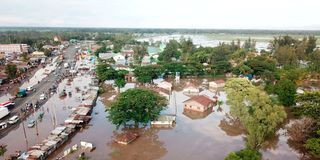
A section of Ahero town, Nyando Sub-County, submerged in flash floods from the River Nyando on November 29, 2024.

What you need to know:
- Experts are now advocating for integration of indigenous knowledge with scientific weather prediction methods, where technology and tradition work hand-in-hand to keep Kenyans safe.
A message pops up half an hour past three in the afternoon. It's not one of the usual notifications from local mobile service providers or a bank reminder about a loan you don't need. It's a message from the weather authorities, warning of impending strong winds that could pose a serious danger.
The message is from Meteo Rwanda –the country’s meteorological agency, an equivalent to the Kenya Meteorological Department.
"We get these messages every time from the meteorological department here in Rwanda. Our country is prone to landslides, and sometimes, very strong winds," explains Anonciata Byukusenge, an environment reporter.
She translates one of the recent messages on her phone: "Between May 4 and 6, 2025, heavy rainfall is expected, which may cause floods and landslides. You are advised to take precautionary measures and follow government guidelines."
This simple text represents a sophisticated early warning system (EWS)—a critical tool in disaster risk reduction that combines science, communication, and community action to protect lives and livelihoods.
But while Rwanda has successfully implemented this life-saving technology, Kenya's journey with early warning systems reveals both progress and persistent challenges that continue to cost lives.
Early warning systems weren't always the technology-driven tools we know today. Throughout history, communities developed traditional methods to predict and prepare for natural disasters.
Dr Gilbert Ouma, a meteorologist and climate scientist at the University of Nairobi, explains that Kenya's indigenous communities have long relied on environmental indicators to forecast weather events.
"The Maasai traditionally observe animal behaviour and certain plant species to predict drought conditions," Dr Ouma notes. "For instance, when certain acacia species produce abundant seeds, or when specific bird species migrate earlier than usual, elders interpret these as signs of upcoming drought and begin moving their herds accordingly."
Similarly, coastal communities in Lamu have historically watched ocean currents, wind patterns, and marine life behaviour to anticipate storms or tsunamis. These traditional systems, while not scientific in the modern sense, often proved remarkably accurate within their local contexts.
Modern early warning systems emerged primarily in response to humanitarian crises. According to a study published in the International Journal of Disaster Risk Science, the catastrophic African famine in Sudan and Ethiopia in 1984-1985, which claimed approximately one million lives, marked a turning point. The disaster exposed the devastating consequences of inadequate warning systems, even for slow-onset phenomena like drought.
In response, the US Agency for International Development and the US Department of State established the Famine Early Warning Systems to enable more timely relief efforts. This initiative represented one of the first systematic attempts to analyse socio-natural processes like famines and droughts to prevent mass casualties. Kenya has made significant strides in developing early warning capabilities, particularly in the past decade. The Kenya Meteorological Department (KMD) serves as the backbone of the country's weather forecasting and early warning infrastructure.
Caroline Amukono, a meteorologist with KMD, reveals that the department is transitioning to an "Impact-Based Early Warning System," which goes beyond simply predicting weather patterns to forecasting potential impacts on livelihoods, agriculture, health, and infrastructure.
"We're no longer just telling people it will rain heavily," Amukono explains. "We're now saying: it will rain heavily, which may cause flooding in these specific areas, potentially displacing communities, disrupting transport networks, and increasing disease transmission risks."
This shift represents a more holistic approach to disaster management that considers both hazards and vulnerabilities. KMD has also worked to decentralise its operations by establishing county meteorological offices and "downscaling" forecasts to provide more localised predictions.
In March 2023, this system was put to test when KMD issued warnings about potential flooding in Western Kenya and parts of the Rift Valley. According to data from the National Disaster Operations Centre, areas that received and acted upon these warnings reported 30 per cent fewer casualties than similar regions where warning dissemination was poor, according to the National Disaster Operations Centre Annual Report, 2023.
Digital transformation in disaster warning
The latest World Meteorological Organization report on the State of Climate in Africa 2024 highlights digital transformation as critical for improving weather data precision and service delivery lead times. Kenya has embraced this technological shift in several ways.
KMD now provides weather forecasts to farmers and fishers through mobile applications and SMS messages. One such initiative is the "M-Kilimo" platform, launched in 2022, which delivers personalised weather alerts to over 500,000 farmers across 33 counties. A study by the Kenya Agricultural and Livestock Research Organization found that farmers utilising these alerts reported 22 per cent higher crop yields compared to non-users during the variable 2023 growing season. Similarly, Lake Victoria's fishing communities now benefit from "TaariFish," a mobile application developed through collaboration between KMD, the Kenya Maritime Authority, and the Lake Victoria Basin Commission. The platform provides detailed lake condition forecasts and has contributed to a 45 per cent reduction in lake accidents since its implementation in late 2022, according to Kenya Maritime Authority Safety Statistics, 2024.
The Kenya Red Cross Society has pioneered another innovative approach through its "Flood Volunteer Network" in flood-prone counties like Tana River, Garissa, and Kisumu. This programme trains community volunteers to monitor river levels using simple gauge tools and smartphone applications, creating a human sensor network that supplements official monitoring stations.
"This network has proven invaluable, especially in remote areas where we lack automated monitoring equipment," explains Ahmed Hassan, disaster risk reduction coordinator at Kenya Red Cross. "In April 2024, volunteer reports from Garissa provided crucial early warnings of rising river levels three days before major flooding, giving communities precious time to evacuate livestock and valuables."
Water doesn't respect political boundaries, making regional cooperation essential for effective flood management. The Nile Basin Initiative exemplifies this approach through its Eastern Nile Flood Forecast and Early Warning System (EN-FFEWS).
Dr Isaac Alukwe, regional coordinator for the Nile Equatorial Lakes Subsidiary Action Program (NELSAP), explains that the system provides warnings for all 11 Nile Basin countries, including Kenya.
"The system broadcasts and sends emails to all countries through their meteorological departments, particularly for identified hotspots," Dr Alukwe says. "It's then upon individual countries to package this information and release it for public consumption." Rwanda exemplifies best practices in this regard, routinely converting technical forecasts into accessible public warnings via SMS. Kenya, while making progress, hasn't yet achieved the same level of systematic public communication.
The EN-FFEWS proved its value during the 2023 long rains when it accurately predicted flooding in Kenya's Lake Victoria basin a week before the events. However, a subsequent assessment found that while technical agencies received these warnings, communication to at-risk communities was inconsistent, with only 38 per cent of surveyed households reporting having received any warning.
Bridging scientific and traditional knowledge
Despite technological advances, many communities still rely primarily on traditional knowledge systems for weather prediction. Rather than viewing these approaches as outdated, experts increasingly advocate for integrating indigenous knowledge with scientific methods.
Rashid Mohamed, chairperson of an environmental rights network in Mandera County, argues passionately for this integration. "In the health sector, traditional birth attendants are not really experts, but they have been integrated into the health system. It's time to include indigenous knowledge on early warning systems," he insists.
Mohamed points to recent flash floods in Mandera that claimed one life and killed nearly 50 goats. "People would have been saved had the government reached out to them in a more convincing way," he explains. "We experience loss and damage in real life." His concerns highlight a persistent challenge: while sophisticated warning systems exist at national and regional levels, the information often fails to reach or convince the most vulnerable communities.
The Kenya National Drought Management Authority (NDMA) has attempted to address this gap through its Community-Based Early Warning System in pastoral counties. This approach combines scientific data with traditional indicators identified by community elders.
James Oduor, CEO of NDMA, cites promising results from this hybrid approach. "In Marsabit, we've documented over 30 traditional drought indicators used by different communities. When we align these with our satellite data and ground measurements, the prediction accuracy improves significantly, but more importantly, community buy-in increases dramatically."
A pilot project in Turkana County that incorporated traditional indicators into official drought bulletins saw community response rates increase from 35 per cent to 78 per cent between 2022 and 2024 (NDMA Community Response Metrics, 2024).
Challenges in "last mile" communication
Perhaps the greatest challenge in early warning systems lies in "last mile" communication—ensuring warnings reach the most vulnerable communities in time and in forms they can understand and act upon.
The 2023 floods in Nyando, Kisumu County, illustrate this challenge. Despite accurate KMD forecasts and warnings issued through official channels, many riverside communities received little or no warning before floodwaters arrived. A post-disaster assessment found that while warnings were broadcast on radio and television, many affected households either didn't receive these broadcasts or didn't have sufficient information about potential severity and specific actions to take (Kenya Red Cross Nyando Flood Response Report, 2023).
Dr Joost Hoedjes, a technical advisor with the Climate Risk Early Warning Systems initiative in East Africa, identifies several persistent barriers:
"First, there's the technological barrier—many vulnerable communities have limited access to smartphones, internet, or even electricity. Second, there's the language and literacy barrier—technical warnings must be translated into local languages and formats accessible to non-specialists. Finally, there's the trust barrier—communities must trust both the warning source and the recommended actions."
Innovative approaches are emerging to address these challenges. The Ada Consortium, working in Kenya's arid and semi-arid counties, has established "Climate Information Service" committees that combine county meteorologists with traditional forecast interpreters. These committees develop consensus forecasts that are then disseminated through multiple channels, including community radio, religious institutions, market days, and SMS services.
"When scientific and traditional knowledge align, the message is much more powerful," explains Mumina Bonaya, a climate adaptation officer with the Ada Consortium. "And when they differ, the dialogue itself helps both scientists and communities understand the limitations of their prediction systems."