Indigenous and scientific weather predictions restore hope for Kajiado farmers, herders
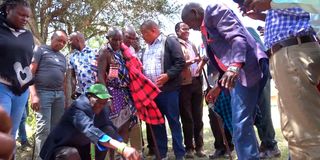
Maasai elders examining intestines of a goat as a way of predicting weather in Kajiado on February 17, 2025.

What you need to know:
- The predictions suggest favourable conditions across all five sub-counties: Kajiado North, East, West, South, and Central.
As the morning sun rises over Kajiado County, Maasai elder Sakimba Mbuyu bends over a freshly sacrificed goat, his weathered hands moving with practised precision.
His eyes scan the intestines intently, reading nature's messages in the delicate pattern of blood vessels — a centuries-old weather forecasting method that has sustained his people through countless seasons. Today, his ancient wisdom finds an unlikely ally: modern meteorological science.
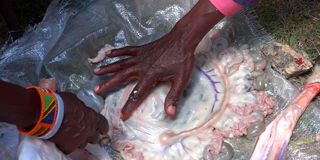
Maasai elders examining intestines of a goat as a way of predicting weather in Kajiado on February 17, 2025.
In a groundbreaking convergence of old and new, both Mr Mbuyu's traditional forecast and Kenya's state-of-the-art weather predictions point to the same hopeful conclusion: the parched earth of Kajiado County will soon drink deeply from long-awaited rains.
In a unique weather prediction ceremony held in Kajiado, Maasai community elders employed traditional forecasting methods that aligned with modern meteorological data. The ceremony involved carefully examining the intestines of a slaughtered male goat, a practice reserved for elders and individuals recognised for their weather prediction abilities.
"After studying the intestines carefully, we can say authoritatively that we will have ample rains from March to May," said elder Sakimba Mbuyu. "The flow of blood in thick veins within the intestines signifies heavy water flow in the rivers. Our people should prepare to restock their herds and plan for crop production." The elders' forecast drew from multiple traditional observation methods such as a detailed study of blood vessel patterns in goat intestines, observation of the moon and stars and an analysis of animal behaviour patterns.
"We had earlier studied the moon, stars and animal movements, all pointing to the same forecast. This is knowledge inherited from our ancestors," explained elder John Waupari.
He noted that animals typically show reluctance to leave their cowsheds for grazing when rain approaches, serving as a natural indicator. The Kenya Meteorological Department's recent forecast supports these traditional predictions. The department projects rainfall exceeding 100 millimetres during the upcoming season in the region. Director Benson Lubanga emphasised the importance of combining traditional and scientific knowledge through Participatory Scenario Planning. "The integration of indigenous and scientific knowledge has led to consistent findings. The elders' rich knowledge is indisputable,” said Mr Lubanga.
However, he noted that environmental degradation continues to affect weather patterns, creating challenges for both traditional and modern forecasting methods.
While meteorological officials introduced the elders to modern forecasting techniques, including balloon-based methods, the traditional practitioners expressed preference for their time-tested approaches.
Veteran meteorologist Francis Nguatah stressed the importance of continued collaboration between scientific and indigenous weather prediction methods to help communities prepare effectively.
Michael Semera, the Climate Change executive, urged farmers to focus on rainwater harvesting during the upcoming wet season. The forecast has particularly encouraged local herders, many of whom are diversifying into crop production following the devastating 2020-2022 drought that resulted in significant livestock losses.
The alignment of traditional and modern forecasting methods has restored hope among Kajiado's residents, particularly herders who feared having to relocate their livestock to neighbouring counties due to diminishing pastures. The predictions suggest favourable conditions across all five sub-counties: Kajiado North, East, West, South, and Central.