Ebola: Focus turns to isolation unit in Nanyuki
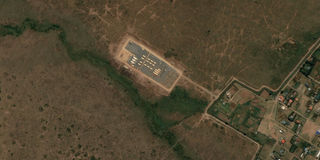
A satellite image shows tents erected at the US-backed Ebola quarantine facility at Laikipia Air Base in Laikipia County, Kenya, on June 22, 2026.

What you need to know:
- Last month, Duale told the Nation that none of the US$14.52 million (about Sh1.9 billion) in Ebola preparedness support extended to Kenya by the US government has gone through the Ministry of Health or KNPHI.
There was little activity at the US-funded quarantine centre at Laikipia Air Base, Nanyuki, on Tuesday when news of the first Ebola case in Kenya broke.
Attention has turned to the centre as it emerges that at least 55 people may have been in contact with the patient.
The patient travelled from the DR Congo and arrived in Kenya on Saturday. He tested positive for the virus on Sunday and died the following day.
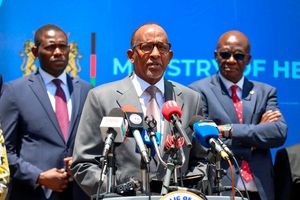
Health Cabinet Secretary Aden Duale said 28 contacts have been listed, including kin and health workers. Twenty-three passengers and four crew members on the same flight are being pursued.
Because the patient moved through the airport and the city before his diagnosis, the tracing could grow.
While Mr Duale and health officials said there are enough isolation and monitoring facilities, attention has turned to the centre in Nanyuki whose construction triggered protests.
On Tuesday, locals reported seeing US soldiers moving behind the perimeter wall. The only planes in the sky were Kenya Defence Forces (KDF) helicopters.
“There is little activity around the airbase apart from helicopters circling for Mashujaa Day celebration rehearsals,” a local near the base told the Daily Nation.
The patient did not go to Laikipia. He was treated at a private hospital in Nairobi days after landing arrivaland he died there.
Now the country is counting its isolation beds, test kits and cash.Will the US-supported centre help Kenyans?
They had arrived five days prior directly from an Ebola response mission in the DR Congo.
The revelation sparked fury from rights groups and residents. Weeks before, Mr Duale was in court apologising for being in contempt. He swore that operations and construction of the centre had been halted.
The case argued that the government broke the law by secretly signing a deal with the US to host a biological containment centre.
The state presented the centre as a joint effort when it was announced in May. The Ministry of Health said it would strengthen Kenya’s monitoring, isolation and emergency response capacity.
President William Ruto said it was part of a cooperation with the US on health and security. He added that he approved it after a request from President Donald Trump, and pointed to decades of US support, including HIV programmes.
The 50-bed centre was conceived for Americans. The White House said it would be built, staffed and run by Americans, with no Kenyan officers involved. It would receive Americans exposed to the virus.
A satellite image shows tents erected at the US-backed Ebola quarantine facility at Laikipia Air Base in Laikipia County, Kenya, on June 22, 2026.
However, Mr Duale later said it would serve multiple users. The minister’s list puts the number of isolation and treatment centres at 23, including an eight-bed unit at Kenyatta National Hospital (KNH), a 49-bed unit at the National Police Service Hospital, twenty isolation beds at Moi Teaching and Referral Hospital, plus 30 surge beds. At least 29 counties have isolation sites.
Prof Shem Otoi, an infectious disease modelling expert, warned of the limits at KNH.
With the contacts and the flight passengers in the dozens, he said the eight beds would not be enough should there be an outbreak.
“We need to move with speed and ensure counties are prepared enough to handle cases. Only KNH can handle Ebola for now. We shouldn’t be caught off guard,” Prof Otoi said.
During a preparedness assessment presentation to the Senate in June, Mr Duale said the country’s stocks of test kits, reagents and protective equipment would support only the first 200 suspected cases.
“With the number of people in isolation, if we were to conduct three tests to every individual before releasing them after 21 days, the kits and reagents might not be enough if that is the number that we still have as a country,” he said.
Last month, Duale told the Nation that none of the US$14.52 million (about Sh1.9 billion) in Ebola preparedness support extended to Kenya by the US government has gone through the Ministry of Health or KNPHI.
Duale said that US$3.77 million (Sh488 million) went to surveillance and response; US$6.5 million (Sh841.7 million) for clinical preparedness, including infection prevention and control and protective equipment with US$2.65 million (Sh343.33 million) for emergency operations. US$2 million (Sh258.9 million) for supply chains and logistics.
In September, Principal Secretary Mary Muthoni said Kenya would require exit surveillance reports for all travellers, certified by authorities in the country they are leaving.
Ms Muthoni, while making a visit at the airport to show the level of preparedness to Kenyans, said that travellers were expected to carry a detailed screening report and share it with the airline or bus company that brought them.
She said the government was considering a 21-day quarantine for travellers from high-risk countries.
“What happened to this case, did we just let a sick person to the country, or what really happened? Was there no travel history for the case to be declared risky,” Prof Otoi questioned.
Whether the new rules applied to this patient from DRC to Entebbe, Uganda to Kenya is a question the Ministry has yet to answer.
The strain in this outbreak is Bundibugyo, first identified in 2007, when it caused an outbreak in Uganda with 149 suspected cases and 37 deaths. A 2012 outbreak in the DRC produced 56 laboratory-confirmed cases and 17 deaths, according to the US CDC. The current outbreak was declared on 15 May 2026 and is the 17th recorded Ebola outbreak in the DRC since 1976.
WHO Director-General Dr Tedros Adhanom has said there are no approved vaccines or treatments for Bundibugyo.
Experimental vaccines from Oxford University, Moderna and the International AIDS Vaccine Initiative are being fast-tracked in trials, backed by the Coalition for Epidemic Preparedness Innovations (CEPI).
Vaccines made for the Zaire strain, such as Ervebo, have been allocated for emergency use or trials to test for partial protection, though they are not licensed for Bundibugyo.
“With no vaccine, Kenya's defence is what it has been building for months: screening, isolation, tracing and supplies. This week showed where those fall short.” Prof Otoi said.