Eco-warriors of Homa Bay turn to bamboo to fix street coffee crisis fuelling lake pollution
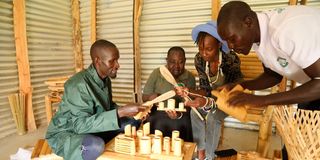
From left: Members of Jipange Echo Champions Brighton George, Mary Okoro, Lucy Onyango and Denish Atandi samples some of the items made using bamboo at their workshop at Dani Stage in North Kabuoch, Homa Bay County, on March 25, 2026.

What you need to know:
- Single-use plastic cups from street coffee are worsening pollution and flooding in Homa Bay.
- Innovators are transforming bamboo into sustainable products to replace plastics and protect Lake Victoria.
On chilly days, many outdoor workers in towns and markets turn to street coffee—popularly known as kahawa chungu (bitter coffee)—to stay warm.
The beverage—made by boiling water mixed with sugar and spiced coffee—is often served in small paper cups, sometimes accompanied by snacks like mandazi or samosa. Vendors target commuters, boda boda operators, jua kali artisans and night shift workers.
The drink costs less than Sh20 and is affordable for most customers. But its consumption is often a threat to the environment. In Homa Bay County, it is served in single-use plastic cups. Most people either leave the cups on the ground or just toss them into drainage systems after use.
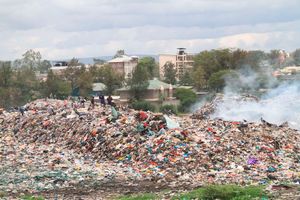
Plastic water bottles, single-use plastic food containers, polythene bags and other plastic objects create massive environmental pollution in major towns. The effects of irresponsible waste disposal are visible when it rains. Runoff collects most solid waste and drags it downstream. Some of the plastics block drains, resulting in flooding in residential areas.
But when the force of moving water is high, all the waste gets deposited in Lake Victoria, leaving a layer of multicoloured material floating on the beach. Officials from the National Environment Management Authority (Nema) point out that up to 30 per cent of waste produced in the region is plastic. Nema Director Jacob Asembo says more than 80 per cent of plastic waste gets into the lake.
Over time, plastic breaks down into micro bits that harm marine life and human health. The micro-plastics are eaten by fish, which eventually finds its way onto lunch or supper plates. “Waste management in the region is a big problem. The county government does not have a well-established dumping site because the one available is located in a residential area,” Jacob says.
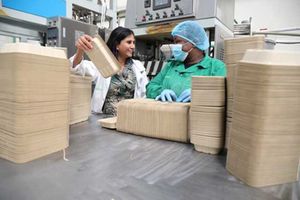
Switching to reusable containers or biodegradable ones is crucial to minimise environmental impact. Bamboo is one of the highly recommended materials. It is a renewable, biodegradable alternative to plastics, capable of growing over one foot daily. Jacob notes that it is one of the best alternatives to single-use plastics like straws and cutlery.
One youth group in Homa Bay is leading a revolution by making products from the plant and encouraging people to switch as a means of fighting plastic. They sell their items to households. The Jipange Echo Champions Self-Help Group makes basic household items such as cups, mats, trays, cooking sticks, lamp shed, dustbins, table, chairs, jewellery, and ornaments. Members select the correct bamboo stem based on age and size.
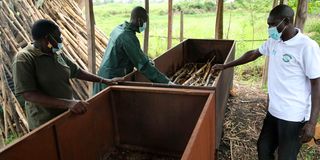
Group founder Brighton George, a specialist in bamboo production, says the plant is harvested and treated using boric acid and borax to minimise insect attacks. It is then taken to the workshop at Dani Stage along Rongo-Homa Bay road in North Kabuoch and turned into a new item.
Making the products requires craft skills, which the group acquires every day. They also turn the plant into briquettes used as fuel. “I graduated from Pwani University in 2021 when I developed the passion for environmental conservation. I started by developing tree nurseries in my village,” Brighton says.
When growing trees, he was identified as a champion of environmental conservation by the International Bamboo and Rattan Organisation (Inbar), an intergovernmental organisation promoting the use of bamboo and rattan for sustainable development. He was made Inbar’s steward in the region.
Brighton was introduced to bamboo farming, taught about more than 1,600 species, and trained, including a two-week trip to Ethiopia in September 2023. When Inbar ended the programme in January 2024, it left him with immense knowledge of bamboo use for conservation, particularly in reclaiming degraded land and making products to replace plastics.
Environment-friendly alternatives
Brighton now uses the skills to help others in fighting solid pollution by offering recyclable, environmentally friendly items. At their bamboo farm near Obera Boys High School, the plants have different stem colours to guide on best use for different items. Those less than one year old have sheath and are not coloured. They are left to grow.
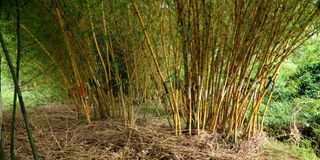
A bamboo farm in North Kabuoch, Homa Bay County, on March 25, 2026. A group is turning bamboos into household items.
“Bamboo that is more than four years old is coloured white while red is used to mark plants that are more than a year old but less than two years old. Black colour is used in the third year while navy blue is used in the fourth year,” he explains.
During treatment, the plant is soaked in hot acid for at least two hours. This is after each internode—the hollow, cylindrical segment between two nodes—is drilled to let the chemical get absorbed for preservation. Brighton explains that items that are used to handle food are soaked in salty water to prevent possible poisoning. “This is to prevent any traces of the acid from mixing with food. We specifically use acid for bamboo used to make things like chairs,” he notes.
Depending on the product to be made, the plant is cut into different sizes. Jipange Echo Champions Self-Help Group has 22 members, including professionals, who spend their free time at the workshop assembling items. They take 40 per cent of the proceeds of the item they make. Some members also make products at home, especially items that do not require use of machines during initial stages.
Brighton says all the items, whether made at home or at the workshop, must go through final touches, which includes sanding to smoothen rough edges and applying resin to make it appealing to the eye. “We don’t use nails to join bamboo. Instead, they are put together using splints,” he says.
The group, applying carbonisation on bamboo waste, also makes briquettes—compressed blocks of biomass used as eco-friendly, high-efficiency fuel for cooking and heating. They heat the waste in a kiln.
Denish Atandi—a member of the group and the person in charge of briquettes production—says carbonised bamboo is crushed into powder and mixed with different binders based on what is available. The group uses either fine soil from an ant hill, cassava flour or molasses. Denish says customers prefer briquettes made from different binders, believing they last longer.
Following the success of Jipange, different state agencies and nongovernmental organisations have partnered with members by offering financial help and technical advice. They include Kenya Forest Service and Nema.
Brighton says they recently got financial support from Shining Hope for Communities and used the money to purchase machines to ease their work. “We were earlier using manual operations to assemble items. But it was consuming a lot of time and energy. Now we have automated production and students who take carpentry and joinery at technical training institutions come to our workshop for industrial attachment,” he says.
County Ecosystem Conservator Sharon Cheluget says bamboo can be used for piping and supplying water. She says the plant is useful in land reclamation. It is an exceptionally effective, fast-growing tool for land restoration, often referred to as “green gold” due to its ability to rehabilitate degraded soils, prevent erosion and provide economic returns.
Its extensive, interlocking rhizome root system binds soil, making it ideal for stabilising riverbanks, gullies and former mining sites. “They are also water purifiers. It absorbs hard metals and can best be used to eliminate harmful chemicals used in farms before it drains in water bodies,” Sharon says.
Around Jipange’s bamboo farm, the difference is visible. On the side where the plant is grown, the soil is intact unlike the opposite side of the river where erosion has taken place.