Every takeaway meal, supermarket tray and food delivery carries consequences that extend beyond the point of consumption. In Kenya, most food packaging is used once and discarded, placing a growing strain on collection and recycling systems.
Although bans, levies and recycling targets have shaped the country’s response to plastic waste, food packaging remains one of the most persistent sources of pollution.
As pressure increases on manufacturers and retailers, focus shifts to alternative materials and whether biodegradable packaging can transition from a niche solution to a mainstream necessity.
Green Stem Products Limited produces eco-friendly, biodegradable packaging designed for Kenya’s food industry. Founded in late 2021 by Anita Shah, the company focuses on packaging that protects food during use and then safely returns to the environment, rather than lingering as waste for decades.
“I was frustrated with the scale of plastic pollution in food systems. Packaging is often designed for convenience and durability, with little thought given to what happens after disposal,” she explains.
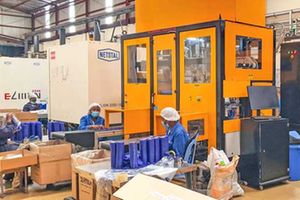
In Thika at the company’s production facility, automation and human labour work side by side. Robotic arms lift, place, and mould materials as operators monitor each stage of production.
Eco-friendly, biodegradable food containers made from bagasse at Green Stem Product Limited’s production plant in Thika, Kiambu County, on January 9, 2026.
Photo credit: Bonface Bogita | Nation Media Group
The end products are trays, containers, and plates designed for food handling across different market segments, from fresh produce to ready meals.
“In food packaging, most products are used for a very short time, yet the materials they are made from last for generations. We wanted to create packaging that performs as well as conventional plastic while being made from resources that would otherwise go to waste,” she says.
The company’s material of choice is sugarcane bagasse, the fibrous residue left after juice extraction. Green Stem collects and processes this by-product to produce certified home compostable, toxin-free, plastic-free packaging designed for single use, with defined end-of-life.
In Kenya, where sugar production generates large volumes of agricultural by-products, bagasse is widely available but underutilised, and much of it is burned or discarded.
Here, the bagasse is transformed into moulded fibre packaging through a manufacturing process that begins with sorting and cleaning to remove sand and other impurities. The fibres are then cooked under high pressure and temperature before undergoing multiple washing stages. What emerges is a pulp that can be shaped into a variety of forms.
Thermoforming machines shape the pulp into trays and containers, which are then heat-pressed at 150 °C to achieve strength and rigidity. Edges are trimmed, surfaces refined, and products inspected before packaging.
One of the key technical challenges the company faced early on was moisture resistance. Conventional fibre packaging often struggles to hold wet or oily foods without leaking or breaking down.
They addressed this by developing a bio-based coating that provides resistance to water, oil, and grease without introducing synthetic chemicals. The result is packaging that can safely contain soups, meat, fish, and other high-moisture foods. The products are also suitable for use in microwaves, ovens, and freezers, widening their applicability across food service and retail.
“The packaging is designed for single use, but with a defined end of life. After disposal, it can break down in home composting systems or on farms, returning nutrients to the soil,” she notes.
This circular approach has attracted clients across several sectors. Restaurants use the containers for takeaway meals and delivery, while pet food companies package both wet and dry products.
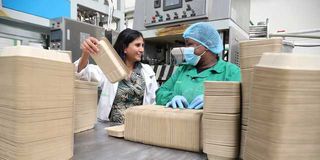
An employee at Green Stem Product Limited checks the quality of eco-friendly, biodegradable food containers on January 9, 2026.
Photo credit: Bonface Bogita | Nation Media Group
Fresh produce exporters and horticultural firms use trays for fruits and vegetables, and bakeries and protein processors have also adopted the packaging.
“We position our products as a practical option for companies looking to reduce their plastic footprint without compromising functionality. Sourcing materials locally and manufacturing domestically also reduces reliance on imported packaging,” she says.
The food system remains the largest source of plastic packaging in Kenya. Industry estimates suggest that the majority of plastic used in food handling ends up in landfills or the ocean, with recycling rates remaining low.
For businesses, regulatory pressure and shifting consumer expectations are increasing demand for alternatives.
Employment creation forms part of the firm’s social impact. The company currently employs about 20 people across production, quality assurance, engineering and administration.
Anita says there is a deliberate effort to recruit and train women for technical roles traditionally dominated by men. The workforce is exclusively female, supported through partnerships with community organisations.
These include Talking Heads, which refers to women who are deaf, and Clean Start Africa, which works with women recently released from prison and in need of sustainable livelihoods. Through this partnership, the women from Clean Start Africa stitch all of the company’s workwear and uniforms.
“We are trying to change what manufacturing looks like,” she says. “Women are part of our production teams, maintenance crews, and quality departments. We want to show that industrial manufacturing can be inclusive.”
Its growth ambitions extend beyond the local market. Plans are underway to scale production and begin exports to Europe and the Middle East, where regulations on single-use plastics are tightening—creating opportunities for suppliers of compostable alternatives.
“Export readiness requires meeting strict certification and quality benchmarks, and we are in the process of securing international compostability standards to support market entry,” she explains.
The company continues to invest in research and development. It plans to innovate further, enhancing product performance and expanding its range of offerings.
At a policy level, Kenya’s manufacturing sector is recognised as a contributor to economic growth and job creation. Initiatives such as value addition, local sourcing, and waste recovery are part of the country’s industrialisation strategies. Green Stem operates within this context, converting agricultural waste into usable products.
Sugarcane bagasse used in the production of eco-friendly, biodegradable food containers at Green Stem Product Limited’s production plant in Thika, Kiambu County, on January 9, 2026.
Photo credit: Bonface Bogita | Nation Media Group
The company is part of a wider shift toward circular economy practices. Keeping materials in use and designing waste out of production processes reduces environmental impact while generating economic benefits.
Challenges remain. Biodegradable packaging often carries higher upfront costs compared to mass-produced plastic. Scaling production to achieve cost competitiveness requires capital investment and stable demand. Supply chains for agricultural residues can also be affected by seasonal fluctuations.
Anita, a Development Economist and Public Health Nutritionist with over 20 years of international experience in humanitarian and development assistance, has a passion for environmental impact and social justice. She believes that the long-term economics favour sustainable materials.
As regulations tighten and disposal costs rise, businesses will increasingly factor environmental impact into their purchasing decisions.
“There is a cost to pollution that society has been absorbing for too long. Our goal is to offer packaging that works for businesses while reducing that burden,” she says.
For Kenya, where plastic waste management continues to strain urban infrastructure and test environmental resilience, local manufacturing solutions could play a role in addressing the problem.
As the food sector grows to meet population demands and changing consumption patterns, the materials used to package food will remain under scrutiny.
Whether biodegradable alternatives can replace plastic at scale will depend on cost, performance, and the support of relevant policies.