Eight beds, zero cases: Inside KNH's Ebola isolation unit
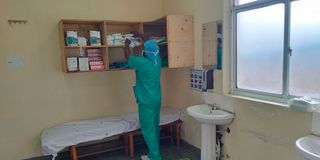
Part of the Infectious Disease Unit that will be used to isolate Ebola patients at Kenyatta National Hospital in Nairobi on June 12, 2026.

What you need to know:
- Eight rooms make up the unit, each one sealed off from the next.
- The rooms are empty, the courtyards quiet, the PPE folded and waiting.
When Cabinet Secretary for Health Aden Duale stood before the nation to reassure Kenyans that the country was prepared for a potential Ebola outbreak, he created the impression that the country had a high level of preparedness.
Mr Duale mentioned that already three isolation and treatment units—including Kenyatta National Hospital, the National Police Service Hospital and 29 counties—had been identified and designated as isolation facilities.
What he did not say was that Kenya’s premier public referral hospital, KNH, the facility most likely to receive any confirmed Ebola cases, is currently operating with only eight isolation beds.

Cabinet Secretary for Health, Aden Duale addresses the media at Afya House in Nairobi on May 22, 2026.
This is despite the country’s close proximity to the Democratic Republic of Congo—the epicentre of the latest outbreak—and Uganda, where some cases have been reported.
Already, the World Health Organisation has declared a public health emergency of international concern, with more than 900 suspected cases and 220 suspected deaths recorded in the Democratic Republic of Congo and Uganda; however, KNH, the frontline of Kenya’s Ebola response at its most advanced public hospital, is a unit that could fill up with the passengers of a single matatu.
This week, Dr Daniel Nyukuria, a consultant physician and infectious disease specialist managing the unit, walked Saturday Nation through it room by room.
The unit sits apart from the rush of the main hospital—a quiet wing built around the idea that infection should never have a chance to wander. Eight rooms make up the unit, each one sealed off from the next. No shared air, no shared plumbing, no shared doorway.
Walk past one room and you cannot smell, hear or breathe anything from the next. It is a building designed around isolation as a principle, not just a word—a critical feature for containing a disease that spreads through direct contact with infected bodily fluids.
The unit was set up in 2014. It has isolated Covid-19 patients during the 2020 pandemic, as well as patients with multi-drug-resistant infections, cholera, tuberculosis and other infectious diseases.
Inside each room, the layout is sparse but deliberate: a bed, monitoring equipment, and surfaces built to be wiped down and disinfected constantly.
“The clinical protocol for managing potential Ebola suspects follows a strict, step-by-step containment and diagnostic pathway from the moment a notification is received,” Dr Nyukuria said.
“Once a suspected case is identified, the patient is treated as highly infectious, requiring healthcare workers to enforce rigid safety measures due to the high-risk nature of the disease. Before any clinical interaction or procedure is conducted, staff must fully don specialised personal protective equipment. For patients arriving from external facilities or border points, continuous personal protective equipment (PPE) use and strict containment are maintained as they are routed directly into a designated triage zone.”
Just outside each room is the donning and doffing area, the space where healthcare workers transform before they walk in. PPE for Ebola acts as an impermeable barrier against highly infectious body fluids, configured so that no skin remains exposed.
A worker layers on a fluid-impermeable coverall with a hood covering the head completely, then either a fit-tested N95 respirator paired with a full-face shield or a powered air-purifying respirator system. Extended-cuff gloves go on in pairs, sealed over the coverall sleeves to protect hands and wrists.
A waterproof apron covers the chest and torso to shield against fluid splashes during procedures. Waterproof boots or heavy-duty shoe covers complete the layering.
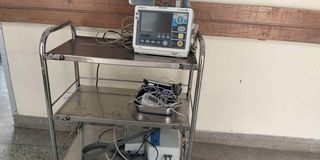
Equipment at the Infectious Disease Unit that will be used to isolate Ebola patients at Kenyatta National Hospital in Nairobi on June 12, 2026.
A trained observer stands by throughout, supervising every step because a single gap—a sliver of exposed wrist, an improperly sealed seam—is the only opening the virus needs. Every piece of equipment is afterwards either safely incinerated or thoroughly decontaminated.
By the time a worker is fully dressed, almost nothing of them is visible: no skin, no hair, no familiar face—just eyes behind a shield.
“Following triage, patients are immediately transferred to a specialised isolation wing to prevent cross-contamination within the general hospital,” Dr Nyukuria said.
“To maintain strict biosecurity, patients are housed individually, and diagnostic sample collection is performed entirely within these isolated environments rather than in communal admission or collective rooms. Once a sample is secured, it is dispatched immediately to the National Laboratory for confirmatory testing, and the patient continues to be managed symptomatically within isolation while awaiting results.”
“Currently, the facility has zero active cases,” he added. “However, because the Ebola virus is actively spreading, the facility remains highly vigilant. Incoming cases are expected to vary significantly depending on the individual patient, ranging from early symptoms like severe joint pain to advanced, serious systemic manifestations of the disease.”
Because there is no approved vaccine or therapeutic for the Bundibugyo strain currently driving the outbreak in DRC and Uganda, an Ebola patient at KNH would receive only supportive care: replacing lost fluids to prevent dehydration, stabilising blood pressure, alleviating pain, reducing fever, nausea and vomiting, oxygen therapy, management of multi-organ dysfunction including renal replacement therapy if needed, and blood transfusions to manage severe internal or external bleeding.
Dr Nyukuria said that despite the available spaces, the hospital can expand into additional capacity should the need arise.
“We work very closely with the Ministry of Health, relying on their collaboration to identify this additional capacity and scale our operations if needed.”
What softens the unit is what lies beyond the rooms. Tucked between the wings are small open courtyards, patches of sky and sunlight that patients can step into without leaving the secure perimeter. It is a quiet design choice, but a meaningful one: even in isolation, a patient can feel the sun on their skin, breathe air that is not recycled through a vent, and not feel as though the world has shrunk to four walls and a door.
As Dr Nyukuria put it, the facility’s goal is to deliver swift, compassionate and secure care to every patient in its charge.
The unit is not designed only for the sick. Because the Ebola virus is transmitted strictly through direct physical contact, a zero-touch policy is enforced inside the clinical zones; family members and friends cannot enter.
But the facility’s layout allows for safe, non-contact visitation—a space where a mother could stand and see her child, where a husband could speak to his wife, voices carrying across a gap that protects them both. It is not the embrace families want, but it is a face seen, a voice heard, a person still visible and present, even from behind glass, air and protocol.
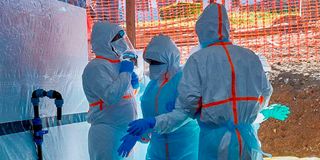
Health workers dress up in personal protective equipment at the Evangelical Medical Center (CEM), one of the facilities at the forefront of the response to the Ebola outbreak, in Bunia, Ituri province, Democratic Republic of Congo, May 31, 2026.
Then there is the question the unit hopes never to answer: what happens if someone dies here? The bodies of Ebola patients remain highly infectious after death, making standard burial practices a transmission risk—a tension that has turned violent in the DRC, where attacks on health facilities have been driven partly by communities demanding the bodies of victims for traditional burial rites.
“In the unfortunate event of a fatality, management of the body must be handled with the utmost respect,” Dr Nyukuria said.
“Cultural practices and traditions hold immense significance, and communities harbour deep fears that failing to conduct proper traditional burial rites will carry long-term spiritual or social consequences. The core challenge for health authorities is to honour these cultural values while simultaneously keeping the living safe from a highly infectious virus. The management of deceased patients must never be treated as a heartless disposal of bodies. Instead, protocols must be executed in a dignified manner that respects the family’s grief while rigorously protecting mourners from contamination. Ultimately, widespread public education is the most powerful tool available; when communities are armed with the right information, they can actively participate in protecting themselves and others.”
For now, none of this has been tested. The rooms are empty, the courtyards quiet, the PPE folded and waiting. Kenya has not recorded a single case of Ebola, even as the disease continues to spread through central Africa.
The latest regional figures show a surge to 635 cases in the DRC, with 127 deaths, concentrated heavily in Ituri province and hitting cities like Bunia and Rwampara hard. Uganda has recorded 19 confirmed cases and 2 deaths, localised mainly around the capital Kampala and neighbouring Wakiso.
Eight rooms. Zero patients. A nation is watching and waiting.
Follow our WhatsApp channel for breaking news updates and more stories like this.