The Kenyan government has been defending the construction of a United States Ebola quarantine facility at the Laikipia Air Base in Nanyuki for weeks, continuing with the project despite a High Court stop order.
But amid the controversy surrounding the Laikipia facility, little attention has been given to the other 22 isolation units that the government says it is building as part of its national preparedness plan for potential Ebola outbreaks.
Health Cabinet Secretary Aden Duale has repeatedly said that the Laikipia facility is not a standalone American project, but part of a broader national Ebola preparedness strategy that includes 23 isolation units being established across the country to strengthen Kenya’s ability to respond to highly infectious diseases.
Health Cabinet Secretary Aden Duale addresses journalists after a meeting with officials from the Social Health Authority, Teachers Service Commission and the Kenya Union of Post Primary Education Teachers at the Ministry of Health offices in Nairobi on March 10, 2026.
Photo credit: Bonface Bogita | Nation Media Group
However, key details about the other 22 facilities remain unclear. Government officials have not disclosed their locations, the counties in which they are being built, their stage of construction, or expected completion dates. It is also unclear whether any of them have broken ground.
The Nation sent written questions to Mr Duale’s office at 11am on Wednesday seeking information on the locations of the 22 isolation facilities, the names of the facilities and the host counties. Neither the CS nor the Ministry of Health had responded to the queries by the time of publication.
Since news of the Laikipia facility emerged, government communication on Ebola preparedness has largely focused on that single site. In his media appearances, Mr Duale has focused on defending the Nanyuki facility; its ownership, command structure and purpose. The Kenya Defence Forces has been cited as the institution that will run the facility, with the Kenya Air Force Commander named as its lead administrator.
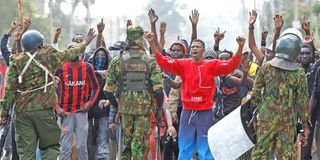
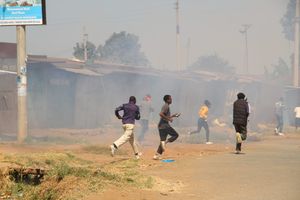
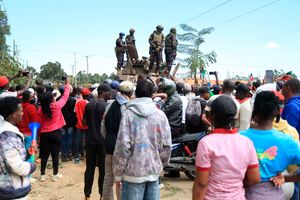
Protesters march toward the entrance of Laikipia Air Base and chant slogans during a demonstration against plans to establish an Ebola quarantine facility for US citizens diagnosed with Ebola in Nanyuki on June 1, 2026.
Photo credit: Reuters
In contrast, there has been little detail provided on the other 22 units. No locations have been announced, no county governments have confirmed construction within their jurisdictions, and no timelines or budget allocations have been made public or presented to Parliament.
For a national preparedness plan the government describes as urgent, the silence surrounding 22 out of the 23 facilities has raised questions about transparency and implementation.
In a statement issued on Saturday, Mr Duale said the government had established specialised Ebola isolation and treatment facilities at key hospitals across the country as part of efforts to strengthen Kenya’s preparedness against potential outbreaks.
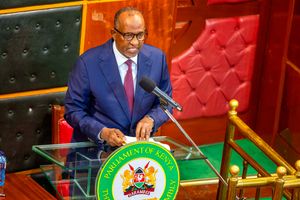
Health Cabinet Secretary Aden Duale before the National Assembly health committee at Parliament buildings in Nairobi on May 15, 2025.
Photo credit: File | Nation Media Group
The CS said “the Ebola outbreak in the Democratic Republic of the Congo is a reminder that infectious diseases do not respect national borders. Kenya, as a regional hub for trade, travel and commerce, must remain prepared to prevent, detect, and respond to public health threats before they reach our communities”.
He added that the government has moved beyond border screening and invested in preparedness systems to ensure the country can respond quickly should an Ebola case be detected.
Unofficial border routes between Kenya and Uganda threaten Ebola management
“To strengthen this preparedness, the Government has established several dedicated isolation and treatment facilities, including specialised units at Kenyatta National Hospital, the Kenya National Police Hospital, and Moi Teaching and Referral Hospital,” he said.
According to Mr Duale, additional response sites have also been identified in more than 10 high-risk border counties to facilitate a rapid and coordinated response in the event of an outbreak.
“The government is also partnering with the United States to establish a similar facility at a military installation in Laikipia County. The project is expected to enhance disease surveillance, isolation capacity, emergency preparedness exercises and access to critical medical supplies,” he said.
Further, the CS said, the partnership supports enhanced surveillance, diagnostic capacity, emergency preparedness exercises, critical medical supplies, and rapid response capabilities.
Mr Duale noted that the investments would not only strengthen Kenya’s response to Ebola, but also improve the country’s overall health security infrastructure.
“These investments will strengthen Kenya’s health security by improving laboratory capacity, healthcare infrastructure, disease surveillance, emergency response systems, supply chains, and workforce readiness beyond the current Ebola threat,” he said.
Cabinet Secretary for Health Aden Duale when he appeared before the Senate Health Committee at Bunge Tower on May 7, 2026.
Photo credit: Dennis Onsongo | Nation Media Group
“By strengthening critical health systems today, these investments will leave Kenya better prepared for future outbreaks and other public health challenges,” he added.
Infectious diseases expert, Prof Shem Otoi, asked: “Where are the isolation units? How is Kenya prepared by building one isolation unit, which it’s putting more emphasis on, unlike in other areas?”
“Yes, the government says it is building 23 isolation units. Yes, CS Duale told Parliament to stop fixating on Laikipia and look at the broader picture. Where is the broader picture, because from where I stand, it does not yet exist in any meaningful, operational form. Where are the isolation units? Where are the reagents? Are the counties actually prepared? We need to be honest about where we are as a country,” he added.
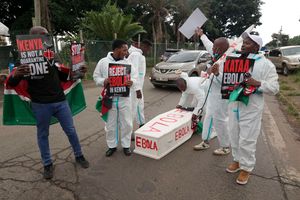
A demonstrator protests in Nairobi on June 2, 2026 against the establishment of a US-backed Ebola quarantine facility in Nanyuki, Laikipia County.
Photo credit: File | Nation Media Group
“The compound is guarded, secured and, according to the White House, the facility is being built entirely by Americans for Americans exposed to Ebola,” he said.
“If a fisherman in Busia, a boda boda rider in Kisumu or a market trader in Bungoma, all in counties the government has identified as high-risk due to their proximity to Uganda and the DRC, presents with Ebola symptoms, Laikipia is not where they are going. The question then is: Where does a Kenyan go? That is the question the government needs to answer,” Prof Otoi added.
According to him, Alupe Sub-County Referral Hospital, in Busia County, which is at the Kenya-Uganda border, “ is one of the most logical choices in the country; a border facility in a high-transit corridor with a history of infectious disease surveillance”.
But according to Prof Otoi, nothing has happened there—no construction, no visible progress.
“Twenty-two other units, including one at a critical border point, have no visible progress to show. Yet Laikipia keeps going through a court order, through a constitutional petition, through a sovereignty dispute. What is so special about this one facility that it cannot stop even when a court says stop, while the 22 others that are actually meant for Kenyans they cannot even show us a foundation?” Prof Otoi asked.
CS Duale appears before Parliament
For a country to be said to be prepared for such an outbreak, it must have its hospitals staffed, equipped, supplied and operational. Its healthcare workers must have been trained in infection prevention and control for viral haemorrhagic fevers. It should have laboratories that can confirm or rule out a suspected case.
The Law Society of Kenya, in its petition in the High Court against the establishment of the Laikipia facility, specifically cited Kenya’s lack of a Level Four high-containment biosafety laboratory and the country’s limited experience handling active Ebola cases.
Kenya Medical Practitioners, Pharmacists and Dentists Union Secretary-General Davji Atellah said they were not satisfied with the government’s statements want proof.
“Where are these isolation units? Show us. Tell us which county, tell us what stage of construction, tell us when they will be ready. Announcing is not building. We need to see the facilities,” Dr Atellah said.
“Our members are on the frontline. They need to know that the infrastructure is there, that the reagents are there, that they will be protected,” he added. “Right now, we are being asked to trust a plan that we cannot see.”