Puzzle of tested people declared Ebola-free before 21-day window
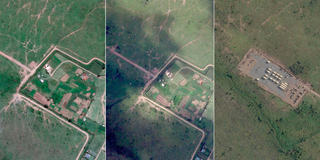
A satellite image shows the Laikipia Air Base (left) at the start of construction work on the Ebola quarantine facility on May 19. A fresh image (right) shows tents erected and vehicles parked at a new field hospital at the venue on June 6, 2026.

What you need to know:
- Health CS Aden Duale told the Nation that the ministry officially began conducting Ebola tests on May 19.
- However, by May 28 the ministry released the first individuals that are purported to have been tested.
The Ministry of Health could be declaring individuals tested for Ebola ‘negative’ and releasing them into the public before the mandatory 21-day incubation period has elapsed, a practice that infectious disease experts warn could spark a deadly outbreak.
Health Cabinet Secretary Aden Duale told the Nation that the ministry officially began conducting Ebola tests on May 19. This makes June 8 the 21st day since the testing began.
However, by May 28 — the 10th day after the testing began — the ministry released the first individuals that are purported to have been tested.
On June 4, while appearing before Parliament, CS Duale said that 22 Kenyans had been isolated, tested and returned negative results. This was only the 17th day — four days before the end of the incubation period.
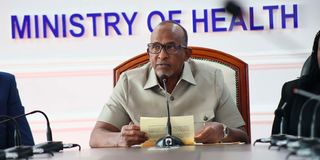
Cabinet Secretary for Health, Aden Duale addresses the media at Afya House in Nairobi on May 22, 2026.
The ministry's official communications platform announced that 67 individuals had been tested by Monday, and all their results were negative.
Yet, the Ebola virus has an incubation period of up to 21 days — between exposure to the virus and the onset of symptoms. During that time, an infected person typically shows no signs of illness and cannot transmit the disease.
Medical experts stress that declaring people free of infection before the 21-day window closes is scientifically premature and could create opportunities for further transmission.
"As part of our heightened surveillance systems, Kenya is testing individuals who present at health facilities with a history of travel or transit through the Democratic Republic of Congo or Uganda. This proactive testing has been in place since May 19, 2026," Mr Duale told the Nation.
"Kenya has not confirmed any Ebola case and has not received any Ebola-exposed persons.”
Lake Region Economic Bloc (LREB) Regional Senior Scientist Prof Shem Otoi, who is an infectious disease specialist, warned that releasing prematurely tested individuals into the community undermines public health efforts rather than strengthening them.
"From the point of contact with an infectious person to the time you are reporting that they have tested negative, if it is less than 21 days, those are premature results. Ideally, they should complete 21 days and then begin testing from that point. They should be tested on the 22nd day. That is when we can comfortably say that these people are free from infection and are not infectious.
"If you want to say they are negative because you want to assuage the public's anxiety, that is counterproductive. Many people might contract the disease when you release prematurely tested individuals into society," Prof Otoi said.
"When should we test people who are suspected cases? First, you test them at the point they present at a health facility or when they are identified. Then you test them again on the 10th day and on the 22nd day, depending on the availability of testing reagents. If they consistently test negative in all three tests, then we can confirm they are negative.”
He also raised concerns about the apparent practice of self-monitoring, whereby released individuals are instructed to return to a health facility if they develop symptoms, calling the approach fundamentally flawed.
"Fever and body fatigue are symptoms common to many illnesses, including malaria, pneumonia, and typhoid. Somebody might have Ebola and think they are suffering from typhoid. They are unlikely to return and report. Ebola's distinctive symptoms — such as internal bleeding, haemorrhaging from bodily orifices, organ failure, and shock — only become clearly recognisable in the severe phase of the illness, by which point extensive internal damage has already occurred,” Prof Otoi said.
"We should be talking about early detection before symptoms appear. Why don't we protect people before they get there?" he asked.
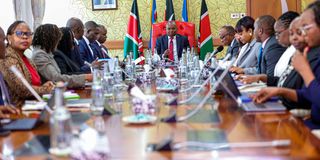
Deputy President Kithure Kindiki has assured Kenyans that the government has heightened its preparedness and response to prevent occurrence of Ebola in the country.
When contacted for comment, CS Duale appeared to distinguish between the two categories of testing that are underway.
In a voice message, the minister said the 67 individuals tested included people who voluntarily presented at health facilities with headaches, vomiting or general discomfort after travelling to the DRC or Uganda, not necessarily confirmed contacts of an infected person.
"You get a headache and you vomit. So those ones, when they go to hospital, the hospital calls us and we test them. They are now 67, and they have all tested negative," he said.
He also confirmed that a separate quarantined group, a government delegation that had transited through Kinshasa in the DRC, had been placed under observation. According to Mr Duale, the first cohort had completed approximately 20 days of quarantine and had been released.
The Ministry of Health, through Dr Maureen Kamene of the Kenya National Public Health Institute (KNPHI), also confirmed that Kenya activated proactive surveillance measures on May 19, following the regional outbreak.
"As part of enhancing surveillance, anyone presenting to a health facility with a history of travel to the DRC or Uganda is offered a test. We conduct two tests from different laboratories before confirming a diagnosis. In the event of a suspected case testing negative, a repeat test is conducted after 72 hours. Dr Kamene said.
"The test is a PCR assay capable of differentiating between the different Ebola species, including the Bundibugyo strain.”
Prof Otoi also called for greater transparency in how the government communicates test results.
"Announcing a blanket figure of 67 negative results without specifying when each individual was exposed, when they were first tested, and when they completed the incubation period is insufficient," Prof Otoi said.
"We have declared 67 Kenyans negative. When you say that 67 people have been declared negative, yet four days earlier there were only 22, you should also tell us that the first 22 had contact with a confirmed case, let's say, on the 15th of last month. By now, they have completed the 21 days and tested negative.
"But the remaining 45 may have had contact later. You must give us the sequence so that the public understands why those declarations are being made.”
Prof Otoi said that Kenya must not apply the same approach used during the Covid-19 pandemic. He said that while Covid-19 had a case fatality rate of roughly 1–2 per cent, Ebola's fatality rate ranges from 25 to 90 per cent, with an average of around 50 per cent.
"Let us not play with Ebola. It is not Covid. It is more deadly, it does not have a widely available vaccine for every strain, and managing it is far more complex. Managing it requires intensive fluid management and continuous oxygen support," he said.
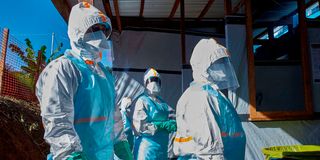
Health workers dress up in personal protective equipment (PPE) at the Evangelical Medical Center, as agencies intensify efforts to contain a new Ebola outbreak caused by the Bundibugyo virus strain, in Bunia, Ituri province, Democratic Republic of Congo, May 31, 2026.
Prof Otoi also questioned the widely cited government figure of 50 isolation beds at Kenyatta National Hospital, saying that, as recently as his last visit, only eight critical-care beds were reserved for Ebola or similar infectious diseases.
"If that is not true, they could go and take a photo and send it to us," he said.
Kenya escalated its national preparedness and emergency response measures following the outbreak of the Bundibugyo strain of Ebola after the World Health Organization (WHO) declared the outbreaks in Uganda and the DRC as a Public Health Emergency of International Concern.
Africa Centers for Disease Control also classified the situation as a Public Health Event of Continental Security.
As of June 6, the WHO reported that the DRC had recorded 515 confirmed cases and 91 deaths, while Uganda had reported 19 confirmed cases and two deaths. In Uganda, the outbreak remains linked to transmission originating from the DRC, with evidence of both imported infections and secondary transmission among contacts and healthcare workers.
Last month, the Health ministries of the DRC and Uganda declared an outbreak of Bundibugyo virus disease — a rare form of Ebola that causes severe haemorrhagic fever, and currently has no approved vaccine or treatment.
Follow our WhatsApp channel for breaking news updates and more stories like this.