Exploring Kenya’s wildlife conservation battles through film

Simon Trevor, an 86-year-old former KWS warden, has spent over six decades documenting the trials and triumphs of conservation in East Africa.

What you need to know:
- Between 1979 and 1989, Kenya faced an alarming decline in its elephant population, driven by rampant ivory poaching. Numbers fell drastically, from an estimated 170,000 to just 16,000.
In the vast, sun-scorched expanse of Kenya's Tsavo National Park, where the rust-red earth meets an endless sky, one man has dedicated his life to capturing the intricate dance between humans, wildlife, and the environment.
Simon Trevor, a former warden turned filmmaker, has spent over six decades documenting the trials and triumphs of conservation in East Africa. His latest work: "Tsavo: A Moment in Time," is not just a documentary series; it's a vivid tapestry woven from the threads of history, struggle and hope.
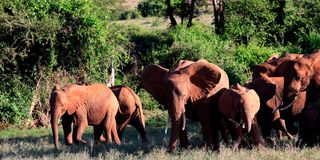
A group elephants feeding at Taita Hills Wildlife Sanctuary within the Tsavo West National Park in Taita Taveta CountyTsavo.
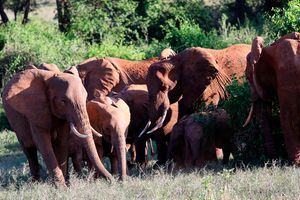
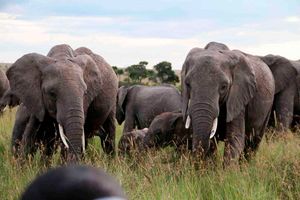
Between 1979 and 1989, Kenya faced an alarming decline in its elephant population, driven by rampant ivory poaching. Numbers fell drastically, from an estimated 170,000 to just 16,000. Over the years, collaborative conservation efforts have helped reverse the decline, and the 2021 national wildlife census recorded an elephant population of 36,280.
This month, the Kenya Wildlife Service (KWS) convened a landmark Conservation Partners' Forum at the historic Ivory Burning Site in Nairobi National Park. The event underscored Kenya's unwavering commitment to preserving its rich biodiversity. Central to the forum was the premiere of "Tsavo: A Moment in Time”. Trevor's work offers a profound exploration of Tsavo National Park's storied past and its pivotal role in global conservation efforts.
From warden to cinematic patrol
Trevor's journey began in 1959 when, at the age of 20, he joined national parks as a junior assistant warden in Amboseli. Reflecting on his early days, Trevor remarked: "I have always been a national parks man in one way or another."
His passion for wildlife led him to a prolific career in film direction, focusing on Tsavo whenever possible. In 1998, he founded the African Environmental Film Foundation (AEFF) with the mandate of providing environmental education through film.
Over 25 years, AEFF produced and distributed 30 films in local languages, free of charge, addressing Kenya’s environmental issues. These films have reached millions across East Africa and beyond, amplifying Kenya's stance against ivory trading at international platforms like Convention on International Trade in Endangered Species of Wild Fauna and Flora.
"By becoming a filmmaker, I have been able to do more for conservation," he remarked, emphasising that the overriding demand for ivory was there long before Tsavo was created. He underlined the importance of creating films about environmental issues for Africans in their own languages, aiming to foster a deeper connection and understanding.
"Tsavo: A Moment in Time" – a chronicle of conservation
The documentary, which recently premiered on NTV, offers an unparalleled look into the complex history of Tsavo and its iconic elephant population.
The premiere marks the beginning of its journey across East Africa and eventually to global audiences. “Its release serves as both a testament to Kenya's conservation achievements and a reminder of the ongoing challenges that lie ahead,” said Trevor.
Trevor describes Tsavo as "a microcosm of the world," reflecting the broader struggles and successes of conservation efforts globally. Elephant conservation remains a high-stakes battle between survival and extinction, with Africa losing over 20,000 elephants annually to poaching despite decades of international bans. Habitat loss, driven by agriculture and infrastructure, has shrunk elephant ranges by more than 60 per cent in the last half-century, while human-wildlife conflict continues to claim lives on both sides.
Yet, glimmers of hope persist: translocation projects in Kenya and community-led conservancies in Namibia have proven that coexistence is possible. With only around 415,000 African elephants and fewer than 50,000 in Asia, conservation now demands not just good intentions but serious investment—an estimated $1.2 billion (Sh154 billion) over the next decade—and stronger cross-border cooperation to outpace the bullets and bulldozers.
The documentary delves into the devastating effects of ivory trade, habitat loss, and human-wildlife conflict, while highlighting the resilience of both the ecosystem and conservationists. Trevor's meticulous archival research and firsthand footage provide viewers with a deep understanding of the challenges over the decades.
By 2014, Trevor recognised the wealth of archival material he possessed—film, sound effects, and photographs—that could narrate the intricate history of the ivory trade and its profound impact on Africa. This realisation birthed the ambitious project, "Tsavo: A Moment in Time," a 36-chapter documentary series delving deep into the centuries-old ivory trade and its ramifications on both wildlife and human communities. Trevor's quest involved sifting through film libraries, literature, scientific reports, and firsthand accounts, culminating in what he describes as "the most detailed series about this one aspect of Kenya’s conservation that has never been assembled."
In his speech at the documentary's launch, Trevor poignantly remarked: "Conservation in Africa is changing at an astonishing rate. It forever seems to totter on the edge of a cliff, held back from falling over by the desire of succeeding generations of younger people to recognise and accept the increasing importance of the environment and everything in it."
The elephant in the room: climate change and human-wildlife conflict
One cannot discuss conservation in Kenya without addressing the looming specter of climate change. The Horn of Africa has been experiencing its worst drought in 40 years, leading to increased competition for scarce resources between humans and wildlife. Elephants, in their quest for food and water, have increasingly wandered into human settlements, sometimes resulting in violent and deadly clashes.
Conservationists have in the past warned of lessening wildlife spaces as animals lose large swaths of territory owing to climate and human destruction of their habitat. A study led by Conservation International scientists found that 88.9 per cent of households interviewed experienced human-wildlife conflict during periods of resource scarcity.
The study, conducted over 16 months in Chyulu Hills, suggests that restoring grasslands can reduce both human-wildlife and social conflicts, offering a glimmer of hope in these challenging times. Data collected from over 1,500 households indicate a significant correlation between the expansion of restored grassland areas and a reduction in both human-wildlife and social conflicts.
Trevor's documentary does not shy away from these harsh realities. It confronts them head-on, providing a platform for discussions on sustainable solutions and the importance of coexistence.
The launch of "Tsavo: A Moment in Time" was more than just a cinematic event; it was a rallying cry for conservationists, policymakers, and the general public. Kenya Wildlife Service Director General Erustus Kanga emphasised the collaborative nature of conservation efforts, stating, "Our conservation story is written daily—by rangers on patrol, scientists in labs, communities living alongside wildlife, and partners who stand with us."
While there have been notable successes, such as Tsavo's elephant population surpassing 15,000 for the first time since the 1970s, challenges persist. Encroachment, declining wildlife numbers, and reduced donor funding threaten to undermine decades of progress. Prof Kanga highlighted the need for continued support in expanding rhino sanctuaries, modernising ranger equipment, securing wildlife corridors, and strengthening veterinary services.
Innovations like the Earth Rangers real-time tracking system offer promise to disrupt poaching activities and reduce conflicts. Additionally, the Meru-Mulika Airstrip upgrade exemplifies how conservation-driven initiatives can create jobs and promote coexistence.
Recently, Tourism and Wildlife CS Rebecca Miano underscored the urgency of operations such as the elephant translocation exercise from Mwea National Reserve to Aberdare National Park. She noted that Kenya’s expanding human population is increasingly encroaching on vital elephant rangelands, intensifying human-wildlife conflict. She stressed that the initiative will deliver long-term gains by strengthening vulnerable elephant populations, improving genetic diversity, and preserving key ecosystems shared by elephants and other species.
Ms Miano also emphasised that elephant conservation cannot happen in isolation, calling for greater regional and international collaboration.
She appealed to partners to rally behind the Kenya Wildlife Service in its efforts to manage and grow the country’s elephant population sustainably.