Fire outbreaks at Ruma National Park put rhinos and endangered species at risk
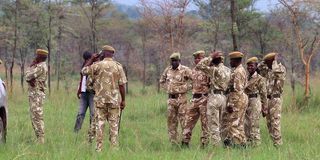
Kenya Wildlife Service rangers at Ruma National Park during a past patrol. Authorities say fire outbreaks at the park remain one of the major threats to rhinos.

What you need to know:
- During a blaze, slow-moving animals, reptiles, ground-nesting birds, insects, and small mammals have nowhere to run.
- Tortoises, chameleons, bird eggs hidden in the grass, and the burrows of warthogs can be wiped out in minutes. Even large herbivores like the roan antelope and rhinos can be trapped by fast-moving flames fanned by wind.
The ground in some sections of Ruma National Park in Homa Bay County is black, with charred logs lying across the landscape. In these areas, trees stand naked with no leaves, their trunks scorched and stripped of life. It is as if the areas will not support life again.
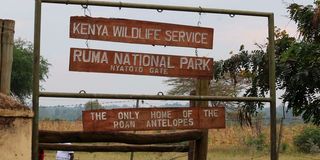
Signages at Ruma National Park in Homa Bay County.
But on a closer look, you will see the magic of mother nature. Defiant, fresh young grass pushes through the ash just weeks after fire swept through sections of the park and a few drops of rain hit the ground. The appearance of the grass points to a quiet comeback of nature.
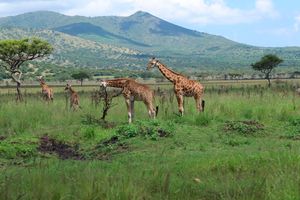
For animals that graze in the park, the fresh green grass is a gift. Rhinos, buffaloes, Rothschild's giraffes, oribis, waterbucks, and the endangered roan antelope depend on grass. The new flush is rich in nutrients and soft enough for young calves and fawns.
Ecologists call it post-fire regeneration. When fire burns old, tough, overgrown grass, it returns nutrients to the soil. With the first rains, the earth responds with a carpet of fresh, palatable pasture.
But beneath this beauty lies a warning. Fire is a double-edged sword. While controlled burns are a vital management tool used by the Kenya Wildlife Service (KWS) to rejuvenate grasslands and control ticks and invasive species, wild, uncontrolled fires are devastating.
During a blaze, slow-moving animals, reptiles, ground-nesting birds, insects, and small mammals have nowhere to run. Tortoises, chameleons, bird eggs hidden in the grass, and the burrows of warthogs can be wiped out in minutes. Even large herbivores like the roan antelope and rhinos can be trapped by fast-moving flames fanned by wind.
The black soil in some parts of Ruma tells that story. Every patch of ash is a reminder of what was lost before the green returned.
The national park suffers from perennial fire incidents that threaten major wildlife species, including some of the big five. Almost every year, wardens report fire outbreaks. Most cases are reported in February and March, when the region experiences warm, dry conditions before transitioning into the start of the long rainy season in March. During this time, the grass is brown and any spark can ignite a fire that destroys a large area.
According to Ndhiwa Deputy County Commissioner Lucy Ndemo, the park normally suffers from fire incidents when conditions are right for fire to spread fast.
She accused families living at the edge of the park of being responsible for these fires.
Most fire incidents in the park are started by farmers who clear land for the next planting season. Some just set fire to dry vegetation hoping to clear it, but sometimes it goes out of control and spreads into the park.
"Farmers must ensure they only undertake activities within their boundaries. We have had multiple cases of fire outbreaks in the park this year," Ndemo said.
The administrator said fire outbreaks are a major threat to the park. They not only deplete food for animals but also put the animals themselves at risk. Ndemo added that the park is prone to poaching, where some rogue individuals set traps to catch animals which are sold as wild meat.
Threats to animals at the park caused by fire and poaching became one of the emphases during World Rhino Day, celebrated annually on September 22 to raise awareness for all five surviving rhino species and advocate for their protection. The occasion provides an important opportunity to celebrate progress in rhino conservation, reflect on the challenges that remain, and renew commitment to ensuring that the world's oldest, most iconic, and most revered animal survives for generations to come.
The rhinoceros has survived for millions of years. But its continued survival today depends greatly on the interventions put in place by different agencies to protect it. Globally, five rhino species remain: the black rhino, southern white rhino, greater one-horned rhino, Sumatran rhino, and Javan rhino.
Tobiko Naiyoma, who represented Tourism Cabinet Secretary Rebecca Miano during the Rhino Day event in Ndhiwa, said the survival of the animal continues to face threats from poaching, illegal wildlife trade, habitat loss, human–wildlife conflict, and climate-related pressures.
He said Kenya has a proud but challenging history of rhino conservation. During the 1980s, the rhino population declined dramatically from an estimated 20,000 animals to about 300, largely due to poaching and illegal wildlife trade.
Naiyoma, an administrator at the Tourism ministry, however pointed out that several interventions introduced to protect the animal helped increase its population when it was on the verge of extinction. Some of the sustained government interventions include strong law enforcement, habitat protection, translocation, and reintroduction programmes. The Ministry of Tourism also implements scientific monitoring, veterinary care, community participation, and partnerships.
"Kenya has made significant progress in rebuilding its rhino population. Ruma National Park remains an important conservation landscape and a secure sanctuary for both black and southern white rhinos," Naiyoma said.
The latest national rhino population assessment records 50 rhinos in Ruma; 22 black rhinos and 28 southern white rhinos.
"These numbers represent more than statistics. Every individual reflects years of conservation, investment, genetic diversity, breeding potential, and hope for the future," he added.
Besides rhino, Ruma is renowned for its roan antelope, Rothschild's giraffe, and oribi. It also supports buffalo, zebra, impala, waterbuck, topi, hartebeest, reedbuck, warthog, leopard, spotted hyena, serval, honey badger, and other wildlife. Naiyoma said more than 400 bird species have been recorded there, including the globally threatened blue swallow.
"The park is Kenya's last remaining sanctuary for the endangered roan antelope. This is therefore an important ecosystem whose protection benefits a remarkable diversity of species," he said.
Despite progress made to protect animals at the park, significant challenges remain. According to the Ministry of Tourism and Wildlife, poaching and illegal wildlife trafficking continue to threaten rhinos, while habitat loss and degradation, encroachment, fragmentation, human–wildlife conflict, climate pressures, and competition for natural resources place additional pressure on wildlife.
Naiyoma noted that addressing these challenges requires an integrated approach that protects wildlife. He added that communities living alongside protected areas should also be involved in conservation efforts.
"The future of Ruma is inseparable from the well-being of the communities surrounding it. Communities must be recognised as partners and custodians of conservation. We must continue investing in conservation education, community engagement, sustainable livelihoods, and opportunities linked to tourism and wildlife," Naiyoma said.
Some of the conservation initiatives where the community is involved include the Roan Antelope Half Marathon, which is hosted at the park. Participants take part in athletics but also get a chance to learn more about the park and its wildlife. Naiyoma said it demonstrates how conservation can connect with sports tourism, community participation, and local development.
"We must therefore build on such initiatives so that Ruma generates meaningful social and economic benefits for the people of Homa Bay," he said.
He added that modern conservation must also be guided by science, technology, and reliable data, saying wildlife monitoring, population assessments, veterinary surveillance, ecological research, tracking technologies, and effective security systems are essential for understanding rhino populations, their reproduction, and the threats they face.
"As Kenya's rhino population recovers, we must continue securing suitable habitats while maintaining ecological integrity and genetic diversity. The responsibility for conserving rhinos cannot rest with one institution. It is shared by the national and county governments, Kenya Wildlife Service, conservation organisations, development partners, researchers, security agencies, tourism stakeholders, and local communities," he explained.
He called on the government to support rangers, saying they must have the skills, equipment, and support they need. He also said scientists must provide evidence to guide management, with communities being empowered to report wildlife crime and participate meaningfully in conservation. Meanwhile, he wants young people to be encouraged to become the next generation of conservation leaders.
"We have a landscape of extraordinary ecological value and communities whose participation will determine its future. Let us ensure that future generations will not encounter rhinos only in photographs, documentaries, or history books, but will have the opportunity to see them thriving in their natural habitat," Naiyoma said.