Guardian of the green: A ranger's 30-year journey through Kenya’s changing forests

Robert Ngotho (right) with Community Forests Association interim Manager Dominic Kimochu at Kinale Forest.

What you need to know:
- Recent years have brought new momentum to forest conservation efforts, particularly following President William Ruto's national tree-planting campaign launched in 2023.
In 1978, a seven-year-old Robert Ngotho watched Kenya Forest Service rangers patrol Nanyuki Forest, their green uniforms commanding respect in his village of Kangaita.
In the shadow of Mount Kenya, between 1978 and 1979, a young Robert would linger near the gates of Nanyuki Gerishon Primary School, his eyes fixed on the khaki-clad rangers returning from patrol. Their sun-worn uniforms, dusty boots, and quiet authority left an indelible mark on the boy—one that would blossom into a three-decade career defending Kenya’s wild spaces.
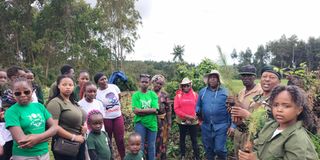
Robert Ngotho speaks to visitors at Kinale Forest during a tree planting exercise.
Today, at 55, Ngotho serves as the forest master of Kinale Forest along the busy Nairobi-Nakuru highway, overseeing conservation efforts at a time when Kenya faces mounting pressure to restore its forest cover while balancing community needs and economic demands.
His journey from a curious schoolboy to senior forest manager parallels Kenya's own transformation in environmental policy and forest conservation approaches.
Growing up near Nanyuki Forest, where many locals got employed by the Kenya Forest Service, Ngotho's career path seemed predestined. His family later moved to Naromoru, where he completed his Certificate of Primary Education in 1983, but the influence of forest work remained strong. His neighbour, Eustance Mihunyo, was among the forest guards who commanded unqustioned respect that villagers would clear paths for his car—a testament to the authority and reverence accorded to forest officers in rural Kenya in the 1980s.
But Ngotho's journey to forestry wasn't straightforward. After completing high school in 1988, he explored several career options, teaching briefly at Mathira Primary School as an untrained teacher and attempting to join both the Kenya Army and police force, only to be rejected for being underweight. These setbacks, however, would prove instrumental in redirecting him toward his childhood calling.
The turning point came through a chance encounter with the same forest ranger who had inspired him as a child. The ranger's advice was direct: abandon his building and construction course at Londiani and instead pursue a three-year forestry course at the Kenya Forestry College. With his mother struggling financially, the promise of sponsored tuition and guaranteed employment proved compelling.
That gamble in 1990 marked the beginning of a career that would coincide with some of Kenya's most significant environmental policy shifts. When Ngotho entered forestry college, Kenya's forest cover had already declined dramatically from historical levels, setting the stage for the conservation challenges he would face throughout his career.
Ngotho officially joined the Kenya Forest Service in 1993 at a time when the country’s forest cover stood at a critically low level. His career has since taken him across the country's diverse forest ecosystems—from Londiani where he honed community engagement skills, to Ranchonyo, Meru, Garindani, and Kericho forests, each presenting unique conservation challenges.
His eight-year stint at Londiani Forest after graduation proved particularly formative, teaching him the delicate art of community relations that would define his management philosophy.
"Without that rapport, it becomes very complex and can derail our conservation goals," Ngotho explains, referring to the relationship between forest managers and surrounding communities.
This approach reflects a broader evolution in Kenya's forest management strategy. Where once forest conservation was primarily about enforcement and exclusion, today's approach increasingly emphasises community participation and benefit-sharing—a shift that has proven both necessary and challenging.
At Kinale Forest, Ngotho has implemented regular community meetings that bring together residents and forest rangers to address conservation issues collaboratively. This approach recognises a fundamental reality: effective forest conservation requires community buy-in, particularly in areas where local populations depend on forest resources for their livelihoods.
The challenge is complex and deeply rooted in Kenya's colonial and post-independence history. Kenya's forests are categorised into three management zones: production areas for timber and related resources, indigenous zones for conserving native species, and exotic zones for non-native species. Each category requires different management approaches and presents varying opportunities for community involvement.
Many of the conflicts Ngotho has navigated stem from competing interests over forest resources. Communities that have historically relied on forests for fuel wood, grazing, and non-timber forest products often find themselves at odds with conservation objectives. His role has increasingly involved finding balance between environmental protection and community livelihoods—a challenge that requires both technical forestry knowledge and diplomatic skills.
Complex issues
"As I prepare to retire in the next five years, I can confidently say that my experience in conflict resolution has helped me manage complex issues amicably," Ngotho reflects, highlighting skills that have become increasingly valuable as forest management evolves.
Recent years have brought new momentum to forest conservation efforts, particularly following President William Ruto's national tree-planting campaign launched in 2023. Ngotho has witnessed firsthand the impact of this initiative, which has drawn organisations including Safaricom, Kijabe Forest Trust, African Wildlife Foundation, and Kenfo to participate in restoration efforts at Kinale Forest.
These partnerships represent a significant shift in conservation financing and implementation. Where government resources alone proved insufficient for large-scale restoration, corporate social responsibility programmes and conservation organisations have provided crucial support. The collaboration has contributed to the restoration of 98 hectares of forest land—a tangible achievement in Kenya's broader goal of increasing forest cover to 10 per cent of the national territory.
"I'm proud to have contributed to the planting of millions of trees. President Ruto's recent support has rejuvenated our efforts, and we don't take that for granted," says Ngotho.
However, the success of such initiatives ultimately depends on long-term sustainability rather than short-term planting campaigns. The survival rates of planted trees, ongoing maintenance, and protection from encroachment remain critical factors that determine the real impact of restoration efforts. Ngotho's experience managing diverse forest ecosystems has taught him that successful restoration requires sustained commitment beyond the initial planting phase.
Ngotho notes that the challenges facing Kenya's forests remain significant and multifaceted. Population pressure continues to drive encroachment on forest land, while climate change brings unpredictable rainfall patterns that affect both forest ecosystems and surrounding agricultural communities. Competing land uses—from agriculture to urban development—create ongoing pressure on forest boundaries.
Yet Ngotho's career demonstrates how individual dedication combined with evolving policy approaches and community engagement can contribute to meaningful conservation outcomes.
Ngotho encourages broader participation in tree planting. "We encourage all Kenyans to heed the President's call and plant trees—not just in forests, but in homes, schools, and villages too. Every tree counts," he says.
For a man who began his career inspired by the respect accorded to forest guards in his village, Ngotho's three decades in forest conservation represent both personal achievement and a window into Kenya's evolving relationship with its natural heritage.
"I've always wanted to take on challenging tasks that help me grow, and forestry gave me just that," he reflects. The father of two expresses views his contribution to forest conservation as part of a larger national effort to preserve Kenya's environmental heritage for future generations.