From childhood pain to saving mothers: Dr Baasba’s Mission to end Lamu’s maternal crisis
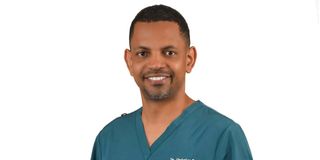
Dr Abubakar Baasba, the registrar at the University of Nairobi studying obstetrics and gynaeocology. He shares his story on how his mother's reproductive health motivated him to take that as a career path.

What you need to know:
- Dr Baasba’s childhood trauma inspired his mission to improve maternal health in remote Lamu County.
- Lack of specialists and infrastructure fuels maternal mortality, yet Lamam champions community-driven reproductive healthcare.
Dr Abubakar Baasba vividly remembers the night his mother lay frail in bed, bawling, bleeding, and in immense pain. He was only nine at the time, her surviving lastborn child. The coastal breeze that evening carried an air of despair, filling his young mind with overwhelming sadness.
He wishes he could have helped, shared her pain, or found a way to end the vicious cycle of suffering that briefly stole joy from their home. “My mum bled until she could not even walk. She lost consciousness,” recalls Dr Baasba.
Their home is tucked away on the north-east coast of Kenya, along the Indian Ocean, in Lamu County. The county borders the ocean and comprises about 65 islands, only five of which are habitable.
That night, his mother had to be transported to Mombasa, nearly 256km from their hometown. At the time, there were no specialists who could handle such a case. She needed an obstetrician-gynaecologist, a doctor specialising in women’s reproductive health, yet their village had neither cars, motorbikes, nor ambulances to rush her to hospital for proper treatment. The experience left him deeply affected. “That ordeal changed me,” he tells Healthy Nation.
His mother lost four pregnancies, three of them after birth. He jokes that he was meant to be her lastborn and the joy of her life, but he recognises how traumatic it must have been for her. “My mum also had fibroids—growths in the uterus that sometimes cause excessive bleeding.”
As a child, he did not understand what was happening; he simply felt helpless. At that tender age, he resolved to be the change his community needed. He dreamt of becoming a doctor specialising in women’s reproductive health.
After high school, he began with a diploma in clinical medicine at the Kenya Medical Training College. His determination never wavered; he later enrolled at Egerton University for a Bachelor of Medicine and Bachelor of Surgery.
At university, the passion ignited at nine was reignited by a social media video highlighting women’s reproductive health challenges in Lamu. Together with fellow students from Lamu, he co-founded Lamu Against Maternal Mortality (Lamam), an organisation tackling maternal health issues at the grassroots.
At that time, nearly half of expectant mothers in Lamu delivered at home without a skilled attendant. Lamam sought partners to help fulfil their mission. One initiative aimed to transform traditional birth attendants into supportive birth companions.
“In our tradition, husbands do not accompany their wives into delivery rooms. Yet ideally, a husband should provide massage, psychological support, meals, hydration, and assist with Lamaze exercises,” Dr Baasba explains.
The organisation also screened expectant mothers door-to-door, identifying high-risk pregnancies. “We took a short break to restrategise, but we hope to return and save more mothers,” he says.
Today, Dr Baasba is a registrar (master’s student) specialising in obstetrics and gynaecology. Before taking a study break, he worked in Lamu, where the struggles he witnessed as a child persisted. “We struggled to recruit an obstetric gynaecologist. I recall placing advertisements nearly three times, yet no one applied,” he says. “The main reasons are the remoteness of the area, the small population, and no private practice opportunities.”
Challenges
With only about five habitable islands located far apart, maternal and reproductive health challenges in Lamu remain unresolved. Most patients rely on boats to travel between islands, but low ocean tides can delay transport for eight to 10 hours. On the other hand, high tides can bring harsh waves that risk capsizing boats ferrying expectant mothers. Security issues, with Boni Forest under surveillance, further deter some women from seeking hospital care.
Lamu also struggles with transporting cold-chain medical supplies such as vaccines and oxytocin, which is critical to preventing postpartum haemorrhage. “Electricity is unreliable. Without investment in solar energy and refrigerators, maintaining these supplies is a challenge,” Dr Baasba explains.
As a women’s reproductive health specialist, he emphasises the need for male involvement in maternal care. In many African cultures, men hold decision-making power. “Men must empower women to make crucial health decisions, even in their absence,” he urges.
He encourages men to walk alongside women on reproductive health matters to achieve better outcomes. Despite significant improvements in maternal care compared to his childhood, health-seeking behaviour remains low. “We will not help anyone if they do not come to health facilities. People must be encouraged to seek proper medical attention,” he advises.
Today, Dr Baasba is grateful that his mother is alive. He looks forward to completing his studies and returning home to save the lives of other mothers.