From herding goats to fighting for climate action at the world’s top court
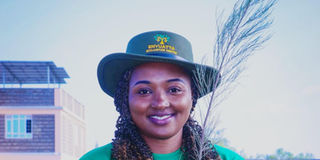
On July 23, Brenda Reson,33, an advocate of the High Court of
Kenya made a submission on behalf of the youth, indigenous
peoples, and marginalised communities from the Pacific Small Island States as well as Africa, in the landmark International Court of Justice (ICJ). Photo/pool

What you need to know:
- Raised in the shadows of extreme weather events, Brenda grew up watching drought erase what her father fought to protect. Now, she’s putting that fight on the global record
In mid-July, on a cold, chilly Wednesday morning at the world's top court, the Hague in the Netherlands, and just before the historic advisory ruling on climate change, 33-year-old Brenda Reson from Olosidaan, Kajiado County, stood tall.
Not only with confidence but also with the weight of nearly every country on earth teetering on the brink of climate collapse, on her shoulders and the hopes of generations in her heart.
Hired by the government of Vanuatu to represent Pacific Small Island States as well as Africa in the matter that has now revolutionised the fight for climate justice, perhaps forever, her goal was just one, yet challenging. To convince a bench of eminent judges at the International Court of Justice (ICJ) why they must now set a precedent for governments around the world to sue each other and for ordinary people to sue governments for failing to protect them from the devastating impacts of the climate crisis.
And she won.
Little did Brenda, an advocate of the High Court of Kenya, know that her powerful submission on behalf of youth, indigenous peoples, and marginalised communities in the landmark ICJ advisory opinion on climate obligations would mark a historic moment, not just for international law.
“I stood there not just as a lawyer,” she says excitedly. “I carried the wisdom of my father, the cries of my community, and the silent hope of every young African youth, especially girls who dream of more despite the many challenges around them," she starts in an exclusive interview with Climate Action. Born and raised in a Maasai household, Brenda's childhood was shaped by the culture of pastoral life. Her father, a fierce guardian of the environment, often reminded her that the land and wildlife were not possessions, but sacred legacies to be well preserved. When he passed away in 2023, it ignited in her a deeper sense of purpose.
“His death crushed me,” she confesses. “But it also clarified my mission, to protect what he loved, our land, heritage, and our future.” Defying odds and social expectations, Brenda charted a path which few from her village had ever dared. From her young age, she pursued education beyond primary school. Her ascent was fuelled by grit, academic brilliance, and an unwavering love for justice.
Eventually, she earned her law degree and later a master's in international relations and cultural diplomacy from Hochschule Furtwangen University in Germany, combining legal precision with global advocacy.
In her professional journey, Brenda has woven together indigenous knowledge, international legal tools, and community resilience. She has traversed more than 15 countries and learned
firsthand about different contexts and realities while championing nature-based solutions, utilising a blend of science and traditional wisdom. But it was the climate crisis and its disproportionate impact on vulnerable communities that stirred her deepest convictions.
So, when a youth-led movement, backed by the Government of Vanuatu, petitioned the ICJ for clarity on states' legal obligations on climate change, Brenda didn't hesitate. Supported by the Organisation of African, Caribbean, and Pacific States (OACPS), she became one of only three young people globally, and the only Kenyan youth, to be invited to address the Court.
"I wasn't just speaking as a lawyer," she says.
"I was a messenger for 1.3 billion people. I was speaking as a daughter of the earth."
On that historic day in The Hague, Brenda's submission reverberated through the hallowed courtroom. Her legal arguments blended firm jurisprudence with the lived realities of communities on the frontlines of climate change. The ICJ advisory opinion, released on July 23, 2025 was nothing short of historic. For Brenda and millions like her, it was validation that their voices had not only been heard but also shifted the scales of global justice. Her submissions had five key demands.
First was the demand that States must guarantee a safe, clean, and healthy environment.
On this, the ICJ ruled that this is not merely aspirational but a legal right that must be safeguarded. In Oloosidan, droughts have become more frequent and severe. Rivers dry up and livestock die. For Brenda's community, the “right to a healthy environment” means survival, access to water, food, and clean air and now, international law backs that claim.
The second demand was that there must be legal consequences for climate inaction. It was made clear that countries that fail to curb emissions or support adaptation can be held
accountable.“When we talk about loss and damage,” Brenda explains, “we're talking about the real pain my people face, losing cattle, culture, and even lives to climate stress. With this ruling,
polluters can no longer hide.”
Third, Customary International Law should be declared binding, and even countries that haven't ratified climate treaties should be held liable. This matters especially for African states
negotiating with powerful nations. Brenda says, “They can't claim they're not part of the Paris Agreement and walk away, the ICJ closed that escape route.”
The court also stated that Climate Finance and technology are enforceable duties. The ruling elevates climate finance and technology transfer to legally binding obligations. “My community
needs water tanks, solar pumps, drought-resistant seeds,” Brenda says. “It's not charity, it's justice. Now, there's legal ground to demand support.”
The ICJ also advised that intergenerational equity is law and that countries are legally obligated to protect future generations. She says, “I am still the girl who herded goats in Oloosidan, the girl who was told law was for others. But education gave me wings. And the ICJ gave me a platform. Now, I want to keep that door open for many more.”
Today, Brenda continues her work as a legal expert, being Member of the Chartered Institute of Arbitrators (England & Wales), a lecturer at Consolata International University, climate justice advocate, and Founder of Enyuatta EcoJustice Centre which empowers communities with legal, policy and scientific expertise as well as on ground projects to adapt to effects and
mitigate the climate change. Her sights are set on ensuring that the ICJ opinion translates into real accountability, especially for countries in the developed world whose emissions drive
disproportionate harm.
And in her own words, “The horizon is only the beginning.”


