Happening Now: NTV KENYA LIVE | Senate Proceedings
Grassroots sex education: Breaking taboos to combat STIs and HIV
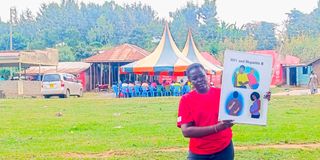
Pauline Odhiambo, a sex educator during a learning session at Ugambe Beach, Siaya County on July 7, 2025.

What you need to know:
- Fishermen are constantly moving between beaches in search of better catches, but they don't bring their spouses along. This often leads to multiple sexual partnerships.
Wooden boats line the shores of Lake Victoria, swaying in rhythmic unison with the waves. A breeze, heavy with the scent of wet nets and distant rain, sweeps over Ugambe Beach in Siaya County.
The morning chaos— fishmongers' haggling and fishermen boasting about their catches—has given way to an unusual sight: dozens of beach dwellers gathered under a towering tree, erupting in laughter and knee-slapping reactions to Mary Nyona's sex education session.
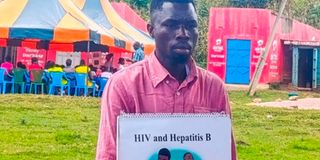
Almas Orwa, a sex educator, takes a group of youth through a learning session on sexually transmitted infections.
Her lesson has drawn the enthusiastic crowd, their faces flickering between scandal and delight.
For generations, conversations about HIV/Aids and sexually transmitted infections (STIs) have been whispered along these shores, where transient lifestyles have normalised risky sexual behaviours. But today, Mary's flipchart displays blunt truths: "HIV doesn't care if you paid for it. Syphilis won't ask if it was just this once."
Caroline Anywero, 48, has abandoned her prized fish-smoking spot for the first time in memory. "Initially I was unsure," admits the veteran fishmonger, her hands still smelling of tilapia as she clutches a notebook. "But the trainers answer all our questions without judgment."
She highlights a common barrier to accessing health information and services at local health centres: lack of time due to job demands. And even at health centres, she says, doctors often have limited time for in-depth patient education due to a high volume of patients.
"These outreaches are important to us—they provide an opportunity to learn collaboratively and engage in one-on-one interactions with experts," says Caroline.
A few metres from the tent, a group of youths aged 19 to 30 sit beneath a tree by the lakeshore, listening to another trainer. Almas Orwa, a young facilitator, educates them on various STIs while discussing preventive measures.
Lucy Atieno, who sat her national form four exams in 2024, is eager to learn and unlearn.
“Speaking about sex education is unheard of in most homes, almost a taboo. All my mother says is that I need to take care but she has never taken time to educate me on how to do it and why,” says Lucy, 19.
What excites Lucy is the fact that she gets to attend the training alongside her age mates while expressing herself without fear of being judged by adults.
Almas explains that the trainers sometimes group learners by age and gender—a practice that helps participants feel more comfortable sharing openly.
"I could never speak freely about these topics in the same session as my sons or daughters. And our children would never share their honest thoughts on sex education if their parents were in the room.”
Daniel Okello, Ugambe Beach chairman, Yimbo East, emphasises the importance of such health outreaches for the fisherfolk community, a group considered high risk.
He explains that many fishermen spend their nights fishing on the lake and their days sleeping at home. After returning to shore in the morning, they supply fishmongers, who then distribute the catch to markets—often leaving the fishermen with little time to return home until the next day.
"As a result, fisherfolk rarely have time to visit health centers, leading to poor health-seeking behaviour.”
The chairman further notes that myths and misconceptions about STIs persist as a major concern in the beach community. Some members still believe sexually transmitted infections result from witchcraft, he explains.
Openness
"Fishermen are constantly moving between beaches in search of better catches, but they don't bring their spouses along. This often leads to multiple sexual partnerships," says Daniel.
The training programme, led by ABCs of Sex Education (an international NGO), targets hard-to-reach populations like fishermen, traders, and youth through age- and gender-segregated sessions, fostering openness.
Phylis Magina, managing director ABCs of Sex Education, says the organisation has been promoting sex education among adults and adolescents in Siaya County since 2021.
According to Phylis, the ABC approach - standing for Abstinence, Be faithful, and Condom use - is a key strategy in the project's mission to reduce HIV/Aids, STIs, and unintended pregnancies.
The initiative was launched after the organisation secured a global grant from Rotary International in response to 2020 HIV/Aids statistics.
“We are currently working with the Rotary Club of Siaya, who are our host on behalf of Rotary International,” says Phylis.
Through collaboration with Siaya County government, the programme has trained 120 Community Health Promoters who act as educators across four sub-counties: Alego Usonga, Bondo, Gem, and Ugunja.
Phylis explains that the educators conduct awareness campaigns targeting women, youth, boda boda riders and fisherfolk communities. "During our outreaches, we partner with various NGOs to provide comprehensive sexual health services to participants.”
Recognising sexuality as a sensitive subject, the programme tailors its approach to different age groups for maximum effectiveness.
The managing director emphasises that group-based learning creates a safe space for open discussion without fear of judgment or victimisation.
"Since we began, we've seen significant results - communities frequently request return visits, and schools report behavioural changes among students and reduced early pregnancies," notes Phylis. "One
Rose Waringa, Rotary Club Western regional coordinator, highlights that the programme aligns with Rotary International's disease prevention pillar. The initiative ensures sustainability through active collaboration with various Ministry of Health departments.