Until May this year, Rose Atieno was a fish trader regularly transporting omena from Sindo Town to Awendo in Migori County, over 100 kilometres away.
Packed in gunny sacks, the small fish would be dried and sold to awaiting customers.
But her fortunes and focus recently shifted dramatically after hearing of a new opportunity that promised greater returns: gold.
Now, Ms Atieno is a mine operator having left the labour-intensive fish trade behind.
“I have no intention of returning to the lake. I’m confident the mining business will bring me far more income,” she declared.
Her transition came in the wake of a startling discovery in Masangura village in neighbouring Homa Bay County after what appeared to be gold deposits on a steep hill roughly the size of a football field.
The news triggered a gold rush that has since reshaped the village and drawn fortune-seekers from across the Western Kenya region.
A once-quiet settlement with panoramic views of Lake Victoria has suddenly become a hub of activity, with makeshift shelters, bustling trade and a steady flow of newcomers chasing the allure of gold.
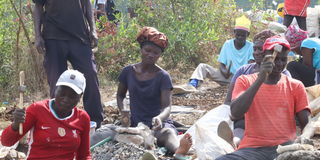
A mining site in Masangura village in Rang’wa East sub-Location in Suba Central, Homa Bay County, on July 13, 2025. Residents of the area claim to have discovered gold and are digging the ground in search of the mineral.
Photo credit: George Odiwuor | Nation
She secured excavation rights from a local landowner and currently oversees two vertical mining shafts. Each is staffed by seven labourers who dig and extract ore which is then processed in search of gold—locally known as mali.
Compared to her previous work, she finds mining more manageable.
Within days of the discovery, the mining area transformed into an informal settlement.
Temporary structures now provide shelter, workspaces and shops including food stalls operated by local women.
The catalyst for the gold rush was 82-year-old Peter Ayoo, a former artisanal miner in Tanzania.
After moving to the area 15 years ago, he stumbled upon an unusual rock formation near his home. Recognising its unique properties, he conducted informal tests confirming the presence of gold.
Word of the discovery spread rapidly and landowners who had long neglected their plots suddenly found themselves sitting on valuable terrain.
Many opted to lease their land to aspiring miners and a local committee chaired by Pascal Omweke was formed to oversee the booming but unregulated industry.
“So far, only a few individuals have found gold and in small quantities but even grams give people hope for a richer strike,” Mr Omweke said.
While the village is flush with enthusiasm, most miners have no prior experience. Basic safety protocols are routinely ignored in the rush to capitalise on the discovery.
As a result, the risk of injury, suffocation or long-term health effects from dust exposure remains high.
The absence of proper equipment also exposes locals to exploitation as middlemen with mining experience from other counties have arrived, offering to test or process the rocks.
“Some people collect rocks five times then claim there’s no gold. We don’t know if they’re telling the truth,” said miner Dominique Okomo.
A mining site in Masangura village, Homa Bay County, on July 13, 2025.
Photo credit: George Odiwuor | Nation
Rocks are packed into 50-kilogram fish feed sacks but due to their weight, they must be divided for transport. Prices range between Sh1,000 and Sh5,000 per sack depending largely on the miner’s negotiating skills.
“Some people are so desperate they sell for as little as Sh800 which is far too low considering the effort involved,” said Samuel Odhiambo, another local.
Unlike other mining regions, Masangura lacks crushing equipment. Gold-bearing rocks must be transported to facilities in Rongo, Nyatike or even across Lake Victoria to Bondo.
The cost of crushing a 50kg sack is Sh300 with an additional Sh150 for processing gold-laden soil. These costs, combined with transport, eat into miners' already limited profits.
Access to the mining site remains a significant challenge with no road infrastructure, vehicles and motorbikes must manoeuvre through private compounds to reach the base of the hill where the mines are located.
Secretary of the Kaksingri Council of Elders Joab Ikawa urged the government to prioritise road construction.
But even then, entrepreneurial locals are seizing the opportunity. Emmanuel Odhiambo, a shopkeeper in Sindo Town, has set up a kiosk at the mining site selling essentials like bread, soda, water, energy drinks and painkillers.
Residents whose homes lie along the makeshift access routes are also cashing in. Mr Docico Ochieng, for instance, charges Sh200 for vehicles, Sh50 for motorcycles and Sh20 for pedestrians crossing his compound to access the mines.
While the mining boom brings hope, it also raises serious concerns as environmentalists warn of potential disasters akin to a past landslide in the region that claimed four lives.
The National Council of Churches of Kenya led by Chairperson Ken Ouma has urged the government to regulate mining activities.
“Without intervention, we risk repeating tragedies caused by reckless land use,” Mr Ouma warned.
He also raised hygiene concerns noting that the site lacks toilets and open defecation is common even as food vendors operate nearby.
Rang’wa West Sub-Location Assistant Chief Walter Odiyo recently held talks with the local committee and directed shaft owners to maintain registers of those entering the mines and to limit time spent underground due to the risk of oxygen depletion.
One trader has proposed setting up a crushing machine on-site, but residents fear the noise it would generate.
However, when contacted, Nema Director for Homa Bay County Jacob Asembo said his office was unaware of any mining activity in Suba, promising to send a team to investigate.
Despite the flurry of economic activity, cash remains scarce. Many transactions are conducted through barter, with miners exchanging rocks for goods and services, including food.
“If this continues, businesses may collapse. The lack of cash flow is already straining the local economy,” warned Mr Odiyo.
Even more troubling are fears that the absence of cash might push women into exploitative arrangements including exchanging sex for rocks, exacerbating the spread of HIV in a region already burdened by high prevalence.
Land disputes have begun to surface as mining expands into neighbouring plots. A public meeting is scheduled this week to explore ways of managing the gold rush sustainably, with community input on fair practices, safety protocols, and long-term planning.
As excitement mingles with unease, Masangura village stands at a crossroads—teetering between newfound fortune and the looming risks of unregulated mining.