He almost lost her twice: A husband's fight against postpartum haemorrhage

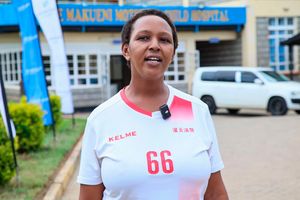
Francis and Mariana Mutwiri, who survived post-partum haemorrhage twice, and participated in the EndPPH run to raise awareness about the leading cause of maternal deaths.

What you need to know:
- As health experts rally behind the annual Run for Her initiative to curb postpartum haemorrhage, specialists warn that fighting preventable maternal deaths requires better spacing, pre-conception care, and dismantling cultural taboos.
When the Mutwiris hit the track on Sunday morning for a run aimed at raising awareness about excessive bleeding during and after childbirth, it was a conviction inspired by a personal experience.
Francis Mutwiri joined the RunforHer marathon from Mombasa in solidarity with his wife, Mariana Mutwiri, who ran from Nairobi.
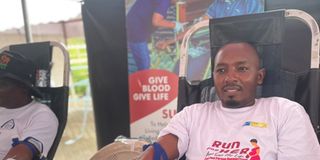
Francis Mutwiri donating blood at the recent Run4Her campaign in Mombasa.
It was Francis' first time joining the run, which was the third edition organised by the End PPH Foundation.
"I remember the day I was told my wife was in critical condition because of excessive bleeding. I felt as though my life was also ending," he tells Healthy Nation.
"Mariana is someone I have interacted with for almost all my life. Having an idea that I was going to lose her was heartbreaking," he adds.
The first time it happened, the two were expecting a twin pregnancy. Francis tells Nation he was eager to meet their children. It was an answered prayer because they had had a series of miscarriages, and he looked forward to the double blessing of twins.
The two lost their twins, and Mariana was bleeding excessively.
"That was a difficult period for me," he says.
The second time, he was out of town and only received a call that his wife was in labour.
"I had gone to work in Kitui. I requested someone to take her to hospital and drove that night to where she was," he recounts.
She gave birth at 36 weeks, but doctors noticed that she was bleeding excessively.
In both instances, Mariana was lucky to have received medication in good time that stopped the bleeding.
After the run on Sunday, Francis posted on his Facebook about his experience and why he chose to run.
"Post-partum haemorrhage (PPH) almost made me a widower. I almost lost my wife, twice," read his post.
Mariana shares that when she was expecting her twins in 2020, she had different bleeding episodes, and she was told that it was related to high blood pressure.
She gave birth to premature twin girls at only 28 weeks. The babies were taken to the neonatal intensive care unit to receive support for breathing, but they got an infection there and died. She was also bleeding but was supported in good time. The next year, she also conceived but had a miscarriage.
In 2022, she got another pregnancy and carried the baby to about 36 weeks.
"I was put on a McDonald's stitch just to support the pregnancy, and I was able to carry the pregnancy to about 36 weeks five days, but my water broke.
Since I had the McDonald's stitch, I had to be taken to theatre," she says.
"After delivery, I bled seriously. I was feeling very dizzy and cold. I was given an abdominal pack and some medication to help me stop the bleeding. I remember asking about my baby, and no one wanted to tell me anything. They wanted me to be assured that all was well," she says.
Mariana was told that she lost more than 1,000 millilitres of blood. This is about a litre of soda.
On her way to the run on Sunday, Mariana wore her t-shirt, and passengers in the public service vehicle that she used were curious to ask her what post-partum haemorrhage is, and what the fuss about RunningforHer was.
"I've been going for this run, and I've been creating awareness and championing for PPH for some time. This year, for the very first time, my husband was able to participate and also donate blood. That is a big thing because male involvement ensures that a woman is supported during pregnancy and also after delivery," she says.
Francis tells us that he got prying eyes, especially from fellow men who appeared to be judging him for participating in the run.
"When I was going back home, I met some men who teased me, asking me to RunforHim next time. I moved closer to them and told them if they organise, I would be happy to join, but I went ahead and asked them if they know what it means to RunforHer?" he narrates.
The men told him that the run was promoting women's issues, but they did not really understand what exactly was going on.
"I listened to them, and then explained to them that PPH does not just affect women, but also men. There are some men that are hurt because their wives die because of PPH," he says.
Francis says that there are some cultural beliefs that contribute to men believing that a maternal health journey is just for ladies.
"Men should understand that by supporting their ladies, or their wives, PPH can be curbed," he says.
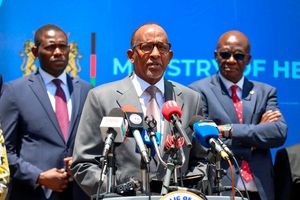
Dr Edward Serem, head of the Division of Maternal and Reproductive Health at the Health ministry, notes that the PPH run is meant to sensitise everyone on the leading killer of maternal deaths.
"We need to eliminate PPH. The government has put up interventions such as Every Woman Every Newborn Everywhere (EWENE) to help in reducing cases.”
He adds that the ministry is training more people and also ensuring that health facilities are equipped with commodities that can help in preventing post-partum haemorrhage.
Prof Moses Obimbo, the lead of the End Post-Partum Haemorrhage Run for Her initiative, says that mothers should no longer die as a result of preventable causes.
"We cannot continue standing still. As we run, we create visibility about the problem. There are many areas that we need to address about PPH such as anaemia, re-training of healthcare workers and blood shortages," he says.
"We are hoping to raise over 2,000 units of blood that will specifically go to hospitals to help mothers. We are also retraining using the PPH school," he adds.
Prof Anne Kihara, a consultant obstetrician and gynaecologist, highlights that women must have pre-conception care so that any complications can be flagged before delivery.
She also explains that the birthing interval of women could contribute to PPH-related complications.
"Ideally, a woman should wait for at least 24 months. That does not happen, so she gets pregnant when her body has not recovered from the previous pregnancy. Women are also missing antenatal care, which is why I believe technology should create a forum for health literacy with a language that women can understand," she says.