Parastatals warned against exploiting interns as State expands recruitment drive
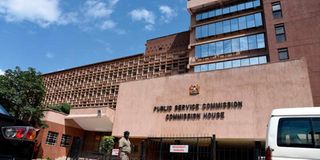
Public Service Commission headquarters. A survey by the commission shows that parastatals recorded the highest number of dismissals at 333, followed by ministries and state departments at 167.

The Public Service Commission (PSC) has directed heads of all public institutions, State corporations, and public universities to immediately declare available vacancy slots as the government prepares to scale up its national internship program to 50,000 recruits starting January 2027.
Speaking at the Kenya School of Government during a capacity-building forum for State agencies on human resource management and disciplinary appeals, PSC Chairperson Francis Meja instructed institutional heads to align their internal capacities with the expanded national directive.


Mr Meja said the government is consolidating parastatal internships into a single national scheme from 2027. Currently, individual internship programmes run independently. However, from next year, various State corporations will be consolidated into a single, centralised public service internship framework managed by the PSC.
"You heard the pronouncement recently that from January next year, the government intends to take about 50,000 interns into the public service under the internship program. Previously, you have been taking an average of 8,000 interns across various government agencies, but from January 2027, we are scaling up to 50,000. Immediately you go back, declare the number of vacancies that are available within your institutions," Mr Meja directed.
At the same time, the PSC boss issued a stern warning to chairpersons of state corporation boards, chief executive officers, vice-chancellors of public universities, and principals of constituent colleges against misusing deployed interns.
Mr Meja expressed concern over reports that some public institutions reduce qualified graduates to performing domestic chores or minor administrative errands rather than providing professional mentorship.
"These are our children; they are our young people, and they need to be meaningfully engaged. We have heard unfortunate incidents in the past where these interns have been reduced to messengers when somebody wants lunch in the office, an intern is sent to go buy it, or to make photocopies," Mr Meja cautioned.

Public Service Commission chairperson Francis Meja.
He urged the institutions to mentor the young people.
“They are professionals in their own right, and reducing them to messengers misses the bigger picture. Kindly help us address that because we have noticed it as a major challenge," he said.
He said internships are contracted for a period of a year to prepare them for the job market.
“They are prepared for the job market not just within the public service anywhere else. So, it is not right expectation that we absorb them because the initial thing is to just prepare them, to expose them to a working environment and make them ready, to be competitive, to look for jobs in the private sector and apply whenever the state advertises,” insisted the PSC chief.
Mr Meja addressed systemic compliance failures across public sector entities regarding human resource management and disciplinary procedures. He noted that the commission has observed widespread resistance to established HR policies, manual guidelines, and constitutional provisions.
A key concern raised was the failure by some accounting officers to enforce PSC directives on disciplinary appeals, an omission that has repeatedly exposed state agencies to heavy financial penalties and legal liability in employment courts.
"The main challenge is failure to comply with the Constitution, the law, and resisting human resource policies and guidelines. Of great concern is the failure by some state agencies to implement the commission’s directives on disciplinary matters. As a result, they end up being penalized heavily by courts for disobedience, and in some cases, officers who fail to comply have been held personally liable," Mr Meja noted.
He cited a recent instance where an institution was slapped with a Sh10 million penalty due to procedural blunders during a disciplinary action he described as entirely avoidable.
Reminding public sector heads of the commission’s legal mandate under the Constitution, Mr Meja emphasised that the PSC retains constitutional oversight to ensure all public agencies adhere to values, principles, and fair administrative procedures, including appellate jurisdiction over disciplinary decisions made by state corporations and public universities.
He explained that the capacity-building workshop was designed as a structured intervention to resolve disputes at the institutional level before they escalate into formal appeals or court litigation.
"Our objective is not to micro-manage your day-to-day administrative operations. What we are seeking is partnership. We want a public service where human resource management and administrative controls are exercised with professionalism, consistency, and humility. We are building their capacities so that they are also able to manage data which is a critical human resource," Mr Meja said.
He urged accounting officers to follow due process in handling staff discipline to save public funds spent on legal fees and court awards, allowing institutions to focus on their core service delivery mandates.
Follow our WhatsApp channel for breaking news updates and more stories like this.