Held together by dialysis: The shared struggle of young Kenyans clinging to life
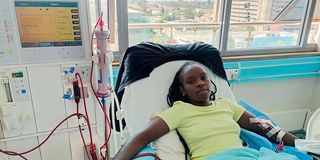
Donah Makandi, 32, undergoing dialysis at London Medical and Dialysis Centre in Nairobi. By the end of 2025, she had completed 1,000 dialysis sessions.


What you need to know:
- Over time, dialysis affects blood vessels, the heart, bones, and blood chemistry, and the body is constantly adapting and sometimes struggling to maintain balance.
- The biggest concerns are heart disease, bone disease, chronic anaemia, vascular access failure, and infections. Cardiovascular complications are the leading cause of illness and death in long-term dialysis patients.
The champagne had barely stopped flowing from New Year’s celebrations when Donah Makandi marked a different kind of milestone. While revellers nursed their hangovers on January 1, 2026, she was counting her 1,000th dialysis session—a grim arithmetic of survival that had begun when she was still a child.
At the London Medical and Dialysis Centre in Nairobi, Healthy Nation finds her at the last of 15 beds, already four hours into her treatment. The gentle hum of machines provides the soundtrack to what has become her second home. Around her, other patients lie in similar states of medical suspension, their lives literally flowing through tubes and filters. Some sleep, others scroll through their phones, all waiting for the machines to finish cleaning their blood.
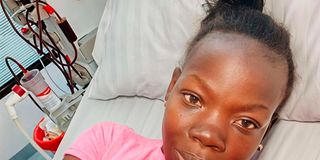
Predencia Wafula, 24, in a dialysis session at Nairobi West Hospital. She is battling end-stage renal disease.
We had expected to find sadness etched on her face after two decades of this routine. Instead, the 32-year-old wears a bright, warm smile despite the tubes running from her arm to the machine beside her.
“One thing I’ve learned through all this is that good health is a gift nobody should ever take for granted,” she says. “I have to come here twice every week just to stay alive. Sometimes I even need an extra session if I fall sick in between, or if the doctor feels there are too many impurities in my body.”
When the body first spoke
Donah’s journey began in a boarding school dormitory when her body first sent distress signals at age 12.
“I was in boarding school when the symptoms started. I experienced stomach pains at first, and later my urine became discoloured and painful to pass,” she recalls. “When I reported it, the school nurse thought I was just starting my menstruation, but I tried to explain it wasn’t that. The pain was coming when I urinated.”
By the time her condition was properly identified, she had already progressed to Stage 3 chronic kidney disease.
“Even after diagnosis, I didn’t understand the seriousness of it because I was just a child,” she explains. “Being in boarding school meant there was no one to monitor whether I was taking medication correctly.”
Despite her failing kidneys, she pushed through and completed Class Eight, managing to avoid dialysis for nine years. But education would soon become another battlefield.
When Donah was preparing to join university, the weight of her illness extended beyond her body. “When I was about to join college, one of my uncles asked my dad why he should keep spending on my education when I was already costing the family so much in medical bills,” she says.
The question cut deep, but her father stood firm. She joined Zetech University, a private institution that accommodated her dialysis schedule.
“I studied nutrition out of practical necessity. That knowledge has helped me survive longer than many of my friends from the dialysis unit.”
The day of reckoning
By July 2016, at age 21, her body gave her no choice. “I had delayed it for a long time because I was afraid of what dialysis meant,” she says. “But eventually, it was either start dialysis or die. I was extremely sick with severe anaemia, fluid overload, vomiting, diarrhoea, and I could barely breathe.”
She has been at the London Medical and Dialysis Centre in Nairobi for three years now. “The staff and patients become like family because you’re together twice a week. When a fellow patient dies, it hurts deeply because you’ve been walking the same journey together,” she says.
“I’ve lost so many friends that I reached a point where I stopped crying at funerals. Instead, I started thinking, ‘Will I be next?’”
Donah’s dialysis days begin at 3.30am, giving her weakened body extra time for simple tasks. Each session costs around Sh10,650, and while SHA now covers her two weekly sessions, her family paid out of pocket for two years before this coverage existed. When she needs an extra session, that cost still comes directly from the family’s pocket.
“By the end of 2025, I had undergone about 1,000 dialysis sessions, and I actually count them,” she says. “Each completed session feels like an achievement.”
Her medication costs alone are crushing. Drugs to control her parathyroid hormone levels cost about Sh300 daily, not counting calcium supplements and blood pressure medication. The dietary restrictions are equally brutal. “People say water is life, but for us, water can be death. We can’t take too much fluid. I can’t eat bananas or avocados because of potassium.”
The isolation has been perhaps the hardest burden. “Living with long-term illness is very isolating. Sometimes you cancel plans because you’re too weak or in too much pain.
Ironically, those are the moments when you most need people around you.”
A reason to fight
Yet through all this suffering, there is a force that keeps Donah tied to life. Her daughter was born weighing just one kilogram when Donah was already in kidney failure.
“My daughter stayed in the nursery for 62 days. But she survived, and now she’s the main reason I’m still here,” she says.
After 13 years of dialysis, a real possibility for transplant has emerged through her father’s willingness to serve as her donor.
“Because I’ve been on dialysis for so long and have developed complications like bone problems and heart issues, I’ve been advised to have the transplant in India.”
The fundraising target is daunting.
“So far, I have raised about Sh1.7 million, and I need about Sh4.5 million in total. My time limit is my body. I describe it as a ticking time bomb.”
Now 32, her message carries hard-won wisdom. “I want other kidney patients to know that it’s not your fault. I was 12 years old when I fell ill. How could I have known how to
‘take care of my kidneys’? Sometimes life simply happens.”
“I believe my dialysis season is coming to an end. I’m hoping to have the transplant by March.”
Doctor’s perspective
To understand just how remarkable her survival is, Healthy Nation speaks with Dr Ken Mukui, her specialist at the London Medical and Dialysis Centre.
“When Donah came under my care, she was already at end-stage kidney disease, Stage 5 chronic kidney disease,” he explains. “By that point, her kidneys were no longer able to support life without dialysis.”
His assessment of her 13-year journey is clear. “It is extremely remarkable. Very few patients begin dialysis so young and continue into adulthood. It speaks to her resilience, consistent medical care, and strict adherence to treatment.”
The medic notes that over time, dialysis affects blood vessels, the heart, bones, and blood chemistry, and the body is constantly adapting and sometimes struggling to maintain balance.
“The biggest concerns are heart disease, bone disease, chronic anaemia, vascular access failure, and infections. Cardiovascular complications are the leading cause of illness and death in long-term dialysis patients,” he says.
Also read: ‘I will not lose hope’: An orphan’s battle with kidney disease and broken education dreams
The impact of starting dialysis as a child has shaped Donah’s entire development.
“In children and adolescents, long-term dialysis can significantly affect growth and puberty. Kidney failure disrupts growth hormone function, delays puberty, and affects bone development.”
Beyond the physical toll, Dr Mukui emphasises mental health.
“Long-term dialysis can lead to depression, anxiety, emotional fatigue, and social isolation. Psychological support is just as important as medical treatment.”
He has noted a trend whereby the younger population is developing kidney failure, listing contributing factors as late diagnosis, untreated childhood infections, genetic kidney diseases, poor access to early healthcare and, in some cases, increasing rates of hypertension and diabetes.
Life after transplant
Jason Sibi-Okumu’s story offers a glimpse into what might await Donah after her transplant. As the son of legendary Kenyan actor John Sibi-Okumu, Jason’s most profound struggle has been deeply personal, a lifelong fight against kidney disease.
The journey began in 2005 when he was just 15 years old. While at school in Nairobi, he suddenly collapsed and was rushed to Aga Khan Hospital with chronic kidney failure.
“I spent two years on dialysis. During this dark time, I found a lifeline in music. I picked up a guitar and began writing songs, using melodies to process a pain that words alone could not express.”
In 2007, at age 17, Jason’s mother donated one of her kidneys. For 17 years, that kidney allowed him to live fully.
“Life after the transplant was good for the most part. It did give me a lot of my life back. I lived a pretty much normal life, save for a lot of medication.”
But in April 2024, the familiar shadows returned. Now 36 and living in the United States, Jason began feeling the tell-tale signs: the bone-deep fatigue, the nausea, the sense that something fundamental was wrong. Doctors confirmed his transplanted kidney was failing. After an eight-day stint in the emergency room, he was diagnosed with end-stage kidney disease. The kidney his mother had given him, the gift that had sustained him through his 20s and into his 30s, was giving out.
Now back on dialysis after 17 years of freedom, Jason views the struggle through an adult lens. “As a child, you don’t really have the depth perception to really entertain your mortality. As an adult, I know very clearly what it would be like if I died in terms of how it would affect my immediate family. Having to deal with that pressure is extraordinary.”
Despite being thousands of miles from his parents in Nairobi, Jason remains spiritually grounded.
“I cope by strengthening my relationship with God. I feel very blessed to be able to choose bravery, and to choose love over fear, no matter what happens.”
He has been on dialysis since August 2024 while actively thinking about transplantation. Inspired by Dr Joe Dispenza, an international lecturer, researcher, corporate consultant, and bestselling author of You Are the Placebo, he has become a student of mind-body medicine, believing in the possibility of kidney regeneration through meditation.
“If I have a kidney transplant, amazing. And if my body regenerates itself, amazing.”
Music remains his sanctuary. “Music is everything to me; it comforts me, guides me, and reminds me that I am okay. Because my love for music is stronger than my circumstances, it sustains me on the days that feel too hard to bear.”
A young woman’s fight
At Nairobi West Hospital’s dialysis ward, Predencia Wafula is still new to this world. Her journey began in 2024. At just 24 years old, her youth is a stark contrast to the medical apparatus keeping her alive.
Just months ago, Predencia was building her future, having enrolled in home care studies before her body began failing. “I didn’t know anything about kidney disease before I was diagnosed. You don’t think about your kidneys at that age.”
Medical professionals explored various causes but found no clear answer. “They talked about hypertension and stress, but there was no single moment where they said, ‘This is exactly why.’ My kidneys were failing, and we had to deal with it.”
The physical toll hits differently at 24. “The fatigue is overwhelming. It’s not just being tired. It’s your whole body feeling heavy, like you’re moving through water.”
Her diet is now a strict calculation. “The dietary restrictions are overwhelming. You don’t realise how much of social life revolves around food until you can’t participate.
Eventually, it’s easier to stay home.”
Each dialysis session costs more than Sh10,000, and while SHA covers her two weekly sessions, extra sessions must be paid in cash. “Between medicine and treatment, we’re looking at about Sh6,500 every month.”
For a young woman who should be establishing her career, being a financial burden is its own suffering.
“I was supposed to be contributing to my family by now. Instead, they’re spending tens of thousands every month just to keep me alive. The guilt of that is sometimes harder to bear than the physical pain.”
“Sometimes I get so scared I can barely breathe. I think about the future; how long will I live? Will I ever be normal again?” What keeps her going is borrowed strength. “The people who love me won’t let me quit. On the days when I can’t find reasons to fight for myself, I fight for them.”
Her younger brother has stepped forward as her donor. “I don’t even know how to properly thank someone for giving you a part of themselves like that,” she says. The transplant requires about Sh2.5 million, of which they have raised about Sh250,000.
“Getting this transplant would mean everything. It would mean I could finish my education. It would mean I could plan more than a few days ahead.”
Despite being new to this journey, Predencia has learned lessons she is determined to share. “Young people need to take their health seriously. We think we’re invincible. We think kidney disease happens to old people. But I’m 24, and here I am.”
Her warnings are urgent. “If you’re using drugs, drinking heavily, taking painkillers without a prescription, you need to think about what you’re doing to your kidneys. They don’t give you warnings. They just fail.” She advocates for regular check-ups with urgency. “If I had known earlier, maybe things would be different. That’s why I tell everyone to get tested. Don’t wait until you’re sick.”
Medical reality
Dr Zoya Adam, consultant physician and nephrologist at Nairobi Hospital, provides crucial context for understanding what awaits transplant patients.
“When kidneys fail, dialysis becomes necessary to do the work the kidneys can’t.”
End-stage renal disease occurs when kidney function drops below 15 per cent. “Patients must connect to a dialysis machine two to three times a week. It’s lifesaving but physically and emotionally taxing.”
For long-term management, a kidney transplant is the best option, but Dr Adam is careful to manage expectations. “A transplant is not the end of the journey. Patients must take lifelong immunosuppressive drugs to prevent rejection. The kidney’s survival depends on strict medication adherence and whether the original disease recurs.”
Jason’s story illustrates this reality. His mother’s kidney gave him 17 good years, but it was not forever. “The longevity of the graft is never a guarantee,” Dr Adam adds.
As for kidney regeneration, Dr Adam is clear. “Kidneys do not regenerate,” she states, though she acknowledges emerging research in regenerative medicine.
In Kenya, transplants usually come from living relatives after rigorous medical and psychological testing to ensure both donor and recipient safety. Because the process is complex and demanding, the medic emphasises prevention as the first line of defence.
“Diabetes, high blood pressure, and autoimmune diseases are the main causes of kidney failure. Controlling sugar and blood pressure, staying hydrated, and avoiding unnecessary painkillers can make a big difference.”
“Kidney disease is often silent in its early stages. Regular check-ups for high-risk individuals help prevent progression or catch problems early,” she says. Despite the challenges, Dr Adam remains hopeful. “With good medical care and strong patient commitment, a prolonged period of good health is possible.”