Hope for children between cancer treatment cycles
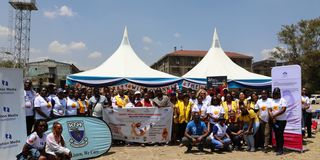
Cancer patients, caregivers, survivors, clinicians, advocates, policymakers and partners pose for a photo after taking part in a 7-km walk to raise awareness on childhood cancers in Kenya on February 13, 2026 at the Kenyatta National Hospital.

As the world marks International Childhood Cancer Day today, Sunday, February 15, Kenya joins the global community under the theme “From Challenge to Change”, a call to move beyond acknowledging the burden of childhood cancer to demonstrating how collective action is driving real, measurable progress.
That shift, from challenge to change, was visible on Friday, February 13, when parents, survivors, clinicians, advocates, policymakers and partners took part in a 7-kilometre childhood cancer awareness walk that began and ended at Kenyatta National Hospital (KNH).
The walk wound through Nairobi before returning to the hospital grounds, where speeches were delivered, survivors shared testimonies, and children battling cancer received care packages and goodies from partner organisations, small moments of joy in a space where childhood is too often interrupted by illness.
The event was officially flagged off by the leadership of Kenyatta National Hospital led by the CEO, Dr Richard Lesiyampe, CBS, alongside Ambassador Simon Njoroge, the Governor of Lions Club District 411A. Their presence underscored a central message of this year’s theme that no single institution can change childhood cancer outcomes alone.
Globally, an estimated 400,000 children and adolescents are diagnosed with cancer every year, according to the World Health Organization (WHO). In high-income countries, more than 80 percent survive but in low- and middle-income regions, where nearly 90 percent of the world’s children live, survival rates fall sharply, often to between 20 and 30 percent.
At KNH alone, over 400 new childhood cancer cases are diagnosed annually, making it the country’s largest paediatric oncology referral centre. Children are referred from across the country, many arriving late, after prolonged diagnostic delays and repeated referrals.
“These are not just statistics. They are numbers representing children who could survive if they are diagnosed early and supported consistently,” noted Dr Irene Nzamu, a paediatric haematologist-oncologist and head of the childhood cancer unit at KNH.
The hospital currently manages childhood cancer care through two main wards; 3D and 1E, which are frequently congested. “Some children remain admitted for months, not because they require continuous inpatient care, but because outpatient systems, accommodation options and follow-up structures are limited.”
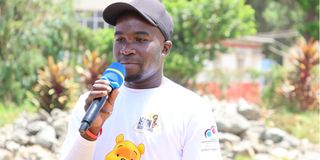
25-year-old Bill Clinton, a childhood cancer survivor, gives his life account on Friday, February 13, 2026 at the Kenyatta National Hospital after taking part in a walk to raise awareness on childhood cancers.
She further intimated that with support from Lions Club District 411A, KNH is expanding outpatient chemotherapy services, allowing stable children to receive treatment without prolonged hospitalisation. This shift is expected to significantly reduce ward congestion, lower infection risk and improve quality of life for both children and caregivers.
In parallel, the hospital, working with partners, is advancing plans for a Hope Hostel, which will provide temporary accommodation for children and caregivers undergoing treatment. The hostel directly addresses one of the leading causes of treatment interruption and abandonment: the lack of safe, affordable housing near the hospital. With the hostel in the pipeline, parents are expected to cope better, and children to recover with dignity, and with improved outcomes.
Among the most powerful moments of the day were the voices of survivors themselves. At 25, Bill Clinton stood before the crowd not as a patient, but as proof that childhood cancer is not a death sentence. Diagnosed as a child, he is now in remission, but survival, he emphasised, was only the beginning.
“Cancer is treatable if diagnosed early. But survivorship is the hardest journey,” he said. He spoke candidly about years of depression, suicidal thoughts and long-term complications, including cardiovascular disease that kept him in and out of hospital even after cancer treatment ended.
His experience reflects a reality that is often overlooked: surviving cancer does not automatically mean returning to normal life.
This is where organisations such as Faraja Cancer Support Trust play a critical role. Faraja provides structured psychosocial support; counselling, art therapy, peer engagement and caregiver support, recognising that cancer affects mental health, family stability and social identity.
The disparity between childhood cancer outcomes in Africa and high-income regions is not only biological but systemic.
AFRON Oncology for Africa, an Italy-based organisation working in East Africa for over 15 years, has been vocal about this gap. While survival rates in Europe and North America exceed 80 percent, much of Africa remains below 30 percent.
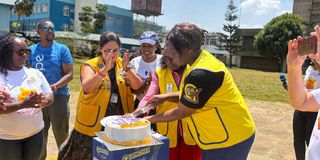
Various partner representatives cut a cake on February 13, 2026 at the Kenyatta National Hospital Grounds after taking part in a 7-km walk to raise awareness on childhood cancers in Kenya.
“This is unacceptable and we are not just fighting cancer; we are fighting inequality as well,” AFRON President Titti Andriani noted during the event. Their work focuses on prevention, early detection, medical training and skills transfer, in partnership with Kenyan clinicians rather than through parallel systems.
Coordination emerged as one of the strongest messages of the day. The Kenyan Network of Cancer Organisations (KENCO), an umbrella body bringing together over 80 cancer-focused civil society organisations, plays a central role in aligning efforts across the country and ensuring families do not fall through gaps in a complex care system.
Equally critical is the role of the State. Representatives from the National Cancer Institute of Kenya (NCI) and the National Cancer Control Program (NCCP) reiterated that childhood cancer is now firmly embedded as a national priority under Kenya’s Third National Cancer Control Strategy.
The strategy integrates childhood cancer across prevention, diagnosis, treatment, survivorship, financing and research; marking a shift from fragmented responses to coordinated policy action.
Among the organisations driving this shift from challenge to change is Hope for Cancer Kids, one of Kenya’s most established and impactful childhood cancer support groups. Founded in 2008 by parents whose own child was treated at Kenyatta National Hospital, Hope for Cancer Kids began as a peer support initiative before evolving into a multi-pillar organisation addressing the real-world barriers that determine whether a child survives cancer.
Their work spans access to diagnosis and treatment, transport and accommodation support, health insurance cover, psychosocial care, caregiver empowerment and advocacy. In practice, this means ensuring that children not only get diagnosed, but remain in uninterrupted treatment, thus reducing abandonment, loss to follow-up and preventable deaths.
The participation of the Nation Media Foundation underscored the role of storytelling as part of the response. Sustained media coverage helps mobilise resources, influence policy and ensure childhood cancer remains visible beyond commemorative days.
International Childhood Cancer Day is marked once a year. For the children in KNH’s oncology wards, the fight continues daily, through chemotherapy cycles, missed school terms, emotional strain and financial pressure.
As Kenya marks this day alongside the rest of the world, the message from its children is clear: they are not asking for sympathy, but for systems that give them a fair chance to grow up.
Follow our WhatsApp channel for breaking news updates and more stories like this.