Hope on the horizon for Kenyan cancer patients as Russia's vaccine shows 100 per cent efficacy
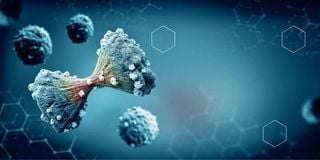
Cancer cells.

What you need to know:
- Cancer is currently the third leading cause of death in Kenya after infectious and cardiovascular diseases, with approximately 42,116 new cases and 27,092 deaths reported annually.
Thousands of Kenyan patients battling cancer stand to benefit from a new lifesaving vaccine that has been found to be 100 per cent effective. Scientists say that Russia’s Enteromix vaccine has been designed to train the body's immune system to recognise and attack cancerous cells, thereby defeating brain, skin and colorectal cancers.
This comes at a time when latest data from the Global Cancer Observatory (GLOBOCAN) and the National Cancer Institute of Kenya (NCIK) show that cancer is currently the third leading cause of death in Kenya after infectious and cardiovascular diseases, with approximately 42,116 new cases and 27,092 deaths reported annually.
The most common cancers in the country, according to GLOBOCAN, are breast, cervical, prostate, oesophageal, and colorectal cancers.
“Cancer is a growing national and global challenge; it continues to exert a profound toll on the lives of Kenyans and health systems. The burden of cancer is not just medical. It is economic, social, emotional and psychological,” Prime Cabinet Secretary Musalia Mudavadi observed during the second commemoration of the national cancer summit in Nairobi last month.
“We are determined to position Kenya as a credible, responsible, and proactive partner in global cancer control. We shall collaborate with international organisations and other industry players in cancer care in research, innovations, and in developing new health products and technologies. We are ready to learn, ready to lead and ready to leverage our networks to serve our people and the region better,” Mr Mudavadi added while reminding that behind every statistic lies a story, a family shattered, a dream delayed and a life stolen too soon.
Now, according to the Russian government, Enteromix, the world’s first and most promising cancer vaccine developed by Russia's Federal Medical-Biological Agency (FMBA), uses a combination of mRNA technology and four oncolytic viruses (OVs) to create a personalised cancer treatment.
OVs are naturally occurring or genetically engineered viruses that selectively infect and destroy cancer cells while sparing healthy tissue.
This cancer treatment approach is a form of immunotherapy as the viruses also activate the body's immune system to attack tumours.
Clinical trials: Phase I human trials began in June 2025 with 48 volunteers
Personalised mRNA vaccine
•Developer: Gamaleya Research Institute (developer of the Sputnik V Covid-19 vaccine).
•Technology: This vaccine uses artificial intelligence (AI) to create a personalised mRNA vaccine for each individual patient. It analyses a tumour's specific genetic mutations to train the immune system to attack the cancer cells.
•Clinical trials: Human trials on melanoma patients were set to begin in September–October 2025.
Trial status:
Phase I: Completed as of early September 2025, with early results described as "highly promising" and "100 per cent efficacy and safety" in early tests. Full trial data is pending review by the Russian Ministry of Health.
Preclinical: Completed preclinical testing showed significant tumour shrinkage and slowed progression, with improved survival rates in test models.
Targeted cancers: Initially developed for colorectal cancer, with research advancing for glioblastoma (aggressive, cancerous primary brain tumour that arises from abnormal glial cells and grows rapidly, affecting the brain or spinal cord) and some forms of melanoma (a dangerous type of skin cancer that develops in the melanocytes—the pigment-producing cells that give skin its colour).
Speaking to Nation in an interview on Monday, Prof George F Njoroge, the founder and chairman of Centre of Africa Live Science who was part of the team at Merck & CO in the US that developed Keytruda, a prescription only cancer drug that goes for Sh492,100 per 100mg/4ml in Kenya and is popularly known for enabling former US President Jimmy Carter, who died last year, live up to 100 years after he was in August 2014 diagnosed with metastatic melanoma (advanced or stage 4 cancer that occurs when melanoma cells spread from the original tumour to other parts of the body), explained how OV’s work.
“By bursting the tumour cells, OVs trigger an immune response that helps the immune system recognise and attack cancer cells throughout the body, essentially acting as an in-situ vaccine. While only a few OVs have been approved, such as T-VE for metastic melaona, many more are in clinical trials, with advancements continuing to improve their delivery, targeting, and efficacy, ”he said.
“The fact that Russian scientists have developed Enteromix, a cancer vaccine that would be ready for clinical use in treatment of brain, skin and colorectal cancers, is a wonderful discovery and has excited the medical community and the entire humanity that is grappling with that devastating outcome of that malady,” he told Nation before explaining further how Russia did it.
“The Russian group has used a cutting-edge technology, messenger RNA (mRNA), which was the same approach that was used by pharmaceutical companies such as Moderna and Pfitzer-BioNTech among others in production of Covid-19 vaccines. Essentially, in this technology, as opposed to the weakened virus one, mRNA vaccines teach the body’s cells to produce proteins that trigger an immune response against the cancer cells and kill them.
“When used as vaccine, mRNA can be injected into the body in tiny fat droplets to deliver them to the desired parts of the body, where they would instruct one or more proteins that are normally found in particular cancer cells,” Prof Njoroge explained.He pointed out that the immune system would then learn to recognise these proteins as ‘flags’ and subsequently attack cancer cells that eliminate them. Just like in the case of coronavirus where the vaccine would provide protection to an individual, if the later was exposed to that Covid-19 virus essentially by the human body triggering an immune response, a very similar case takes place in case of cancer cells, where the immune system facilitates elimination of cancer cells that are targeted by corresponding vaccine.
“The Russian group’s vaccine is based on combination of four non-innocuous viruses that have ability to destroy malignant cells and simultaneously activate the patient’s antitumour immunity in a mechanism described above. The drug has been found to be safe and effective in treatment of brain, skin and colorectal cancers; it provides 100 per cent efficacy,” Prof Njoroge highlighted.
“The team is also exploring a second direction for personalised mRNA vaccines, where each patient would be treated according to the genetic makeup of their tumour. The vaccine is therefore both preventive but can also be curative in some instances,” he noted before explaining what he has observed from the clinical trials conducted by the Russian scientists.
“The Enteromix vaccine in this clinical trial has helped patients with large tumours by reducing their sizes and destroying the cancer. Although these results have been reported in an Eastern Economic Conference, this vaccine still waits for official approval by regulatory agencies before it can go to market,” he observed while adding that of importance to note is that mRNA are commonly found in human and other living cells and do not affect or interact with DNA.
So, what does the new cancer vaccine mean for Kenya?
By 2040, according to NCIK, the number of new cancer cases in the country is expected to rise to 95,217 annually.
Approximately 82,000 people in Kenya are currently living with cancer.
The country has fewer than 10 functional radiotherapy machines for a population of over 55 million people. Most of these are located in Nairobi, leaving rural areas underserved.
Chemotherapy services are available in some public and private hospitals, but access is limited, and stockouts are common.
Trained oncologists
Kenya has fewer than 50 trained oncologists, heavily concentrated in urban areas. Palliative care specialists and oncology nurses are also in short supply.
Each year, over 800,000 individuals face life-limiting illnesses, but only about 14,552 receive necessary services. Fewer than five per cent of children requiring palliative care have access to it.
Dr Njoroge reminds that Africa accounts for about seven per cent of global cancer cases, but nearly 70 per cent of cancer deaths are in low -middle income countries (LMICs).
“By 2040, cancer cases in Africa are expected to double, exacerbating current healthcare challenges,” he explains while citing the World Health Organization-Africa Region’s latest report. He adds that in the developed world, patients are mostly found to be at cancer stage I/II during diagnosis, while in developing world countries such as Kenya, most patients are diagnosed late at stage III/IV.
In the developed world, radiotherapy units are high density per capita while in the developing world, the units are critically low (often one per 5–10 million).
Survival rates in the developed world is between 60–90 per cent for treatable cancers, while in the developing world, the rates often are below 30 per cent.
“Only 35 per cent of low-income countries reported having pathology services generally available in the public sector,” said Prof Njoroge while painting a picture of why the new cancer vaccine is set to save millions of lives in Kenya and on the continent.
“The mRNA vaccines, unlike conventional vaccines, do not contain any viruses, thus pose no possibility of viral infections. This area of cancer prevention and treatment would greatly benefit our country and the world at large since the vaccines would result in ultimate cure and prevention of cancer,” he told Nation, adding that this would be in line with affordable universal health care and could result in saving many lives with treatment that might not require chemotherapy, radiotherapy or even surgery.
“In terms of health economics, mRNA could be possibly cheaper to achieve particularly due to their rapid design and production capabilities, their high adaptability in modifying sequence to target specific antigens and potential for personalised therapeutic approach tailored towards unique profile of individuals. Kenya stands to benefit from these types of vaccines with the advent of institutions like Biovax, Kemri, Kipre and academic institutions like the Nairobi University and Egerton,” Prof Njoroge said.