Muslim leaders make U-turn, advocate for HPV vaccination to protect girls from cervical cancer
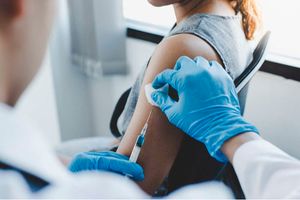
A girl reacts after receiving the HPV vaccine.

What you need to know:
- According to the World Health Organization, the HPV vaccine protects against specific types of human papilloma virus (HPV), particularly those linked to cervical cancer and other cancers.
Religious and political leaders from Northern Kenya have reversed their previous opposition to the HPV vaccine, now actively encouraging parents to vaccinate girls aged nine to 14 to prevent cervical cancer.
Speaking on Monday at a press conference in Nairobi, the leaders, mainly from Mandera, Wajir, Isiolo and Garissa counties, announced that their stance on HPV vaccination had changed after getting correct information from doctors.
According to the World Health Organisation (WHO), the HPV vaccine protects against specific types of human papilloma virus (HPV), particularly those linked to cervical cancer and other cancers.
The leaders’ initial resistance was rooted in mistrust and misinformation, believing that the HPV vaccine was a ploy to reduce their population.
The 2019 Kenya National Census and the launch of the HPV vaccination campaign occurred in the same year, creating a perfect storm of mistrust and suspicion in the region. After the census, the leaders complained that their region’s population was undervalued.
On January 29, the court ordered for a fresh recount of the affected counties. The Kenya National Bureau of Statistics (KNBS) complained two days after the court ruling that it may not be easy to repeat the census in those counties. The leaders accused KNBS of deliberately undercounting their populations, depriving them of political representation and resources.
This bred deep suspicion— and when the HPV vaccine was introduced the same year, many saw it as another "scheme" to control their numbers.
Wajir County First Lady Rukia Mohamed said the HPV uptake has been quite low, noting that only one per cent of their eligible girls have been vaccinated.
“We have called our religious leaders because people trust them and listen to them. We are trying to go back to our people and create awareness. Hopefully by next year at a time like this, our numbers will have gone up,” she said.
She attributed the low HPV vaccine uptake in the region to a common misconception that the vaccine is a form of family planning.
Dr Ali Maalim, Mandera deputy governor, said that while the exact number of people who have cervical cancer is still obscure, they know that the disease exists.
“The vaccine is absolutely necessary. If we know people can die from cervical cancer and we have a solution for its prevention, we should prevent it. One death is too many,” he said.
“We Kenyans and Africans are known to be suspicious about anything from the western countries. In our regions, we also have deep seated suspicions about family planning, vaccines and census control,” he added.
Dr Maalim said the launch of the vaccination drive in 2019 missed the mark, especially in Northern Kenya.
“Public vaccination is a public matter, and it requires public awareness. In my opinion, it was never launched in my region. We are launching it today,” he said.
Dr Hussein Iman, director of Health and Sanitation at the Supreme Council of Kenya Muslims, explained that this is a turning point as it ensures that leaders whose voice is valuable at grassroots level have a say.
“We want this message to reach fathers to ensure that our girls are vaccinated,” he said.
He explained that religious leaders, especially those from Northern Kenya, have had a change of heart because the concerns they had raised were addressed following a series of meetings over the years.
More girls
Prof Fredrick Were, chief executive officer of the Kenya Paediatric Consortium, said the exact burden of cervical cancer, either illness or death, in Northern Kenya, is not known.
“We should focus on prevention rather than waiting for a curative response, which doesn’t work well,” he explained.
“We now know that the previous regime of using two vaccine doses is not necessary and one is enough. The adoption of one dose will allow stakeholders to vaccinate more girls,” he added.
Dr Abdi Maalim, Director Medical Services in Mandera County, said onboarding the right stakeholders to spearhead a vaccination campaign goes a long way.
He noted that early HPV vaccine campaigns failed to engage religious leaders
“The religious leaders will now help us in terms of mobilisation. We know of existing myths and misconceptions that have been addressed,” he said.
He also empasised the need for more healthcare workers to improve maternal health screening and early diagnosis of conditions in counties.
Latest data from the Kenya Demographic Health Survey shows that testing for cervical cancer is higher in urban areas, about 20 per cent, compared to rural areas at 14 per cent.
Counties with the highest percentage of women screened for cervical cancer are Nyeri (32 per cent), Kericho (27 per cent), and Nairobi (25 per cent ), while Mandera, Marsabit, Garissa, and Wajir have the lowest (two per cent or less).