How better latrines are changing lives in Homa Bay

Alice Atieno Okoth, a resident of Kadede village in Homa Bay County, shows her clean latrine during the interview at her home on November 18, 2026, a day ahead of World Toilet Day celebrations.

What you need to know:
- Homa Bay has raised latrine coverage to 98 per cent, with more than 3,000 villages certified open defaecation-free.
- These modern pit latrines are helping families improve hygiene while giving women and girls safer spaces to manage menstruation.
Alice Atieno understands the importance of having a latrine, and a good one, for that matter.
Less than two years ago, the resident of Kadede village, Rachuonyo North, says that attending to the call of nature came with many compromises. Her family would either use a latrine at a neighbour’s home, which meant knocking on doors to request keys, or relieve themselves in the bush. Most of the time, they chose the bush because the idea of asking for keys did not sit well with them.
For her teenage daughters, the lack of a latrine became even harder whenever they were on their monthly periods. They needed privacy to change into clean sanitary towels and dispose of the used ones. “I only came to know about the challenge after bumping into used sanitary towels while cleaning our compound. As a mother, this did not sit well with me,” Alice says.
Also read: Kenya records major sanitation gains as 423 more villages attain open defecation-free status
She later learnt that the teenagers sometimes dug shallow holes in the compound to dispose of the pads. At other times, they threw them out. Either way, the used pads still found their way back into the compound. “Sometimes it was the heavy rains that would sweep them back into the compound, or our dog,” she says.
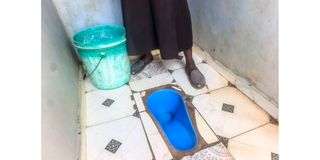
Alice Atieno Okoth, a resident of Kadede village in Homa Bay County, shows a latrine cover that helps keep her latrine clean and free of unpleasant odour during the interview at her home on November 18, 2026.
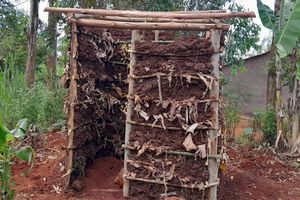
In 2023, she decided to put up a makeshift latrine. The family dug a hole and walled it with plastic bags for privacy. Then came the foul smell from the facility and endless flies in the compound. The walls were at times torn, which compromised privacy and made it hard for family members to use the latrine, especially during the day.
When heavy rains came, the latrine would sometimes collapse, and the family had to put up another one. In the meantime, the only solution was to relieve themselves in the bush. “My visitors were also reluctant to eat or drink anything from my house, thanks to the smell and flies from the makeshift latrine,” Alice says.
Her daughters now had a place to dispose of their used sanitary pads, but they still complained about using the structure during the day. It was “embarrassing”, as they put it. Worse still, the family’s struggle with diarrhoeal diseases, especially among the younger children, did not stop.
In 2024, the Ministry of Health, in partnership with Homa Bay County and other partners, ran a community awareness campaign dubbed ‘Choo Bora’. Alice was among the Homa Bay residents who then put up a modern pit latrine.
Her family’s pit latrine is now fitted with a Sato pan, which has a lid that keeps it closed when not in use. The lid opens when any slight weight lands on it and closes afterwards. After use, the faecal matter is flushed with water.
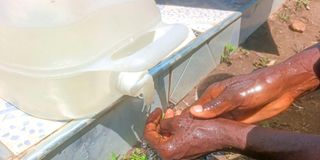
Alice Atieno Okoth, a resident of Kadede in Homa Bay County, cleans her hands at a handwashing station installed next to her latrine during the interview at her home on November 18, 2026.
“The Sato pan is also child-friendly. Initially, my younger children were scared to use our old latrine because of the visible hole, which is now concealed by the Sato pan,” Alice says.
She says her children can now use the latrine without supervision.
In neighbouring Konyango Village, Lazarus Rabach has for years made sure his family never lacks a sanitation facility. His biggest challenge, he says, is the swampy nature of the village, which makes latrines sink during heavy rains.

Lazarus Odoyo Rabach during the interview at his home in Kadede village, Homa Bay County, on November 18, 2026.
Lazarus, who is fully aware of the consequences of open defecation, made a habit of putting up a new facility any time the old one collapsed. “I put up a modern latrine fitted with a Sato pan two years ago, and I am yet to regret my decision. The latrine has stood the test of time; my family still enjoys using it to date,” he says.
Kenneth Omondi, the Homa Bay County Public Health Officer, says that 10 years ago, latrine coverage in Homa Bay was 36 per cent. In 2019, the National Census revealed that 7.4 per cent of Kenyan households lacked sanitation facilities. According to the data, 10 per cent of the population, or 4.7 million people, practised open defecation.
The data also showed that Homa Bay was among 14 other counties struggling with open defecation. The others were Baringo, Garissa, Kajiado, Isiolo, Kilifi, Kwale, Mandera, Marsabit, Narok, Samburu, Tana River, Turkana, Wajir and West Pokot.

Homa Bay County Public Health Officer Kenneth Otieno Omodhi during the interview in Homa Bay on November 18, 2026.
The United Nations Children’s Fund (Unicef) says open defecation has devastating consequences for public health. Faecal contamination of the environment and poor hygiene lead to child mortality, morbidity, undernutrition and stunting.
According to Unicef, poor sanitation can also be a barrier to education and economic opportunities, with women and girls particularly vulnerable to the consequences.
In November 2021, the government of Kenya, in partnership with Unicef and other partners, launched the Kenya Sanitation Alliance. Its target was to eliminate open defecation in the 15 burdened counties.
The programme was funded by the government of Japan and the United States Agency for International Development (USAID). It focused on Community-Led Total Sanitation (CLTS), as Kenneth explains. “We kicked off by registering households with details on the existence, type and usage of latrines,” says the public health officer.
The campaign then focused on raising awareness of the impact of access to water, sanitation and hygiene (Wash) services. After that, villagers were given time to apply what they had learnt, with a major focus on building pit latrines.
“We later came back to inspect the structures, checking the latrine lids, cleanliness, the kind of structure built and privacy levels,” Kenneth says.
The county then brought in an independent team for monitoring and evaluation. This was followed by quality assurance ahead of the Open Defecation Free (ODF) declaration.
According to Kenneth, the county has since certified over 3,000 villages as ODF, up from just 700 in 2021. “For a long time, Homa Bay struggled with cases of cholera and diarrhoeal diseases. For years, we never missed being mentioned as the epicentre of cholera,” he says.
He says the county’s latrine coverage now stands at 98 per cent, and Homa Bay is set to receive ODF status from the Ministry of Health. He says the impact of these gains is already visible, with county hospitals recording a drop in cholera, typhoid and diarrhoeal diseases. “School absenteeism as a result of waterborne infections has also dropped,” Kenneth says.
He says they are yet to hit the 100 per cent target because some households share facilities. Wangui Karanja, the Chief of the Kisumu Zonal Office at Unicef, says that as of 2026, Busia, Kitui, Siaya and Migori are the only counties that have achieved ODF status.
According to Wangui, Kenya has made major strides in eradicating open defaecation, which stood at 5.9 per cent in 2024, down from 12 per cent in 2015. She says this has been made possible by the 2030 Roadmap for Sanitation and the Rural Sanitation and Hygiene Protocol.
“Other major contributors are the national and county Wash hubs for coordination purposes, real-time monitoring of the sanitation progress, and training of the 15,000 health workers on CLTS protocol,” she says.
Wangui says the country is now shifting its focus to sanitation and climate resilience. This, she says, is because climate shocks are increasingly threatening to erode the gains made against open defecation.
The world is marking the 2026 World Toilet Day under the theme ‘Safe Toilets, Equal Futures’. Wangui says it is time to think about poor sanitation, which affects everyone, with women and girls the most affected. She says this makes it a fundamental gender equality issue.
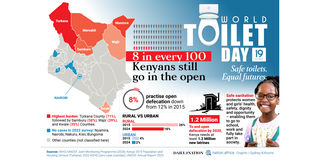
The sanitation expert says it is also time to think about menstrual hygiene management, with a focus on easy and safe access to toilets for girls and women.
“When periods are not managed effectively, girls drop out of school or miss learning days. When not strategically placed, toilets put women and girls at risk of sexual assault,” she says.
“A clean, accessible toilet is important to a girl in managing her periods, while having the facility strategically placed also becomes a protection issue,” she concluded.