How extreme heat is putting pregnant women and newborns at risk
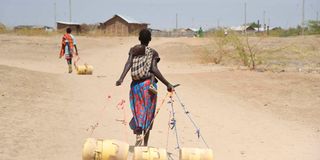
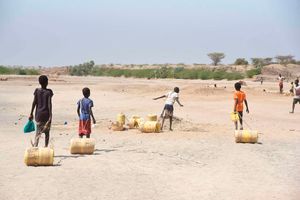
A woman with a child strapped on her back pulls containers with water in Abulon Village, Turkana Central Sub-County on February 12, 2026.


What you need to know:
- Kenya has had dangerous heat before. Mbithi points to a heatwave in March 2016, studied by KMSA scientists led by Dr Joyce Kimutai.
- It lasted at least seven days in each of Nairobi, Kisumu and Mombasa. In Kisumu, temperatures stayed above 37 degrees Celsius for seven days. Mombasa recorded more than 35 degrees for about 20 days.
At 10 o'clock at night, Irene Echapan can still feel the heat in her bedroom wall.
The wall faces West, and her bed stands against it. All day, the sun beats on the wall. At night, it radiates the heat back.
"When you touch them even at 10pm, you will feel their heat," she says.
Echapan is five months pregnant with her third child. She lives in Kawalase village, in Lodwar Township Ward, Turkana County. Her rented house has one door and one window. It sits in a rocky landscape where the ground itself retains heat. This pregnancy, she says, is nothing like the first two.
"The first two pregnancies, I was in Eldoret, a totally different environment compared to Lodwar. I enjoyed a cooler climate in Eldoret and didn't have difficulty sleeping or doing my daily household chores. At the moment, I am five months pregnant in Lodwar, facing extremely hot weather conditions," she says.
Also read: Lodwar residents struggle to beat 40°C heat
Between September and October, daytime temperatures in Lodwar town swung between 38 and 40 degrees Celsius. Health officials warned that the heat could bring more cases of heat stroke, kidney stones and bladder stones.
Irregular power cuts made things worse. People said they could not rely on fans or air conditioners. The cuts also disrupted the water supply. Taps ran dry, leaving little water to cool the body.
For Echapan, the sun is hot by 9am. She says it is hard to find any good time to be inside the house.
"Where I stay, the heat has been too much, especially for me as an expectant mother. There is a lot of sun during the day, and it begins to be hot as early as 9am. I don't sleep comfortably at night because the walls on the western side where my bed is are releasing the heat… This makes sleeping on the bed very uncomfortable," Echapan said.
She says the heat sometimes makes her feel faint or sick, or gives her a headache. She cannot rest on a mat in the shade of her house because the rocky ground stays hot.
To cope, she wears light cloth called "deras", loose dresses, when she walks around the village or does her chores. At home she wraps herself in a leso. After a bath, she sometimes wears damp clothes to cool down for a short time, as the water dries off her skin.
That trick has a cost. At about four in the morning, the air turns cool, and she can finally sleep. But she says she sometimes forgets to change out of the wet clothes.
"I experience a cold environment at 4am where at least I can sleep well, but sometimes I forget to change my wet clothes, resulting in pneumonia and chest pain," Echapan said.
The long walk for water
Water is the other half of the struggle. The village water supply is irregular. Echapan says she sometimes walks three kilometres to the seasonal Kawalase river, where she scoops water from holes in the riverbed. She goes early in the morning, and again after six in the evening when the sun has set. She needs enough water to cool her body in the day and at night.
At night, she says she often leaves her bed. She lays a mat at the door, or outside the house, to catch a little cool air. But she cannot relax out there, or even inside with the door open.
"I will just keep my house door wide open and never close my eyes because if I suddenly fall asleep, someone might break into the house or even sexually abuse me."
She says her nights now add up to less than four hours of deep sleep. In Eldoret, she slept at least the eight hours that are recommended to support a mother's health and a baby's development.
A few metres from Echapan lives 18-year-old Selina Lotonia. She gave birth to her first child, a baby girl, on September 27, at Lodwar County and Referral Hospital.
Lotonia was relieved to be past the pregnancy. But she says the heat has not stopped troubling her.
"The sun would be so hot from 8am to 5pm," she says. Her mud-walled house has just one window and little fresh air. During her pregnancy, she spent her days sleeping on a mat in the shade of the house. There are no trees on the rocky ground.
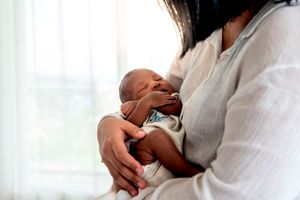
Now she has a newborn to protect. At noon, when the shadow of the house is short, she sits with her baby at the door when the baby is awake. That keeps them out of both the direct sun and the stuffy house. She says the baby often cries from the heat.
When that happens, she makes sure her daughter wears light clothes. She breastfeeds her more often, to guard against dehydration. She gives her a lukewarm bath, or wipes her sweat with a soft damp cloth. When the baby is asleep in a cool place, Lotonia cools herself.
"During the day she sleeps near the door where there is free flow of fresh and cool air while I ensure that I take in as much water as I can because of excessive sweating, where it is at least a litre at an interval of two hours. Due to frequent sweating, we are forced to change into many clothes a day, with the challenge being getting adequate water for cleaning them, bathing and drinking due to unreliable supply," Lotonia says.
At night, when the heat is too much, she keeps her body away from the baby while the baby sleeps.
Both women keep their drinking water cool with a home-made fridge. They fill a 10-litre jerrican with water and cover it with a used blanket. They keep the blanket wet and place the jerrican in a cool spot.
Farther from the clinic
Echapan and Lotonia live in Lodwar. For women in more remote parts of Turkana, the journey to care is harder.
On October 22, temperatures in parts of northern Kenya reached 40 degrees Celsius, the highest recorded this year. Many people may have thought it was just another hot day.
Now picture that heat on wide, dry land with thin bush and little shade. Picture being pregnant and having to travel to a clinic on foot. Or being a new mother trying to breastfeed with no relief, even indoors.
Many people in Turkana poured water over their bodies to cool down. In a place where water is precious, that was no small sacrifice. Families sheltered in grass-roofed manyattas. Children sat in makeshift shade, and adults took off clothes to stay cool.
Some communities are far from a health facility. Reaching one can mean a hard journey on bad roads, often on foot. Community health promoters take some services closer to homes, but regular antenatal care remains a worry.
Dr Gilchrist Lokoel, the Turkana County Chief Officer for Medical Services, told Healthy Nation that health workers have seen pregnant women miss or delay antenatal visits.
They have also seen women who are distressed and exhausted. He links both to the extreme heat.
How hot is too hot?
For women like Echapan and Lotonia, and for the health workers who care for them, there is a basic problem. No one has clearly said how much heat is too much.
First, it helps to be clear about the words. People often use "high temperature", "heatwave" and "heat stress" to mean the same thing. They are different.
High temperature means the air is warmer than usual for that place and time of year. A heatwave is a long spell of unusually hot weather, often three or more days above a set temperature. Heat stress happens inside the body when it cannot keep its own temperature steady. It does not need several hot days in a row.
How the body copes depends on more than the number on a thermometer. Humidity, direct sun, wind, hard physical work, clothing and a person's health all matter.
Kenya has long enjoyed fairly mild weather for most of its history. That may be one reason it has been slow to say how hot is too hot for human health.
Pamela Mbithi, who works on meteorology and health at the Kenya Meteorological Services Authority (KMSA), says heatwave thresholds exist for only three cities. In Nairobi, a heatwave is 32 degrees Celsius or more for three or more days in a row. In Mombasa, it is 36 degrees, and in Kisumu, 37 degrees, also for three days or more.
The thresholds are meant to set off heat-health action plans that protect the most vulnerable. Those include children, older people, pregnant women, outdoor workers and people with long-term illness.
There is no threshold yet for heat stress. And there is none at all for places such as Turkana, where temperatures can climb to 40 degrees Celsius. The thresholds that exist are being reviewed, and work is under way on a more inclusive framework.
That leaves questions. How hot is too hot for a pregnant woman? At what point does heat become dangerous for a newborn? And how should health workers spot and respond to heat risks in communities whose living conditions are very different from those in big cities?
Building a proper threshold takes time. Mbithi said: "Developing a scientifically accepted and usable heatwave threshold requires research that involves statistical analysis of long-term, quality-controlled climatic data like daily temperatures for at least 30 years and reliable health data of a particular region, then choosing the right metric for each region." The result would then be checked and reviewed by stakeholders. They include the Ministry of Health, county health departments and national disaster management authorities.
Kenya has seen heat before
Kenya has had dangerous heat before. Mbithi points to a heatwave in March 2016, studied by KMSA scientists led by Dr Joyce Kimutai. It lasted at least seven days in each of Nairobi, Kisumu and Mombasa. In Kisumu, temperatures stayed above 37 degrees Celsius for seven days. Mombasa recorded more than 35 degrees for about 20 days.
The study found more hospital admissions in all three cities during that time, a sign of the possible health cost of long exposure to extreme heat.
This year, a different kind of warning has caused debate.
An El Niño Heat Mortality Tracker, built by the Climate Impact Lab, a research group linked to the University of Chicago, projects about 2,800 extra heat-related deaths in Kenya between October 2026 and March 2027. The tracker compares expected deaths with the number that would normally be seen in that period. It comes during an El Niño event, which brings unusually warm weather and shifting rains.
Healthy Nation could not independently check the model or its Kenya estimates. The Climate Impact Lab did not respond to a request for comment by the time of publication.
Kenya's Director-General for Health, Dr Patrick Amoth, disputed the projection. He said the country had not recorded a single heat-related death.
Both things can be true. A lack of recorded heat deaths does not prove that heat is not harming people. Many heat-linked deaths happen when high temperatures worsen an existing condition, such as heart, lung or kidney disease. Those deaths may be recorded under the illness, not the heat. Health problems can also appear days after the exposure, which makes them hard to link back to the heat.
The warning from COP31
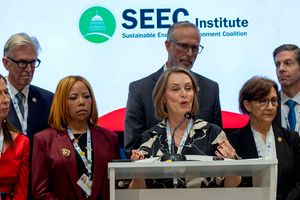
The same concern about mothers and babies was raised far from Lodwar, at the COP31 climate talks in Antalya, Turkey. There, speakers also put people's health first.
UN Climate Change Executive Secretary Simon Stiell singled out pregnancy. "The impacts of rising heat on pregnancy, newborns and maternal health are another unfolding health disaster which has the fingerprints of the climate crisis all over it," he said.
"The world is getting dangerously hot," Stiell told delegates. He said a "super El Niño" is making the damage worse.
The Wellcome Trust released data at COP31 linking heat to pregnancy problems. It says every 1-degree Celsius rise in global temperature goes with a five per cent rise in premature births and a seven per cent rise in gestational diabetes. Wellcome says this is based on a survey of 1,000 maternal health professionals across five continents.
Dr Alan Dangour, Wellcome's Director of Climate and Health, said people must be at the centre of climate talks. "We should approach climate negotiations as though people's lives depend on them, because they do," he said.
The World Meteorological Organisation (WMO) said the global average temperature from January to September 2026 was about 1.47 degrees Celsius above the pre-industrial level, and that an exceptional El Niño has pushed it higher. WMO Secretary-General Celeste Saulo said ocean heat has reached record levels for the tenth year in a row, and sea levels are at an all-time high.
"Indeed, this 2026/2027 El Niño is off the charts. It is different from any El Niño that we have monitored," Saulo warned. An El Niño is declared when the sea surface in the Tropical Pacific is 0.5 degrees Celsius above average. The WMO forecasts it may reach nearly four times that level between November 2026 and January 2027.
The Lancet Countdown on Health and Climate Change released its 2026 global report on October 27. It involved 146 experts from 71 institutions. It says climate impacts are speeding up and affecting health and survival worldwide, and it calls for climate change to be declared an international health emergency.
Heat is not the only threat
In Kenya, the effects reach beyond heat. In the arid and semi-arid lands, long hot spells and changing rains have hurt crops and livestock, pushing acute malnutrition among children to serious levels. As water sources dry up, families turn to contaminated water pans, and cholera and other water-borne diseases keep returning. Rising temperatures are also pushing mosquitoes into higher areas, spreading malaria to communities not ready for it.
The government has said it understands the threat. On December 3, 2023, at the COP28 summit in Dubai, the Ministry of Health launched the first Kenya Climate Change and Health Strategy for 2023 to 2027. It treats health as the "human face" of climate change in Kenya. It calls for health facilities that can withstand climate shocks and for early warning systems linked to health services.
President William Ruto, speaking for Africa in earlier addresses, has said the continent carries a heavy load for a problem it did little to cause. "Weak action is unwise; no action is dangerous," he said.
What could help
The reporting points to several gaps that need closing.
• Local heat limits. Without thresholds, health workers in places like Turkana have no clear signal for when heat turns dangerous. Setting them needs at least 30 years of climate data and reliable local health data, then review by the Ministry of Health, county health departments and disaster agencies.
• Better records. If heat deaths are often recorded as heart, lung or kidney deaths, the true toll stays hidden. That makes both the 2,800 projection and the official "no deaths" claim hard to test.
• Care closer to women. Community health promoters already bring some services nearer to homes in Turkana.
• Money. Dangour said the Climate & Health Funders Coalition, set up at COP30 in Belém, has given more than 225 million US dollars in its first year to projects on extreme heat, air pollution and climate-sensitive infectious diseases. It has secured another 150 million dollars in pledges. Speakers at COP31 said solutions exist but need much more international funding.
An hour at a time
Back in Kawalase, none of this has reached Echapan's bedroom wall.
She has a window, a door, a leso and a jerrican wrapped in a wet blanket. She has a river three kilometres away that flows only part of the year.
"My only challenge in Eldoret was managing pregnancy cravings for the food I desired, but in Lodwar I am really disturbed because what is on my mind is how to keep cool for the next hour," she says.