How herders are restoring grazing lands damaged by harmful weed
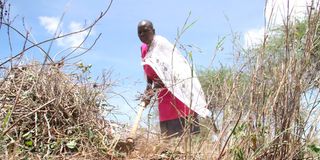
Esther Oponi clearing Ipomea weed from her farm in Oloiborr Ajijik village, Mashuru, Kajiado County on March 27.

What you need to know:
- Since its first appearance following the El Niño rains of 1997, the Ipomea weed—known locally as "oltiameleteti"—has colonised approximately three million acres across Kajiado County.
In Kajiado’s Oloiborr Ajijik village, 60-year-old Esther Oponi sits under the scorching midday sun, surveying her expansive land. Despite scattered clouds, the April seasonal rains that have begun in other parts of Kenya have yet to reach this remote area.
Earlier that morning, Esther had joined her family members in the tedious work of uprooting and burning the invasive Ipomea weed that is rapidly destroying local pastures. Her blistered palms and weary expression reveal her deepest concern—the diminishing grazing lands that sustain her livestock and livelihood.
But there is hope.
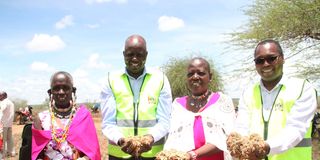
From Left: Leah Kiloku, Kajiado County Water, Environment and Climate Change Executive Michael Semera, Esther Oponi and County Environment Chief Officer James Ngugi during the launch of rangelands reseeding programme in Mashuru on March 27.
A Sh6 million re-seeding initiative is bringing hope to Kajiado herders as they battle the dual challenges of climate change and invasive weeds that threaten their pastoral livelihoods. The programme focuses on reintroducing high-quality pasture species, reversing the damage caused by the fast-spreading Ipomea, and restoring the grazing ecosystem crucial to Kajiado’s pastoral economy.
Esther is a member of Emugur Women Group, one of 10 community groups selected for the first phase of “Reclaiming Our Land,” an ambitious project to restore Kajiado’s degraded rangelands. The initiative is part of a larger Sh200 million investment funded by the World Bank in partnership with the Kajiado County government under the Financing Locally-Led Climate Action Program (FLLoCA).
FLLoCA is a five-year environmental programme jointly supported by the government of Kenya, the World Bank and other donors (Denmark, Germany, Sweden and the Netherlands). It is aimed at delivering locally-led climate resilience actions and strengthening county and national governments’ capacity to manage climate risks.
“In recent years, we hardly receive consistent rainfall due to climate change. The Ipomea weed has been another catastrophe over the past decade. Diminishing pasture means fewer animals and less milk,” explains Esther, referring to the crucial role of milk in Maasai women’s economic activities.
At the county’s demonstration farm in Oloiborr Ajijik, herders spent three days uprooting the weed, earning Sh1,000 daily per person. Following this work, agriculture extension officers trained them in effective grass seed dispersal techniques, including mixing seeds with livestock manure for optimal distribution.
Each participating group received 300 kilogrammes of improved grass seed—a combination of Maasai Love grass (Eragrostis Superba) and bush rye grass. According to the Kenya Agricultural and Livestock Research Organization, these species offer high germination rates, excellent nutritional value, and drought tolerance—critical qualities for the region’s challenging climate.
“The ongoing adverse effects of climate change have taken a severe toll on local herders. The Ipomea weed has accelerated these impacts,” says Michael Semera, the county’s Water, Environment and Climate Change executive. “If this trend continues unchecked, Kajiado could transform into a ‘green desert.’ Through this re-seeding programme, we aim to restore not just pasture but also hope for our herders.”
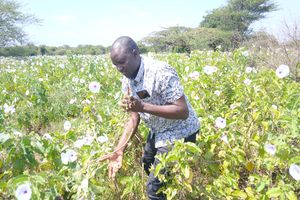
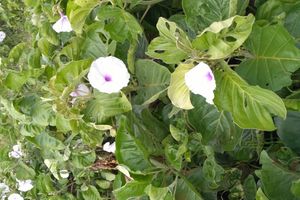
The scale of the challenge is immense. Since its first appearance following the El Niño rains of 1997, the Ipomea weed—known locally as “oltiameleteti”—has colonised approximately three million acres across Kajiado County. The plant’s aggressive growth habit allows it to smother native grasses, with a single plant capable of spreading up to four metres in diameter and growing more than two metres tall.
The economic impact has been devastating. Isaiah Kelele, a local herder, recounts how drought and diminishing pasture reduced his herd from 80 cattle to just 20 over the past five years. “Wild animals, especially hyenas hiding under the cover of Ipomea weed, prey on lambs and kids,” he explains.
County records indicate the livestock sector’s annual turnover has shrunk by at least 30 per cent from Sh3.2 billion five years ago. The 2022 drought was particularly severe, forcing at least 15 women’s dairy cooperatives to temporarily cease operations due to milk shortages.
Environment Chief Officer James Ngugi describes the current three-tonne seed distribution as a pilot programme that will be replicated across the county if successful. “We have established two demonstration farms measuring at least 50 acres each. We’ve engaged climate champions recognised by FLLoCA to ensure the Ipomea weed doesn’t return through continuous monitoring, uprooting, and grass reseeding.”
The initiative aligns with one of Kajiado’s core development strategies—modulated pastoralism—which seeks to enhance sustainable livestock farming through improved pasture availability and resilience to climate shocks.
While reseeding represents the primary intervention, parallel efforts include research by University of Nairobi scientists on methods to eradicate the weed, and emerging youth enterprises that transform the plant into eco-friendly paper products and baskets.
In June 2024, recognising the severity of the threat, Kajiado County officially declared the Ipomea weed a disaster, enabling more coordinated response efforts across government agencies and community groups.