How insurance is becoming a vital tool for Kenyan farmers against drought
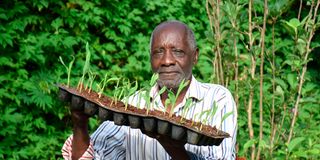
Mika Mukoko displays maize seedlings in a tray in Luanda, Vihiga County on October 23, 2025. He establishes maize in a nursery before translocating the seedlings to the farmland to accelerate growth.

What you need to know:
- Kenya is among the hardest-hit countries in the Horn of Africa by the effects of climate change
- Africa Re estimates that about two million smallholder farmers in Kenya have some form of insurance, though the number remains far below the total farming population.
In 2022, Kenya experienced a drought described as one of the worst in 40 years, leading to the loss of livestock and crops worth billions of shillings, particularly in the Arid and Semi-Arid Land (ASAL) regions. It is estimated that between 2.5 million and 2.6 million livestock died.
The National Drought Management Authority (NDMA), the Ministry of Tourism, the Kenya Wildlife Service (KWS), and humanitarian organisations such as the International Fund for Animal Welfare (IFAW) and the Danish Refugee Council estimated the economic value of these losses at about Sh11 billion (approximately USD 80 million at the time).
These devastating effects of climate change are pushing farmers to rethink their resilience strategies, and agricultural insurance is increasingly emerging as one of the most vital tools for survival.
For farmer Francis Kiragu, who runs a feedlot enterprise in Machakos County, the lessons on the importance of insurance came early.“After college, I worked for five years in the insurance industry, so I understand the importance of insurance cover,” he says.
When he decided to invest in feedlot farming, Kiragu realised the niche was prone to livestock theft — a risk that pushed him to take an insurance cover.
He established his feedlot about a year ago in Mavoko, Machakos, sourcing livestock from ASAL counties such as Kajiado, Narok, Marsabit, Turkana, and Isiolo, among other dry counties.
Mr Kiragu, who runs the enterprise alongside his 26-year-old son, rejuvenates undernourished bulls purchased from pastoralists. The animals, he says, are fed a nutritional formula under veterinary supervision, gaining substantial weight within 90 days before being sold to meat processors supplying export markets.
He began with only 50 head of cattle. The feedlot has since grown to accommodate hundreds of animals. While the insurance premiums are not cheap, Kiragu believes they are worth every shilling.
“It gives me peace of mind,” he told Climate Action during the Africa Re Agriculture and Climate Insurance Workshop 2025 in Nairobi.
Themed, “Enhancing Market Proficiency in Agriculture Insurance in Africa,” the conference, held from November 4 to 5, brought together agriculture experts, policymakers, and industry leaders to share knowledge and develop a sustainable business case for agriculture and climate insurance in sub-Saharan Africa.
The workshop was organised by the African Reinsurance Corporation (Africa Re) in partnership with the International Finance Corporation (IFC).
Mr Kiragu revealed that he pays an average premium of Sh4,000 per animal annually. His policy covers livestock deaths resulting from natural calamities such as floods, drought, and diseases, as well as theft, accidents, fire, and damage to farm property like feed storage.
“The amount may seem high, but when you compare it with the cost of losing animals to theft or drought, insurance becomes a necessity rather than a luxury,” said the founder of Boma Cattle Feedlot.
According to Mr Joseph Chegeh, Assistant Manager for Agriculture Marketing and Underwriting at Africa Re, insurance plays a critical role in giving farmers the confidence to invest despite unpredictable weather patterns.
Kenya is among the hardest-hit countries in the Horn of Africa by the effects of climate change, according to the Food and Agriculture Organisation (FAO) of the United Nations, and according to Chegeh, with these shocks, agriculture has become a risky investment.
“Farmers can no longer rely on rainfall; it comes late, in excess, or fails. Crop and livestock insurance gives farmers the confidence to invest and access credit, as financial institutions can bundle loans with agricultural insurance. This creates a win-win situation for both farmers and lenders,” he added.
However, the uptake of agricultural insurance in Kenya remains worryingly low.
Emphasising its crucial role in building climate resilience across Africa, Isaac Magina, Head of Agriculture and Climate Insurance at Africa Re, estimates penetration to be less than one per cent.
“While agricultural insurance penetration in Kenya is below one per cent, across the African continent it stands at about two per cent of GDP,” Mr Magina told Climate Action.
“But its importance cannot be understated, it secures the food production value chain. When agriculture is insured, we are guaranteeing the country’s food security.”
Africa Re estimates that about two million smallholder farmers in Kenya have some form of insurance, though the number remains far below the total farming population.
“Most insured farmers are in the western and highland regions, the country’s breadbasket, and among pastoralists in northern Kenya,” Magina noted.
These areas, he said, are highly dependent on rainfall, and with climate change, crop failures and livestock losses are becoming more frequent and severe.
He warned that the consequences of uninsured losses are dire. “When farmers lose crops or animals, they slide into poverty. They can’t feed their families or repay loans. Agricultural insurance ensures continuity and stability even when climate shocks occur.”
On the question of high premiums, Magina noted that the cost is largely due to the nature of agriculture itself.
“Farming is scattered across rural areas. Collecting data, conducting assessments, and managing risks in remote regions make it expensive,” he explained.
“That’s why we call for partnerships between governments, development agencies, and insurers to subsidise premiums and make them affordable for farmers.”
He emphasised that addressing climate shocks requires collective action. “Agricultural insurance is not just an individual responsibility but a shared effort involving governments, insurers, farmers, financial institutions, and development partners,” he said.
Seen as one of the modern approaches to make farming sustainable and profitable, agricultural insurance is still relatively new in Kenya.
It began gaining traction in 2019 after the government launched the National Agricultural Insurance Scheme in 2015. The initiative was unveiled in two phases: The Kenya Livestock Insurance Programme (KLIP) in 2015, and the Kenya Agriculture Insurance and Risk Management Programme (covering crops) in 2016. The crop program was rolled out nationwide to protect small-scale maize and wheat farmers from production shocks such as drought and floods.
However, most smallholder farmers still prioritise buying fertilisers and seeds over insurance due to high production costs.
Mr Chegeh noted that while large-scale farmers who rely on irrigation and commercial production are more likely to take up insurance, the majority of smallholder and medium-scale farmers remain unprotected.
“Smallholders view insurance as an intangible promise. They prefer to spend their limited resources on visible inputs. Unfortunately, when disasters strike, the burden shifts to the government, which ends up spending billions on relief food and livestock restocking,” he said.
Nevertheless, he pointed out that insurance products are increasingly being tailored to meet farmers’ needs.
“We now have affordable products designed for small-scale farmers. For instance, index-based insurance uses satellite data to monitor rainfall and determine compensation. If a farmer’s area receives less than a certain threshold of rainfall, they are automatically compensated without the need for farm visits,” he explained.
As climate extremes continue to batter Kenya’s farming landscape, experts agree that agricultural insurance is no longer optional — it is an essential shield for farmers, livelihoods, and national food security.