How Kenya's fake drug problem is showing up in ordinary homes
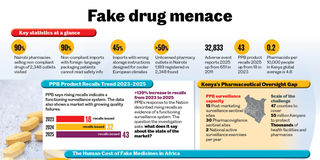
Of the 22 medicines examined, all failed at least one major regulatory requirement, and 45 per cent carried storage instructions meant for European climates, not Kenya's heat and humidity.

What you need to know:
- On July 1, the Pharmacy and Poisons Board confirmed what many Kenyans and health experts had long suspected: that substandard and falsified medical products had been detected in pharmacies, health facilities and other licensed outlets.
Anne Atieno's son almost lost his eye to a box she trusted.
It started with a persistent redness in his right eye. Anne thought little of it at first, blaming it on dust from the football pitch behind their home in Nairobi's Donholm estate. But the redness would not clear, and after a few days, she took him to an eye clinic. The diagnosis: allergic conjunctivitis, an inflammation of the membrane covering the eye triggered by allergens in the environment. It is common in children, and usually clears up once treated. The doctor prescribed eye drops, and Anne picked them up from the clinic pharmacy before they left. Two weeks in, the eye was healing.
Then the family travelled upcountry, but forgot to carry the drops.
Anne had a photo of the box saved on her phone, so rather than make the trip back to the clinic, she went to a pharmacy near their house and showed the pharmacist the picture. He came back with a box that matched it exactly, same name, same colour, same size, and she paid for it without a second thought.
She started the drops that evening. Two days later, there was no improvement. A week on, the eye was, if anything, worse: the redness had deepened, the watering had increased, and her son began complaining of an itch when the drops went in, something he had never experienced with the first medication. The swelling set in, and he became so sensitive to light that he asked to sit away from the classroom windows.
They went back to the doctor, carrying both boxes and asking for the medication to be changed. On examination, the membrane covering the eye was inflamed in a way it had not been at the first visit.
"Then he looked at the two boxes," Anne recalled. "Same brand name, same font, same colour scheme, same general design. But up close, in the small print that most patients never read, the story was different: different manufacturers, different listed active ingredients, different concentrations of the compounds that actually did the work."
The doctor explained that although both boxes shared the same name, they were produced by different companies with different formulations, and that the eye, being one of the body's most sensitive organs, could be irritated or even harmed by the wrong one. He immediately revised the prescription and instructed Anne that, from then on, every prescription for her son must be collected from the hospital pharmacy, where the supply chain is strictly controlled, and the products are verified.
"Many products use the same name, but they are not the same drug," the doctor told her. "If you are not careful, the wrong drug can damage your son's eye."
Within 48 hours of the change, the boy’s eye began to improve: the redness subsided, the watering stopped, and the photosensitivity resolved. By the end of two weeks, the eye had fully returned to normal. He was lucky, and the margin before real damage was set in was narrower than Anne had realised.
Her son’s case is not an isolated scare. It offers a glimpse into a wider problem that Kenya’s drug regulator has now formally acknowledged: substandard and falsified medicines have already infiltrated the country’s regulated supply chain, and no one can say with certainty how many patients have been affected
A regulator admits what many had suspected
On July 1, the Pharmacy and Poisons Board (PPB) confirmed what many Kenyans and health experts had long suspected: that substandard and falsified medical products had been detected in pharmacies, health facilities and other licensed outlets. Among the products identified were falsified Truvada, the antiretroviral used by people living with HIV; falsified HIV rapid test kits that deliver inaccurate results; falsified heparin injections capable of causing bleeding, organ damage, and death; falsified Viagra; and counterfeit malaria and cancer drugs that had previously been withdrawn from the market.
"The alerts we have issued are based on real findings, not speculation. These products were in circulation," said Dr Edward Abwao, the PPB's Head of Post-Market Surveillance.
Falsified medicines deliberately misrepresent a product's identity, composition or source. They often closely resemble genuine medicines but contain the wrong ingredients, an inadequate amount of the active pharmaceutical ingredient, or none at all. For patients unknowingly taking them, the consequences can be severe: they follow their treatment faithfully, yet continue to deteriorate, because the medicine they trusted never had the intended effect.
Across health facilities and online forums, doctors are beginning to notice a troubling pattern. Patients who have been on prescribed medication for months, sometimes years, are reporting worsening symptoms. Blood pressure refuses to come down despite treatment. Blood sugar remains high. Infections keep recurring.
When this happens, doctors typically investigate adherence first: is the patient taking the medication as prescribed, at the right time, without missing doses? For many, the answer is yes. The next line of investigation looks at drug resistance, disease progression, or the need to adjust dosage. What it rarely looks at is the quality of the drug itself.
The PPB runs 15 Post-Marketing Surveillance Sentinel Sites and 30 Pharmacovigilance Sentinel Sites, but these are built to catch problems at the supply chain level, not to notice a specific patient in a specific facility who has been on the same prescription for eight months and is only getting worse. By the time a recall is issued, the affected batches have usually already been consumed. By the time adverse event reports accumulate enough to trigger action, the harm has already occurred. It is, by design, a reactive system—one that detects problems after exposure, not before.
In a presentation, Dr Abwao revealed that Kenya recorded 1,413 product quality complaints and 99 product recalls between 2021 and 2025. Adverse event reports, cases where a medicine caused harm instead of healing, rose from 651 in 2011 to 32,833 in 2025. Since 2020, the PPB has issued 18 suspected falsified medicine alerts, seven of them in 2025 alone and one already in 2026, and the recalls themselves have climbed steadily too: 18 in 2023, 32 in 2024, 43 in 2025. Under PPB's own regulatory standards, a drug recall is simply the removal of batches found to threaten public health on grounds of quality, safety or efficacy.
Nine in 10 Nairobi pharmacies fall short
The PPB is not alone in flagging the problem. An academic study has found that nearly every pharmacy in Nairobi stocks imported medicines that break Kenyan law, raising serious questions about patient safety and how well drug regulation is actually working. Conducted by consultants Valérie Faillat and Epaphrodite Twahirwa of Mt Kenya University and published in a French pharmaceutical journal, the study found that 90 per cent of retail pharmaceutical outlets across all 85 Nairobi wards were selling at least one unauthorised parallel-imported medicine.
Researchers visited 2,348 outlets between September 1, 2023 and October 31, 2024. Six wards were picked out for closer analysis based on socio-economic profile and distance from the Central Business District: Kilimani, Parklands, Kangemi, Korogosho, Njiru and Roysambu.
A recent report by the Auditor-General added a further, uncomfortable detail: at one public hospital, expired and unexpired drugs were found stored on the same shelf.
They identified 22 parallel-imported medicines in circulation. Nearly three-quarters were drugs for heart conditions, diabetes, urinary problems and mental health, and half were on Kenya's official essential medicines list. Almost all were already available as cheaper generics, with patients in some cases having more than ten generic options to choose from instead. Most of the imports came from Turkey, with smaller numbers from Italy, South Africa, Hungary and Pakistan.
Parallel importation, the practice of bringing medicines into Kenya from overseas markets without the patent holder’s consent, is legal in principle. In 2019, the PPB introduced rules to govern the practice, following international trade agreements aimed at lowering medicine costs. But the study found that the reality bears little resemblance to that intention. Of the 22 medicines examined, all failed at least one major regulatory requirement, and 90 per cent were missing the stated amount of active pharmaceutical ingredient per dosage unit, the batch number, the manufacturing and expiry dates, or the name and address of the marketing authorisation holder.
More alarmingly, 45 per cent carried storage instructions intended for cooler European climates rather than Kenya’s hot and humid conditions. Medicines stored outside their required temperature range risk losing potency or becoming toxic. One sample of the diabetes drug Diamicron, according to the study, displayed contradictory storage instructions on the same packaging, raising suspicion of falsification.
A regulator's answers, and what they leave out
On March 5, 2026, Nation sent the PPB a detailed set of questions on border inspection gaps, enforcement failures and staff corruption. The regulator responded in writing on March 9, 2026, and the answers, while measured, revealed between the lines a system stretched far beyond what it can adequately cover.
Asked how many inspectors are deployed at ports of entry, given Kenya’s long and porous borders that allow counterfeit drugs to slip through unmanned crossing points, sometimes hidden in trucks carrying legitimate goods or misdeclared as other cargo, the PPB said it “continuously reviews its inspection capacity” and is working to recruit additional staff. It did not provide a figure.
When pressed on what percentage of pharmaceutical imports are physically inspected, the PPB said it applies a risk based approach: high risk consignments receive 100 per cent physical inspection, while all others undergo document verification only. It did not disclose what proportion of imports fall into the high risk category.
On the question of how long it typically takes from identifying a substandard product to issuing a public recall, and whether that timeline is acceptable given the risk to consumers, Dr Ahmed Mohamed, the PPB’s acting chief executive officer, explained that the timeline varies depending on the nature and classification of the defect. Once a potential issue is reported, he said, the board verifies the report, assesses the risk to patients, and traces the distribution of the affected product, a process that can take anywhere from a few days to several weeks depending on the complexity of the investigation.
Confronted directly on whether the PPB is adequately fulfilling its mandate to protect Kenyans from unsafe medication, the board answered in the affirmative, pointing to its record of issuing recalls as evidence of a functioning surveillance system.
“Recalls are often a strong indicator that a country’s pharmacovigilance and post market surveillance systems are functioning effectively,” the response read. Yet the logic runs in a circle: drugs are deemed unsafe because they are recalled, and they are recalled; therefore, the system is said to be working. What the response does not address is
what happens to patients who consumed the drugs before the recall was issued, or to the stock that remains on shelves after a recall has already been announced.
The board acknowledged that gap indirectly. When questioned on whether recalled products are successfully withdrawn from the market, the PPB said it works with distributors and marketing authorisation holders to retrieve affected batches. It then added: “The Board, however, encourages you to share any of the products from the recalled list that you may have come across for further investigation and regulatory action.” In effect, the regulator was asking journalists to help locate drugs it had already recalled.
One case illustrates how little the public is told, even when a recall does happen. Among the questions Nation put to the PPB was what specific finding triggered the recall of substandard condoms: how long the condoms had been on the market before the recall, how many units were affected, and the board's own estimate of how many Kenyans may have used them before the recall was issued. None of those questions was answered. Instead, Dr Mohamed replied only that "as part of routine quality assurance procedures before distribution, quality testing indicated that the condoms did not conform to the required quality specifications," and that "following this finding, the affected batches were immediately quarantined, and appropriate regulatory measures were implemented." The scale of the recall and the number of Kenyans potentially exposed remain unknown.
What a substandard drug does inside the body
For patients with chronic conditions, says Dr Kiplangat Ngetich, an industrial pharmacist at Kenyatta University Teaching and Referral Hospital, a degraded drug is dangerous precisely because of how much time it buys before anyone notices. A diabetic patient whose medication has quietly lost potency may think they are managing their condition well, even as their blood sugar climbs unchecked, and over weeks and months that damages blood vessels, kidneys and nerves. For a hypertensive patient, a weakened drug means a slowly rising risk of stroke or heart attack, one that often only becomes clear once the harm is already permanent.
"Heat and humidity accelerate chemical reactions inside a medicine," he says.
"This can cause the active ingredient to break down, meaning the patient is effectively taking a weaker dose than they think. For someone managing diabetes or high blood pressure, a medicine that has lost potency could mean their condition is going uncontrolled without them realising it."
That kind of degradation, he says, is almost always invisible. The tablet looks the same. There is no unusual smell and no change in colour. Nothing alerts the patient, who continues to take it faithfully each morning, believing they are being treated—while their condition quietly worsens.
"But degradation does not only mean a medicine becomes weaker," he adds. "In some cases, it becomes actively harmful. The breakdown products of a degraded medicine can themselves be toxic, so the patient is no longer just getting less benefit; they may actually be ingesting something dangerous."
Dr Davji Atella, Secretary General of the Kenya Medical Practitioners and Dentists Union, widens the picture further. "When a patient takes a substandard antibiotic, one of two things happens," he says. "Either the infection does not clear, the patient gets sicker and may die, or the bacteria are exposed to an insufficient dose of the drug and develop resistance. That resistance does not stay in one person. It spreads. Antimicrobial resistance is one of the biggest public health threats we face globally, and substandard medicines are fuelling it."
For patients on antiretroviral treatment, he says, the consequences are the most severe. "If someone is taking falsified Truvada, the virus is not being suppressed. It is replicating, and as it replicates in the presence of a drug that is not properly constituted, it learns to resist that drug. When the patient is eventually put on real medication, it may not work because the virus has already developed resistance to that class of drugs. That is not a reversible situation. You have permanently narrowed that person's treatment options."
Kenya is home to 1,481,853 people living with HIV, of whom approximately 1.4 million are currently on antiretroviral treatment. Everyone of them takes a pill each day and trusts that it is working. If even a fraction of those pills is substandard, the viral suppression Kenya has spent decades building begins to unravel, not suddenly or visibly, but quietly, one patient at a time.
A regulator stretched thin
The scale of Kenya's oversight challenge is visible both in the data the PPB provided and in what the Nairobi study uncovered. Only 1,189 pharmacies are formally registered in Nairobi, yet researchers visited 2,348 outlets, meaning more than half of the outlets they found were operating without a licence. Kenya has 0.2 pharmacists per 10,000 people, against a global average of 4.8. The PPB conducts two national active surveillance exercises a year, for a country with 47 counties, thousands of health facilities and millions of patients.
The problem is not unique to Kenya. According to World Health Organisation data, at least one in ten medicines in low- and middle-income countries is substandard or falsified, costing countries an estimated US$30.5 billion every year. In Africa, more than 267,000 people die annually from falsified and substandard antimalarial medicines alone, and a further 169,271 deaths a year are linked to substandard antibiotics used to treat severe pneumonia in children. In 2022, more than 60 children in The Gambia died after taking substandard, contaminated cough syrup. In Cameroon in 2021, more than 180 deaths were linked to falsified Covid-19 vaccines.
Kenya has not had a documented mass casualty event linked to substandard medicines. But the conditions that produced those events elsewhere, porous borders, an under-resourced regulator, unlicensed outlets and a pharmaceutical market growing faster than oversight can follow, are present here too. Kenya's porous borders with Uganda, Tanzania, Somalia and Ethiopia allow counterfeit drugs to slip through unmanned routes, some hidden in trucks transporting legitimate goods.
Are Kenyans safe?
The PPB says yes: its mandate is being fulfilled, its recall system is functioning, and its surveillance network is expanding. Yet falsified products continue to reach the market, patients continue to report unexplained treatment failure, and an inter-ministerial committee is only now being formed to tackle the problem.
Dr Atella says the question is more complicated than a straightforward yes or no.
"The PPB has been operating for years. They have the mandate and the authority. They have been issuing alerts. And yet, falsified products are still being found in the regulated market, patients are still experiencing unexplained treatment failure, and we are only now forming an inter-ministerial committee. The committee may help, but we should also be asking what went wrong before the committee was needed, and what accountability looks like for the patients who were harmed while we waited."
Dr Joseph Wahome Mukundi, a toxicologist and pharmacist at the Ministry of Health, has previously tells Nation that the number of counterfeit medications making their way into trusted pharmacies, and from there into patients' medicine cabinets, has been rising for years. These drugs, he said, may contain no active pharmaceutical ingredient at all, an incorrect amount of it, an inferior-quality version of it, the wrong ingredient entirely, contaminants, or repackaged expired products, and some are incorrectly formulated and produced in substandard conditions.
"Imagine a scenario in which a patient takes medication for a life-threatening illness, only to become aware later that the doses contained no active pharmaceutical ingredients," Dr Mukundi said.
"It is estimated that this misfortune has occurred with thousands of people worldwide and continues to happen. The growing issue of counterfeit medications is a concern not only for the patient, but also for pharmacists and pharmaceutical companies."
How to tell if your medicine might be fake
• Look for misspellings of the product name, poor print quality, or inconsistencies in logos, colours or font sizes on packaging and labels.
• Watch for any noticeable difference in the medicine's size, colour, shape, taste or smell compared with what you are used to, and confirm any change with a
pharmacist.
• Check that the packaging is sealed in its original manufacturer's form. If it looks tampered with, opened, or unusual in any way, ask a pharmacist before use.
• Some manufacturers use security features such as holograms and QR codes on packaging, which patients can verify.
• Always buy medicines from licensed pharmaceutical outlets.
Source: pharmapproach.com