How Makueni farmers are doubling pixie profits through water harvesting

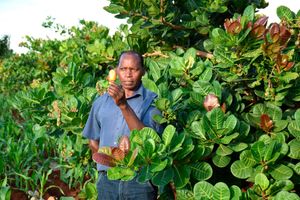
Onesmus Mbutu tends to his pixie trees at his Mbulutini Village orchard in Makueni County on February 16, 2026. By utilising irrigation and strategic production timing, he ensures his citrus harvest hits the market at the perfect moment to fetch a premium price.

What you need to know:
- With 1,800 pixie trees spread across his 10-acre farm, Mbutu is among the largest pixie farmers in the county.
- Unlike many farmers who rely on rainfall to cultivate the sweet hybrid of oranges and tangerines, the environmental conservation champion irrigates his orchard and carefully times his production to fetch premium prices.
It is three months before the pixie harvesting season begins in June, but at Onesmus Mbutu's orchard in Makueni’s Mbulutuni Village, the peak is already here. Traders and farmhands are busy picking the fleshy citrus fruits.
"We start harvesting in January. It peaks in February and lingers into the first two weeks of March. After that, we begin preparing for the next cycle by pruning the fruit trees and withholding water for some time," Mbutu told Healthy Nation.
A tour of his orchard reveals a masterclass in dryland horticulture: large basins covered in mulch surround each tree, preventing water loss and sustaining the crop.
With 1,800 pixie trees spread across his 10-acre farm, Mbutu is among the largest pixie farmers in the county. Unlike many farmers who rely on rainfall to cultivate the sweet hybrid of oranges and tangerines, the environmental conservation champion irrigates his orchard and carefully times his production to fetch premium prices.

Onesmus Mbutu showcases the dam that anchors his pixie enterprise in Mbulutini Village.
"A kilo of pixie goes for Sh150," Mbutu said.
This is double the price of conventionally produced fruits.
Mbutu's success lies in intensive rainwater harvesting and the application of indigenous knowledge backed by science. When he wants his pixie trees to flower, he stops irrigating them for a period, stressing the trees. At the peak of the stress, he introduces a small amount of water, prompting them to bloom. A sprawling dam at the heart of his orchard keeps the pixie enterprise flourishing even under harsh weather conditions.
"A stressed tree stops everything else and directs its remaining resources to reproduction. We see this with acacia trees, which bloom at the peak of the February drought," Mbutu explained, shedding light on the traditional knowledge that sets his enterprise apart. Scientists concur.
"When plants are subjected to stress, either water stress or nutritional stress, they respond by halting the production of branches and leaves and instead direct their resources to the formation of flowers and other reproductive materials. This is a plant survival mechanism. It is widely used by scientists in crop breeding and by farmers in fruit production during the low season," said Prof Jane Ambuko, who teaches horticulture at the University of Nairobi.
Mbutu's pixie enterprise is the culmination of a journey that began with the construction of his dam as the world attempted to emerge from the grip of the Covid-19 pandemic.
The venture has added a steady revenue stream for the businessman, who constructs terraces, dams, and farm ponds, and also renovates degraded farmlands using a shovel loader.
He grew up surrounded by orchards in the Nziu region, the heart of a traditional fruit belt in Makueni County.
Mbutu was alert when pixies took the region by storm. After relocating to Mbulutuni Village in the 1990s, he quickly became one of the biggest growers of maize.
"In 1997, I became the talk of the town when I produced around 270 bags of maize from a 10-acre farmland through simple methods such as early planting. However, the cost of production made the venture unsustainable," he said.
He has witnessed a steady decline in maize production on his farm despite consistently applying conservation agriculture practices such as crop rotation. Until he joined a growing number of farmers cultivating pixies, the businessman struggled to afford enough food to sustain his family. Experts attribute this decline to changing climate patterns.
One downside of off-season fruit production is that crops become more prone to pest attacks. Agronomists note that pest concentrations are typically higher on orchards that thrive during the dry season.
"The absence of hosts in neighbouring orchards to share the pest burden during low-season fruit production explains the pronounced pest problem. This calls for intensive pest management practices," said George Kamami, an agronomist at the Makueni County government.
Mango farmers who have embraced low-season fruit production say the benefits outweigh the costs. A good example is a group of farmers growing mangoes along a section of River Athi that passes through Makueni County. Their fruits fetch premium prices because they hit the market in September and October when mangoes are typically out of stock. Many of them end up in overseas markets.
Also read: Pixie, a fleshy fruit minting the money
"I earn around Sh400,000 from an acre of mangoes per season," said Maingi Mwasaa, a retired teacher who grows the fruit using irrigation.
Makueni Agriculture Executive Elizabeth Muli has advised fruit farmers to explore off-season production to avoid the low prices associated with glut during the conventional season.
To enhance the resilience of pixies to climate shocks, citrus farmers such as Mbutu graft them onto hardy lemon rootstock.
"Ordinarily, we buy pixies from farmers in the Nziu region and other parts of Makueni County who produce them in June. The mushrooming of off-season pixie production ventures has significantly boosted our business. It keeps our customers satisfied and our operation running for more months," said Alex Mwenda, who supplies pixies to high-end supermarkets in Nairobi.
Inspired by the performance of his enterprise, Mbutu has set out to expand it many times over. He aims to become the largest pixie farmer in Kenya within the next six years.