How one farmer’s experiment sparked a cashew revolution in Lower Eastern
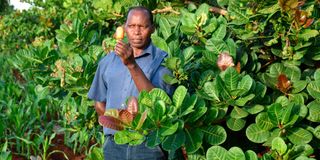
Sebastian Kioko displays a cashew nut in Siembeni village, Makueni County, on December 23, 2025. He is part of a team of farmers promoting the production of cashew nuts in the region.

What you need to know:
- What began as an experiment by a Makueni farmer has grown into a fast-spreading cashew nut movement across Ukambani, offering climate resilience, improved soil health, and higher incomes for small-scale farmers.
- With support from agronomists and the Agriculture and Food Authority, cashew nut farming is emerging as a viable alternative to traditional crops in semi-arid regions affected by climate change.
For many years, Sebastian Kioko assumed cashew nuts only thrived at the Coast. That perception changed three years ago when he planted a cashew nut seedling in Muuni village, Makueni County. The tree has since flourished into a luxuriant canopy and inspired a thriving cashew nut enterprise.
“This is the tree we should all have in our compounds and farmlands. It is a major source of shade since it is evergreen. We literally sweep fruits and nuts under all our cashew nut trees, which are at least two years old,” he tells Healthy Nation.
A guided tour of Mr Kioko’s cashew nut plantation is a masterclass in agroforestry. He grows cashew nuts alongside crops such as beans and maize, as well as fruit trees like mangoes. “Trees like cashew nuts do not just grow because we talk of climate change. Someone has to plant and tend them. To insulate cashew nuts against the shocks of the dry spell, we grow the seedlings in zai pits measuring 2 feet by 2 feet by 2 feet. This pit, which is filled with the top soil before introducing the seedling, serves as a reservoir, which harvests water during the rainy season and retains the moisture the plant requires to cope with the dry spell,” he says.
According to agronomists, cashew nuts thrive in warm climates where temperatures range between 20 and 30 degrees Celsius. They require well-drained soils and between 800 and 1,600 millimetres of rainfall annually. This makes most parts of the Ukambani region well suited for cashew nut production.
Mr Kioko agrees, adding that pruning plays a critical role in enhancing yields. “You should not allow a cashew nut to have branches until it is one-and-half-metre tall. This is achieved through pruning so that it creates a strong root system. Once it attains the height of two metres, you should clip the apical bud to encourage the production of branches. Cashew nut leaves are not poisonous to the soil. Upon rotting, they make the soil healthy by enriching it with essential nutrients. This makes cashew nuts ideal for agroforestry,” he says.
A retired officer of the Kenya Defence Forces and a dyed-in-the-wool environmentalist, Mr Kioko is part of a growing community of farmers at the forefront of efforts to counter the negative effects of climate change through agroforestry. He is at the centre of an aggressive campaign to promote cashew nut production in Kitui, Machakos and Makueni counties.
“We have set out to enlist at least 60,000 cashew nut farmers in 10 years in Makueni County alone. With only 100 cashew nuts trees per farmer and 200 kilos of nuts per tree per year, this will produce at least 1.2 billion tonnes of cashew nuts annually and create a critical mass required to attract investors to set up a cashew nut processing factory,” Mr Kioko said.
A government directive to incorporate valuable trees into the ambitious plan to grow 15 billion trees by 2032 has further boosted the cashew nut campaign. “Instead of selecting random trees for agroforestry, we encourage farmers to go for fruit trees or trees that produce timber. With cashew nuts, a farmer ticks this box. The fruit is rich in Vitamin C, while the nut is rich in healthy fats, proteins, and essential minerals,” says Lawrence Matolo, an environmentalist and chairman of the Agriculture Society of Kenya in Kitui, Machakos and Makueni.
Early adopters of cashew nut farming in the three counties are already reaping returns on their investments. Beyond income generation, cashew nuts are playing a significant ecological role—restoring forest cover in a region heavily affected by climate change, conserving soil, and providing farmers with a steady livelihood.
Cashew nut production has taken the region long known for mangoes and pixies by storm. A teacher who grows cashew nuts on the fringes of Chyulu Hills believes it is only a matter of time before the crop overtakes mangoes in popularity. “A mature mango produces around 300 fruits per year. This translates into around Sh3,000. This is a far cry from a cashew nut yield. A mature cashew nut produces up to 300 kilos of nuts per year. At the current price of Sh70, this translates into Sh21,000. A cashew nut is less vulnerable to pests,” says Francis Munyeke.
The Agriculture and Food Authority is supporting production beyond the traditional Coast-growing zones. Through its nuts and oil crops directorate, the authority has been supplying interested farmers in Ukambani with hybrid cashew nut seedlings to boost output, alongside providing advisory services on propagation. A handful of nursery operators, applying the training offered by the agency, have made brisk business selling the seedlings.
Lillian Langat, the deputy director spearheading the cashew nut promotion drive at the authority, says the Ukambani region stands to benefit significantly as the government pushes for increased production of edible oils. By encouraging farmers to grow cashew nuts, sesame and sunflower, she says, the plan is to promote healthy living through better cooking oils, reduce reliance on imports and create sustainable livelihoods.