How new AI tool will save mothers from bleeding to death during child birth
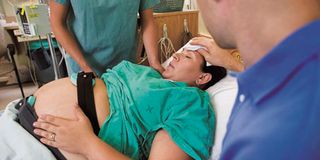

A half-litre of milk. When you pour it into a glass for breakfast, chances are that you will chug it in minutes and move on. In a delivery room, the same volume could mark the difference between life and death if no intervention is done urgently.
When this amount of blood drains from a mother’s body in the moments after childbirth, it leads to excessive bleeding, clinically referred to as postpartum haemorrhage (PPH).
It is the leading cause of maternal mortality worldwide despite experts saying that it can be prevented.

University of Nairobi Professor Julius Ogeng’o at a past event.
Julius Ogeng’o, a professor in Human Anatomy at the University of Nairobi tells Nation that every year, 1 in every four (or 25 per cent) mothers who die because of bleeding could have been saved if there was readily available blood for use in theatre.
“We see challenges on access and storage, especially in remote areas. Either it is not enough, unsafe or cannot be delivered to them,” he says
In April this year, Senators probed into the stark shortage of blood in the country where not even half of what is required annually is in the blood banks. The country needs about 500, 000 to a million units of blood but collects roughly 200,000 units.
"We need to be told the measures and strategies in place to enhance public education and awareness campaigns regarding the reluctance of Kenyans to donate blood and demystify the reasons, myths and beliefs that may lead to this reluctance,” said Machakos Senator Kavindu Muthama.
This was in response to the clarion call from the Health ministry, which needed about Sh2.7 billion to optimally operate the Kenya National Blood Transfusion Service.

Postpartum haemorrhage is the leading cause of maternal mortality worldwide.
The entity’s fund was crippled in 2020 when the United States withdrew its Sh2 billion annual support forcing the ministry to seek alternative funding from the World Bank.
The World Health Organization recommends blood donation of 10 units per 1000 people in a population, one which is yet to be achieved in the country.
Prof Ogeng’o and a team from the End Postpartum Haemorrhage Initiative in collaboration with the Kenya Obstetrics and Gynaecological Society and the Midwives Association of Kenya are piloting a programme at Pumwani Hospital on Roaming Blood Banks.
Roaming stands for the Rural Outreach and Mobilisation Initiative for Network Growth.
“It is like a walking blood bank,” he says.
He explains that they have a mobile application that has registered a pool of people whose blood groups are well known and have committed to be blood donors. So, anytime there is an emergency in any part of the country, they can be reached easily to donate blood wherever they are.
Beyond the mobile application, they have also formed a network with the transporters of the blood to ensure that it reaches those who need it when in good condition.
In the pilot phase at Pumwani Hospital, they hope to generate about 1,000 units of blood that have been tested and are ready for use.
“Once we demonstrate from a pilot phase that this can work, we can scale it by targeting hotspot counties where PPH is quite high,” he tells Nation.
The system uses artificial intelligence to ensure that it works seamlessly.
“We have created data and trained machines to be able to pick certain indicators and predict that based on available data, blood is likely to be required in a certain area,” he says.

Artificial intelligence involves using digital computers or computer-controlled robots to perform tasks commonly associated with intelligent beings.
Prof Ogeng’o hopes to get more blood donors for the sole purpose of saving mothers as he works with the EndPPH initiative Run for Her campaign which will have its second run on September 28 this year. This year, the run will happen in five counties including; Nairobi, Homabay, Mombasa, Uasin Gishu and Kajiado.
Prof Moses Obembo of the University of Nairobi and the lead of the End Postpartum Haemorrhage Initiative told Nation that the run is important because out of the 260,000 women who die from preventable causes when giving birth every year, about 180, 000 are from Africa.
That inspired the idea of running to create awareness for postpartum haemorrhage which tops the list of what kills women during delivery.
“We are creating awareness because we know the first part of systemising and getting to solve a problem is knowing the parts of this problem,” he says
Prof Obimbo tells Nation that the causes of PPH are preventable and should not lead to the mothers dying.
He says that while there have been some challenges including an implementation gap where people have been trained to do the right thing, but at the point of care, they don't do the right thing, awareness will go a long way.
Some of the most common cause, including failure of the uterus to go back to its normal size, a tear after delivery, blood clotting, or traction where an unskilled worker or person who's not properly trained can pull the placenta so hard that the uterus turns against itself and then starts bleeding a lot.

Drinking alcohol during pregnancy puts infants at risk of developmental problems and brain damage, but one in 10 US women say they drink while pregnant, US health authorities said Thursday. PHOTO| FILE| NATION MEDIA GROUP
This then means that blood needs to be on standby should any of these causes happen.
In the coastal region, Dr Mitei Chepwogen, an Obstetrician and Gynaecologist and chairperson of KOGS coastal region told Nation that tackling PPH should start by tackling the risk factors.
Some of the risk factors include anaemia, which refers to low blood level in a human body.
“In the coastal region, because of the low altitude, women are pregnant, with low blood levels but they do not present any symptoms,” she says.
“The food we get from the coast comes from other parts of the country, by the time it gets to the coast, sometimes the nutritional value will have waned. And, since we also live by the ocean, we eat a lot of seafood which contains mercury, one that is known to affect blood levels,” she explains.
She says that this can be mitigated by people seeking pre-conception counselling where a doctor can pick anaemia way before a mother conceives.
Dr Kireki Omanwa, President of the Kenya Obstetrical and Gynaecological Society (KOGS) says that healthcare workers need to get frequent refresher training that updates them on management and care for patients experiencing postpartum haemorrhage.
“They have hands-on experience, but, sometimes, they may lack the specific skills needed in cases of PPH,” he explains.
“Most of the difficult cases are usually handled by consultants, so the younger professionals play a supportive role. It is something else to play a supportive role and another to be the person actually handling a case,” he adds.
He says that blood remains a key pillar in saving mothers since almost three-quarters of the blood collected in the country is consumed by our mothers.
He says that even though blood transfusion centres are decentralised, they are not in places where they are needed the most.
“When a mother has PPH, they need the blood immediately, not after two hours, or three hours, because the longer they wait, tragedy will have struck,” he says.
Dr Kireki says that while the causes of maternal deaths are known, governments fail to make a conscious decision that their lives are worth saving.
“If we can get the National and County government to ring-fence a certain amount for maternal and newborn care, then that will go a long way,” he says.
Mary Magubo, Advocacy and Communications Manager from the Health Ministry’s division of Reproductive and Maternal Health told Nation that the goal is to have all stakeholders to be involved in ending PPH.
“We need to look at the issues leading to PPH and sort it out. Things like buying drugs like the heat stable carbetocin and training healthcare providers as well as sensitising the public on some of the danger signs,” she says.
You may also read other AI In Our Lives story series below.