How one mother’s six-year-battle against drug-resistant epilepsy led to a historic breakthrough
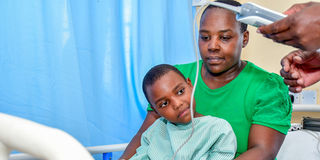
Milkah Nyakundi with her daughter Annabel Gesare, who has lived with drug-resistant epilepsy since she was six months old. She recently underwent vagus nerve stimulation implant surgery at Jaramogi Oginga Odinga Teaching and Referral Hospital during a neurosurgery camp.

What you need to know:
- Six-year-old Annabel Gesare has lived with epilepsy since she was six months old. Multiple drugs failed.
As she stepped out of the Jaramogi Oginga Odinga Teaching and Referral Hospital (JOOTRH) on the evening of September 9, ready for the two-hour journey back home in Kisii County, Milkah Nyakundi whispered a silent prayer hoping that in two weeks' time, her daughter's medical procedure would bear fruit.
Just 24 hours earlier, her six-and-a-half-year-old daughter Annabel Gesare had undergone a rare medical procedure with the hope of offering relief from constant convulsions.
The mother can only hope that the three-hour surgery will soon help reduce the random convulsions and allow her daughter to enjoy both social and academic life.
"My hope is that Annabel will soon get to lead a normal life, just like her peers. Just maybe, I will also once again be able to run errands without having to worry a lot about her," says Milkah.
More than six years ago, Milkah helplessly watched her months-old daughter experience her first seizure.
She recalls breastfeeding the six-month-old baby, who had a fever, before laying her back to sleep.
A few minutes into her sleep, the baby's body suddenly became stiff while her eyes rolled up.
This was accompanied by 10 minutes of convulsions while the mother watched, unsure of what to do.
"For a moment, I thought I was going to lose my baby and only remembered to pray, asking God to spare her life," says Milkah.
While the convulsions eventually stopped, Milkah decided to take her daughter to the nearby hospital the following day since it was late in the night.
At the hospital the next morning, the baby was diagnosed with febrile convulsions, a seizure triggered by high temperatures in children between six months and five years.
The medic also informed them that Annabel would continue experiencing the convulsions for at least the next five years.
During this period, all the doctors could do was manage the condition through continuous routine clinic check-ups and drugs.
"All this time, I had wished that this was a bad dream, but it was not. I was carrying my daughter in my arms with no idea how I was going to manage the seizures," says Milkah.
For the next couple of months, the baby would experience random seizures during the day and at night each time she had a fever.
Over time, however, the seizures became common at night and would last 10 to 15 minutes.
Milkah says the seizures would be triggered by body discomfort, including fever and stomachache.
"On days when the temperatures are high or extremely low, she is also likely to convulse," notes Milkah, who says she has resorted to regulating her daughter's play time in the open.
After Annabel's diagnosis, Milkah abandoned her private business to focus on taking care of the baby in order to minimise harm whenever she suffered an episode.
Years after her first diagnosis, Annabel was diagnosed with drug-resistant epilepsy.
According to the Epilepsy Foundation, while a majority of people with epilepsy become seizure-free with seizure medicines, some continue to have seizures even after trying treatment with medication.
Drug-resistant epilepsy occurs when seizures continue after trying at least two seizure medicines appropriate for the person's seizure type, taken at full dose and as prescribed, according to the foundation.
Drug-resistant epilepsy affects about one in three adults and one in four children with epilepsy, according to the Epilepsy Foundation.
"Frequent seizures resulting from drug-resistant epilepsy are likely to result in injuries, learning and developmental difficulties in children, anxiety, depression, or other mental health concerns, problems at school or work, or sudden unexpected death."
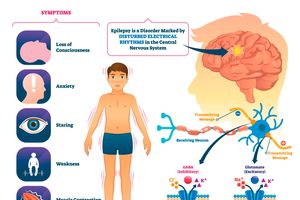
In such cases, neurostimulation devices that use electrical signals such as Vagus nerve stimulation (VNS), Deep brain stimulation and Responsive neurostimulation can be used to help reduce seizures.
Milkah says at the time of diagnosis, the minor would on most occasions experience up to three convulsions in a single night.
On rare occasions, however, she would go for an entire week without convulsing.
Milkah says together with her family, they had tried exploring options online; however, the cost of VNS remained expensive.
As a result, the family resorted to routine clinic check-ups, but the convulsions only worsened.
The frequent convulsions also hindered the minor from enrolling in school until she attained the age of five.
"We took her to school last year but realised she had difficulties catching up with the rest of the learners since she easily forgot what she was taught, a characteristic the medics had explained is associated with the condition," says Milkah.
She adds: "Our doctor helped us draft a letter which was presented to the Ministry of Education offices, allowing her to secure entry into a special school."
She further reveals that for better monitoring, she sleeps closer to her baby during the night in order to wake up and attend to her at the slightest movement.
Her biggest fear over the years, she says, is the minor convulsing when she is not around and either injuring herself or having her airways blocked due to bad positioning and suffocating.
"The condition also came along with stigma. Many do not understand her condition and instead claim she has been bewitched, while some children also avoid playing with her. It has not been easy," she says.
Last week, however, Annabel was among the patients who benefited from a neurosurgery camp at JOOTRH, with a promise of better health outcomes.
Baby Annabel underwent a VNS transplant surgery alongside another minor, one that the doctors hope will grant her relief from the continuous convulsions.
The neurosurgery procedure is the first to be conducted in East Africa. Similar procedures have been conducted in South Africa.
Dr William Owiti, a consultant neurosurgeon at JOOTRH, describes Annabel as a jovial six-year-old who has lived with epilepsy since the age of six months.
Dr Owiti says the minor is currently on multiple drugs for management of epilepsy but has recorded minimal effect.
The multiple convulsions, he says, have in the process affected her development, including schooling and language.
The minor has since undergone the VNS implant with the hope of achieving better health outcomes.
The device is primarily meant for treatment in multi-drug-resistant epilepsy, usually epilepsy not caused by tumours, as explained by the medic.
During the surgery, a device like a pacemaker is placed under the skin in the chest and connected to the vagus nerve in the left part of the neck. It sends small currents to the brain to detect convulsions.
The VNS, he says, provides electrical currents to stimulate parts of the brain when they detect an oncoming convulsion.
While the device does not cure convulsions, research has proven that it can reduce the frequency, length and severity of convulsions by up to 50 per cent over a five-year period, as explained by Dr Owiti.
When the battery life diminishes after five years, the stimulator should be replaced.
"The main impact of VNS is a reduction in the frequency and severity of convulsions," says the neurosurgeon.
He adds: "The device is significant, especially for patients who have multi-drug-resistant epilepsy, and can improve the quality of life, enabling children to develop language skills and participate in schooling."
Once implanted, a patient may experience slight side effects such as hoarseness of voice or increased coughing.
Young Annabel, he says, is expected to be back at the facility in two weeks' time for monitoring of infections that may result from surgery, hoarseness of voice or constant cough for further medical attention, as explained by the medic.
During surgery, he says, the device is placed on minimal settings and often adjusted based on the symptoms a patient exhibits during check-up.
"The procedures remain out of reach in most parts of Africa due to the cost of implants. There is, however, scope to request that it be included in the essential list of services offered under the social health insurance fund, and also sensitisation of possible users," says Dr Owiti.
The yearly camp conducted in partnership between JOOTRH and the Kisumu Neuroscience Initiative marked a major milestone, with 700 brain and spine surgeries successfully performed since the collaboration began in 2017.
The partnership has been strengthened by the involvement of the Foundation for International Education in Neurological Surgery, which is working alongside JOOTRH and the Kisumu Neuroscience Initiative to move the programme beyond periodic surgical camps towards long-term development of local neurosurgical expertise.
International specialists, including experts from New York, together with representatives of medical technology company Medtronic, are working alongside JOOTRH clinicians during the camp.