Why agroecology must be central to Africa's next agricultural investment plans
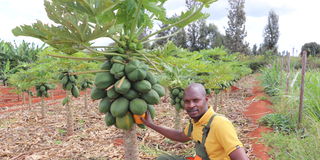
Julius Njine on his orchard in Mwea, Kirinyaga County on October 10, 2025

What you need to know:
- Synthetic fertilisers reduce the diversity and abundance of soil microorganisms, which can impair plant nutrient uptake.
In the quiet village of Ahiti Doba along the Mwea – Embu Road, a one-acre organic orchard is thriving. It hosts 1,000 pawpaw trees alongside other fruits like apples, berries, and plantains, yielding produce all year long, with or without rainfall.
“I don’t have to wait for rains at all,” said Julius Njine, the 35-year-old farmer behind the orchard. “I draw 10,000 litres of water daily from my shallow well, which I pump into the orchard through a drip irrigation system, and the soil is kept moist by mulch to ensure minimal evaporation.”
Behind his farm, a small livestock unit provides manure, which is mixed with water to create a liquid slurry. This natural fertiliser is pumped directly to the base of each tree.
“Dung from my cows feeds the soil, the soil feeds my fruit trees, and the trees feed my family,” said Njine, who has earned at least Sh50,000 weekly from pawpaw sales for the past three years.
Njine’s success is more than personal; it is a model of the climate-resilient agriculture Africa needs. As studies and civil society organisations point out, soils across the continent are degrading due to overuse of synthetic fertilisers, leading to dropping yields and leaving farmers struggling with climate impacts and rising input costs.
A report by the Heinrich Böll Foundation notes that synthetic fertilisers reduce the diversity and abundance of soil microorganisms, which can impair plant nutrient uptake. For instance, a decline in mycorrhizal fungi affects a crop's absorption of zinc, with consequences for human and livestock nutrition.
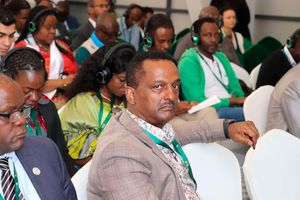
As African leaders convened in Kigali from October 29-31 for the Comprehensive Africa Agriculture Development Programme (CAADP) meetings, there was a pressing call for countries to develop policies that promote crop rotation, diversification, cover cropping, intercropping and agroforestry.
CAADP, established in 2003, is the African Union's policy framework for agriculture-led development. Its 2026-2035 Strategy and Action Plan envisions sustainable and resilient agrifood systems. However, analysts note that it falls short by not centering climate-resilient approaches like agroecology, instead creating room for more imported synthetic inputs that harm African soils and biodiversity.
They also argue that farmers like Njine and civil society voices are marginalised in CAADP governance, and that investment pathways for biodiversity-based systems are lacking.
“Without deliberate action, the next decade risks deepening reliance on industrial, export-driven models that fail to meet Africa’s ecological, cultural, and nutritional realities,” pointed out Dr Million Balay, the general coordinator at the Alliance for Food Sovereignty in Africa.
Central pillar
While the CAADP action plan commits governments to sustainable production and resilience through approaches like climate-smart agriculture, Dr Belay argues that agroecology must be a central pillar.
“The omission of agroecology, farmer-managed seed systems, and inclusive governance risks reinforcing industrial agriculture models,” he said. “These models prioritise export crops, external inputs, and corporate control, while failing to address the ecological, cultural, and nutritional needs of African communities.”
However, according to John Macharia, AGRA’s country manager for Kenya, the use of climate-smart agriculture (CSA) was deliberately used because climate change is an existential threat to agriculture and the environment, and actions that should be taken must be ‘climate smart.’
“Through CSA, we are considering all the agroecology practices, regenerative agriculture practices that are all meant to support how we manage water in the soil, how we replenish micronutrients,” he stated.
However, proponents of agroecology worry that CSA could include genetically modified crops and harmful herbicides, which contradict agroecology's principle of working with nature.
According to Dr Mamadou Goïta, executive director of the Institute for Research and Promotion of Alternatives in Development, a radical shift in agricultural thinking is needed. He argues for a move away from a colonial mindset toward one that centers on indigenous knowledge and food sovereignty.
“The 1980s structural adjustment programmes.that gutted local industries, sold off national assets, and handed control to multinational corporations left Africans with no option other than producing what they do not eat, and eating what they do not grow,” he said. “CAADP is an opportunity to reclaim Africa’s food sovereignty by investing in home-grown solutions.”
But all is not lost.
As countries develop their National Agriculture Investment Plans under CAADP, there is a window for individual countries to put emphasis on solutions that promote food sovereignty and indigenous knowledge.
While leaders debate the continent's agricultural future, farmers like Njine are already leading the way. Counties such as Murang’a, Vihiga, and West Pokot have already adopted agroecology policies, proving that a sustainable, productive, and sovereign food system is within reach.