How rocket stoves are saving forests and women’s health
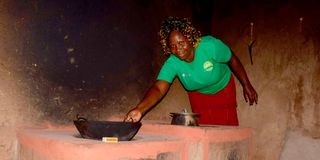
Joyce Kimanthi, a cook at St Paul Winners Academy in Kisayani, Makueni County, prepares a meal using an energy-saving stove at the school on March 17, 2026. The stove, which uses significantly less firewood than traditional three-stone cookers, is part of a growing wave of clean cooking technology sweeping across the region.

What you need to know:
- A campaign promoting rocket cooking stoves is saving trees, reducing harmful indoor smoke, and freeing women from the backbreaking burden of firewood collection.
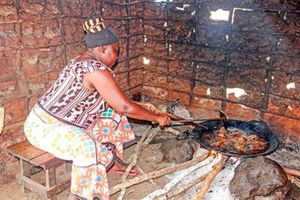
For most of her long life, 76-year-old Anna Mutindi has carried heavy bundles of firewood on her back, a burden that has defined rural womanhood across Kitui, Machakos, and Makueni counties. August marks the start of the collection spree as families stock up ahead of the short rainy season. A defining feature of households in the Ukambani region is Kiveta: a neat pile of firewood that women build gradually through relentless work during the dry spell.
"To amass enough firewood to last an entire rainy season, we keep going deeper into the forests. This has become increasingly tiresome," the peasant farmer tells Healthy Nation in Kalimani Village, Makueni County. "Collecting firewood also exposes us to conflicts with authorities and attacks by wild animals."
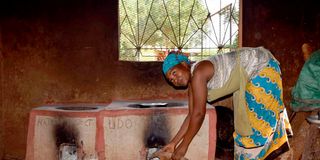
Catherine Kisengese, a clean energy champion, demonstrates the use of an energy-saving stove in Muangeni Village, Makueni County on March 16, 2026.
Anna still uses the traditional three-stone cook stove for cooking and heating. In neighbouring Muangeni Village, however, that is now considered backward. A team of environmental conservationists has rolled out a campaign to unshackle communities from the yoke of firewood collection.
The campaign, spearheaded by Utooni Development Organization, an NGO promoting climate-smart agriculture and environmental conservation, centres on promoting energy-saving stoves. The organisation champions rocket cooking stoves, which are highly efficient.
"A rocket cooking stove significantly reduces forest depletion since it uses less firewood than the traditional three-stone stove. It also produces relatively less smoke," says Nyambura Kamau, the CEO.
According to the 2019 census, at least 70 per cent of rural households rely on firewood for cooking, a reality that environmental conservationists say places immense pressure on forests.
"Trees play a critical role in saving the planet. It is a zero-sum game to keep growing trees when we end up harvesting them indiscriminately for fuel. This underscores the need for energy-efficient stoves," says Ms Kamau.
The alternative lies in the rocket cooking stove. Making one requires well-roasted bricks, sand, and cement. "Using materials that are poor conductors of heat enhances the energy efficiency that characterises the rocket stove," explains Agnes Munyao, an environmentalist at Utooni Development Organization.
The organisation has empowered a dozen residents in Kikumbulyu North Ward, Makueni County, by training them in stove construction and entrepreneurship. According to Jackson Vandi, a mason involved in the work, innovation keeps the stoves affordable.
"Instead of using expensive heat-resistant cement, we mix conventional cement with ash to make it more versatile, especially for the combustion chamber," he tells Healthy Nation.
Ruth Kitheka, a peasant farmer in Muangeni Village and an early adopter, has watched the technology reduce both firewood consumption and the trips women make to a nearby forest owned by the University of Nairobi.
"The end of kiveta is nigh. With an energy-saving stove, no one needs a stockpile of firewood. A single piece cooks an entire meal," she says. These days, she simply prunes the trees in her compound for the little firewood she requires.
At the neighbouringSt Paul Winners Academy in Kisayani Township, the school cook is over the moon. Since the school switched to an energy-saving stove, her work has transformed.
"Initially, I used to take periodic rests outside the kitchen to survive the intense heat and smoke. This is no longer the case. The kitchen is cool. It takes three pieces of firewood to cook lunch for the entire school," says Joyce Kimathi.
Beyond comfort, environmental conservation experts link the intervention to broader benefits: significant reduction in indoor air pollution, a health risk that claims lives, and the ecological gains of preserving mature forests, which convert carbon dioxide to oxygen.
Also read: The deadly cost of traditional cooking
The campaign has also spawned entrepreneurship. Catherine Kisengese is among a handful of artisans trained by the NGO to construct energy-saving stoves. A year into the green energy space, she has become a household name in a region where owning an efficient stove is now fashionable.
"Making energy-conserving stoves has become my main economic mainstay. It makes more economic sense than growing maize and beans," she tells Healthy Nation in Muangeni Village, as orders come in fast and furious. The mother of two charges at least Sh3,000 for labour to install a standard rocket stove.
Underpinning this brisk business is a community-led push. Women around Kisayani Township have teamed up to accelerate uptake among themselves.
"When one of our members cannot raise the money for a stove, we join hands. We collect the required materials and raise the artisan's fee. This explains the accelerated uptake in this region," says Ruth Kitheka, chairperson of Taa wa Muangeni, a community-based organisation promoting the stoves.
A growing realisation that deforestation has made firewood scarce has fuelled the urgency. At the same time, a new Makueni County government policy promoting clean energy has sharpened appetite for improved cook stoves.
"We aggressively advocate for energy-saving stoves to reduce deforestation and the health risks associated with conventional cooking," says Naomi Nthambi, Energy chief officer in Governor Mutula Kilonzo Junior's administration.