Inside Kenya's health diplomacy push: What Health ministry actually secured at New York UN meeting
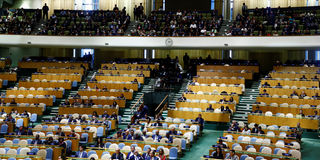
Delegates at the General Assembly hall during the 81st United Nations General Assembly (UNGA) at UN headquarters in New York City, US, September 24, 2026.

What you need to know:
- Kenya's delegation attended the pandemic preparedness summit, five high-level side events and 13 further engagements, and walked away with eight concrete outcomes.
Kenya's health delegation spent last week fighting a battle far removed from the cameras trained on the United Nations General Assembly's main stage. In side rooms, hotel conference halls and closed-door dinners scattered across New York, the real work of this United Nations General Assembly (UNGA) unfolded quietly over coffee, handshakes and two-minute speaking slots as Kenya's health officials chased funding, partnerships and a seat at the table where global health rules are discussed.
The delegation attended the pandemic preparedness summit, five high-level side events and 13 further engagements, and walked away with eight concrete outcomes. Led by Cabinet Secretary Aden Duale, its task was to defend Kenya's universal health coverage reforms, chase investment and manage the delicate transition in US health funding, while participating in some of the week's most important meetings.
The centrepiece of the week was at Unitaid's 20th anniversary panel. Director General for Health, Dr Patrick Amoth, laid out Kenya's vision for the next two decades of global health innovation, arguing for three shifts: "from innovation access to innovation ownership, from fragmented interventions to integrated systems, and from technology transfer to technology capability." Kenya closed its remarks with a challenge aimed squarely at donors and pharmaceutical partners alike: "Let us ensure that the innovations of tomorrow do not simply reach countries. Let them build stronger countries."
The panel delivered good news on pricing: a generic lenacapavir price of $40 per person per year for twice-yearly HIV prevention, opening up access across 120 low- and middle-income countries from 2027. Kenya's own HPT Local Manufacturing Strategy, aiming for 60 per cent of essential health product demand met locally by 2030, was highlighted alongside it, and a Kenya-Unitaid Memorandum of Understanding was presented as the next step.
At the government of Kenya and Africa CDC's side event, "Roadmap to Self-Reliance," the alimatravir partnership took centre stage as proof that African manufacturing ambition can translate into a real product. Principal Secretary for Medical Services, Dr Ouma Oluga, distilled the argument into one line: "Health sovereignty means local manufacturing of pharmaceutical products."
MSD's Dr Priya Agrawal described the drug in "four ones": one pill, once a month, effective within one hour, with a one-week grace period for a missed dose. The voluntary licensing of alimatravir to Kenya's Universal Corporation Limited was held up as the model the rest of Africa's manufacturing strategy should follow.
Kenya's engagements with the Susan Thompson Buffett Foundation convened a select group of African ministers on sustainable, country-owned maternal and reproductive health programming. At a follow-up meeting, President William Ruto and the Foundation agreed to elevate the partnership to a strategic level, providing greater support to the Social Health Authority, the Digital Health Agency and Kemsa in fulfilling their mandates. The partnership will also support the establishment of a drug treatment and rehabilitation centre in Garissa. The ministry will work with the Foundation to translate the partnership into stronger health systems, improved access to care and better outcomes.
Turkey's First Lady Emine Erdoğan and Health Minister Kemal Memişoğlu discussed a proposal for six "Uwezo Hospitals", Kenya-Turkey centres for children's ability and women's health, to be built in Taita Taveta, Isiolo, Homa Bay, Nandi, Nairobi and Uasin Gishu, with Turkey funding infrastructure and Kenya providing land and running the facilities from day one. A $419 million Letter of Intent with GKSD/Gruppo San Donato for 15 hospitals rounded out the week's biggest health investment pitches.
The most consequential bilateral of the week was Kenya's meeting with the US State Department's Bureau of Global Health Security and Diplomacy. CS Duale thanked the American people for a partnership that has "saved countless Kenyan lives," but was equally direct about what Kenya wants next: a shift "from recipient of health assistance to self-reliant strategic partner," through what he called a phased and well-planned handover rather than an abrupt disruption of essential services.
At a related "One Year On" review of the America First Global Health Strategy, hosted by the State Department and the US Chamber of Commerce, the room resolved to pivot from donor-driven aid toward direct government-to-government funding, with recipient countries progressively assuming ownership of their own health workforce and commodities. The Ministry's report notes this direction aligns closely with Kenya's own transition agenda, even as it expects continued US resistance to "equity" and "obligation" language in multilateral negotiations.
Away from the formal panels, the numbers presented at smaller side events carried their own weight. At the "Financing for Women's Health" session, Kenya's delegation reported that official development assistance fell roughly 23 per cent in the past year, with a further 26 per cent decline projected for 2026, and that 80 per cent of 67 surveyed countries reported serious hits to women's, children's and adolescents' health budgets as a result.
Kenya cited its 'Every Woman Every Newborn Everywhere' rapid-results initiative, rolled out across all 47 counties, with three of 26 high-burden regions already showing improvement within three months. Speaking on behalf of President Ruto, Duale reported that Kenya's under-five mortality rate fell from 115 to 41 per 1,000 live births, and stunting from 36 per cent to 18 per cent, between 2003 and 2022. He announced plans to expand school meals from 2.6 million to 10 million learners by 2030.
The Second UN High-Level Meeting on Pandemic Prevention, Preparedness and Response convened three years after the first such meeting and the 2023 Political Declaration. Kenya was the lead ministry within the country's national UNGA process for this meeting, and its message was simple: "an early warning anywhere must produce decisive action everywhere."
Kenya pressed three commitments on the room: strengthen WHO's coordinating mandate and invest in Africa CDC; conclude the long-stalled Pathogen Access and Benefit-Sharing Annex, on the principle that "Africa shares its pathogens without hesitation; Africa must share in the benefits without exception"; and address the root conditions in which health threats emerge, with communities, women and youth engaged as partners rather than afterthoughts.
Kenya's delegation argued that "equity is decided years earlier" and that "goodwill is not a supply chain," pushing for Africa to become a producer, not just a recipient, of pandemic countermeasures. South Africa, meanwhile, used its floor time to recall the punishment it faced for its transparency, reminding the room of the unilateral travel bans it was hit with after identifying the Beta and Omicron variants, a grievance Ghana and Kenya both echoed.
On financing, the Organisation for Economic Co-operation and Development delivered a sobering data point: official development assistance for infectious diseases is projected to fall by up to 40 per cent between 2024 and 2026, even as the Pandemic Fund reports demand running at more than six times its available resources.
Ghana's delegation offered the line that best captured the week's undercurrent of frustration with manufacturing ambition unmatched by market demand: "a factory without buyers cannot protect anyone."