At 81, is the UN still doing what it was built to do?
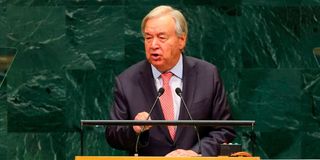
United Nations Secretary-General Antonio Guterres addresses the 81st United Nations General Assembly at UN headquarters in New York City on September 22, 2026.

What you need to know:
- Attendance explains something more troubling, shrinking belief in the institution itself.
- This year, UN cut its budget by 15 per cent in response while eliminating nearly 2,900 jobs.
In New York
The United Nations marked its 81st year this week at a moment its biggest funder is walking away from its bills.
Several of its most powerful members skipped the meeting altogether.


And the outgoing chief, António Guterres, the ninth secretary-general of the UN, spent his final address warning that the system built to keep the peace is buckling under the weight of the world it was meant to govern.
So, is the Assembly still doing what it was built to do?
According to Guterres, the honest answer is: less than it should. But it has been written off before, and it has kept surviving.
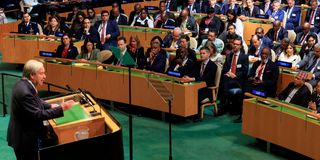
United Nations Secretary-General Antonio Guterres addresses the 81st United Nations General Assembly at the UN headquarters in New York on September 22, 2026.
“Nothing at the UN moves without money, and the money has stopped coming. Member states owe the organisation a record $1.568 billion in unpaid dues. Collections cover barely three-quarters of what was promised,” Mr Guterres said.
Mr Guterres described the situation as a "Kafkaesque cycle," the UN forced to return unspent funds even in years when the money was never paid in at all.
Washington carries the largest share of the blame. The US is assessed at 22 per cent of the UN's regular budget, its single biggest contributor, and owes close to $2 billion. Its own FY2027 budget request proposes a 79 per cent cut to the account funding US contributions to international bodies, and a 92 per cent cut to peacekeeping.
Money and gridlock explain the UN's shrinking capacity. Attendance explains something more troubling, shrinking belief in the institution itself.
"The test before us is whether power will be exercised with the law, or beyond it. We must pass that test," Mr Guterres said.
Whether the institution that Mr Guterres leaves behind still has the money, the membership and the credibility to pass that test is the real question the UN carries into its 82nd year.
This year, several major powers simply chose not to attend the meeting, while others sent their representatives.
Chinese President, Xi Jinping skipped New York for a bilateral summit with US President Donald Trump in Washington instead. He last addressed the Assembly by video in 2021. This year he skipped it entirely.
India, Germany and South Africa sent officials rather than heads of state. Russia stayed away entirely.
Italy's Giorgia Meloni, a Trump ally, broke a 15-year attendance streak amid tension with Washington and did not show up.
Mr Richard Gowan, director of UN and Multilateral Diplomacy at the International Crisis Group, called it a "split-screen moment."
“When the world's most powerful leaders start treating the Assembly as optional, its authority erodes quietly, without a single vote cast against it,” he said.
The Trump administration is said to have pushed through its own Board of Peace, a body that has secured Security Council approval and claims responsibilities once handled by UN agencies, including aid distribution and refugee management, despite having achieved few of its stated goals.
Trump has also imposed sanctions on UN special rapporteurs and on bodies like the International Criminal Court.
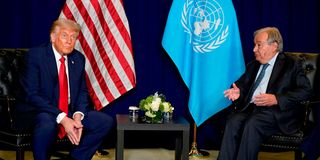
US President Donald Trump meets with United Nations Secretary-General Antonio Guterres during the 80th United Nations General Assembly, in New York City on September 23, 2025.
“This kind of Security Council paralysis is creating environment of impunity, where the conduct of major powers is teaching middle powers and others to believe that they can do whatever they want because nothing will happen to them,” Mr Guterres said.
This year, UN cut its budget by 15 per cent in response while eliminating nearly 2,900 jobs.
The agencies absorbing the pain have the least room to absorb it. The World Food Programme faces a 34 per cent cut. UNICEF faces up to 20 per cent. This means meals and vaccines will not reach people counting on them.
Mr Daniel Forti, head of UN Affairs at the International Crisis Group, said world leaders are not under any illusion that the UNGA is in good health.
"The vast majority of leaders, from small states, from middle powers, and even a few from major powers, recognise the importance of a UN that is a global conversation platform.”
Even as they watch its operational capacity strain under funding cuts and political deadlock.
Currently, he said, the UN is simultaneously juggling conflicts in Ukraine, Gaza, Sudan and now Iran, with limited ability to act on any of them.
In Ukraine, the UN says more civilians were killed in the first eight months of 2026 than in the whole of 2025. Russia has repeatedly vetoed Security Council resolutions on the war.
Mr Forti said the Assembly will still give parties space to talk, but genuine breakthroughs remain unlikely.
“What member states have tried instead is reaching for older, half-forgotten tools to work around the veto,” he said
Ukraine President Volodymyr Zelenskyy, addressing the Assembly for the fifth time since the full-scale invasion began, named the problem directly.
"Many of you here have seen more than once how the abuse of the veto at the UN weakens the world and pushes peace further away," he said.
In Gaza, the UN has labelled Israel's conduct a genocide. But Security Council resolutions on the war have been repeatedly vetoed, and UN relief agencies operating there have been targeted without accountability.
Prof Alanna O'Malley, and chair of Global Governance and Wealth at Erasmus University, said the pattern is now consistent across every major crisis on the UN's plate.
"From Ukraine, to Gaza, and Sudan, and also with what's happening now in Iran, the veto problem leaves the UN hamstrung," she said.
Since Israel's war on Gaza began in 2023, she said, calls for reform have only grown louder, producing an unprecedented majority votes in the Assembly challenging the Security Council head-on.
“These conflicts are already driving real humanitarian fallout worldwide, including reduced food access, rising fuel prices and global inflation,” Mr Guterres said in his final address to the Assembly.
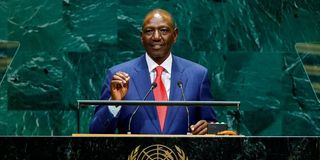
President William Ruto addresses the 81st United Nations General Assembly at UN headquarters in New York City on September 23, 2026.
In his address to the Assembly, President William Ruto said the problem is deeper than money or attendance, noting that the UN's core promise, one nation, one vote, stops being true exactly where it matters most.
"On the gravest question of war and peace, five nations possess a permanent power that the other 188 do not," President Ruto said, adding that 65 armed conflicts were recorded last year, the highest in eight decades of data.
"The world has since transformed; the Security Council has not,” he said.
President Ruto tied the credibility gap directly to how selectively the rules get enforced.
"International law cannot be invoked loudly in one crisis, cautiously in another, and disregarded when convenient," he said. "Every perceived double standard carries a price. And that price is trust."
President Ruto further said the Assembly was never built to depend on the Security Council working, or on every great power showing up.
"The founders of the UN assumed that the Security Council would be the centre of most decision making in 1945," he said. "But after the UN started working, the big powers became divided very quickly, and suddenly a lot of political discussions moved to the General Assembly."
Through the 1960s, as newly independent states flooded in, the Assembly became the stage that isolated apartheid South Africa and eventually suspended its membership.
"Without the Assembly, the vast majority of UN Member States wouldn't have had a voice on many global affairs. We are at a moment in time where there's a whole lot of diplomatic clubs out there, but for a lot of small countries, and a lot of middle powers, the General Assembly is still their main stage," President Ruto said.
“When a crisis breaks, the place the world goes to react is the General Assembly. There's no alternative to that," he added.
Follow our WhatsApp channel for breaking news updates and more stories like this.