Inside KNH’s first beating-heart bypass surgery
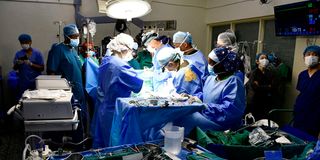
Surgeons performing an Off-Pump Coronary Artery Bypass surgery at Kenyatta National Hospital (KNH) on September 23, 2026.

What you need to know:
- There is a quiet beauty in watching the heart steadily pump throughout the operation.
- The specific technique — operating on a beating heart to correct its function — is a first locally, though the underlying procedure itself has been performed by specialists before.
It is about 10.30am on a Wednesday when we get into the theatre. There is a hive of activity. A 74-year-old male patient is already on the operating table when we get a chance to film.
The team, led by Prof Hiroshi Niinami from Japan's Tokyo Women's Medical University, Department of Cardiovascular Surgery, is performing a first-of-its-kind procedure at a public facility in the country.
There is a quiet beauty in watching the heart steadily pump throughout the operation. The specific technique — operating on a beating heart to correct its function — is a first locally, though the underlying procedure itself has been performed by specialists before.
Prof Niinami calls it off-pump coronary artery bypass grafting. This means the doctors do not use a cardiopulmonary bypass machine, also known as a heart-lung machine, during the surgery. Ideally, the heart is stopped when surgeons carry out such complex procedures, and the patient is placed on that machine instead.
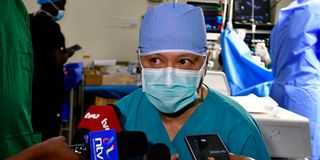
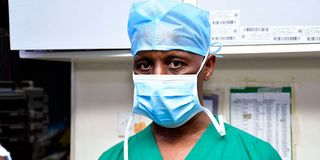
Prof Niinami Hiroshi speaks on the process of performing an Off-Pump Coronary Artery Bypass during the interview at Kenyatta National Hospital (KNH) on September 23, 2026.
He explains that coronary artery bypass grafting can be done while the heart is still beating because the artery lies mostly on the surface of the heart, so doctors do not need to open it up.
"The advantage of this technique is that it is less invasive for patients, which is good for them. The difficult part is that it is technically demanding, because the heart is still beating," he says.
He adds that a heart-lung machine can sometimes cause a stroke.
Eleven heart surgeries in a week
Kenyatta National Hospital is this week performing about 11 heart surgeries, in collaboration with doctors from Canada, Japan and Sweden, brought in by the Kibos International Health Foundation. All the patients were pre-screened for about three months to determine their eligibility for surgery at the facility.
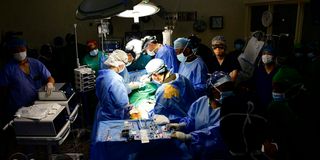
Surgeons performing an Off-Pump Coronary Artery Bypass surgery at Kenyatta National Hospital (KNH) on September 23, 2026.
We find Elizabeth Wanjiku caring for her mother, who is waiting to be wheeled into theatre. Her mother is 52.
"My mum got heart disease about 18 years ago. She had one surgery before, where her valves were changed, and she was fine. This year, though, she had a stroke and was referred to KNH. We have been here since February, and I hope all goes well," she says.
Hosea Juma is his wife's chaperone. His wife is already recuperating after her surgery on Tuesday.
"I came all the way from Kisumu. My wife could not walk even 10 metres without getting tired. When I took her to hospital, we were told she needed a valve replacement. That happened yesterday, and she is doing well. She has even asked for tea," says Hosea.
High demand
Dr Simon Nderitu, a heart surgeon and head of the cardiothoracic surgery unit at Kenyatta National Hospital, says that although only 11 patients made it onto the programme, demand is far greater, and the number of inquiries reflects an unmet need.
"We believe there are many more patients who may not even be diagnosed. We don't know the exact number, but our experience with this project shows that once we started screening, we found many more patients than we could handle," he says.
"The criteria targeted patients who had already presented at Kenyatta National Hospital, because we knew we had many. Doctors also assessed the suitability of the vessels for the operation," he adds.
He says the country needs to train more personnel and build capacity — more hospitals, more beds, more theatres and more intensive care units.
"There's a lot more work to be done to reach all the patients in good time," he says.
Kenyatta National Hospital (KNH) Cardiothoracic Surgeon and Head of Unit Dr Simon Nderitu speaks on the process of performing an Off-Pump Coronary Artery Bypass during an interview at the hospital on September 23, 2026.
Dr Nderitu explains that the heart is a large muscular pump that needs a steady supply of blood to keep working. Sometimes, though, the vessels become blocked by cholesterol deposited over time, and that is what leads to heart attacks.
Asked whether Kenya will now adopt the off-pump technique fully, he says the country is only just beginning to learn it.
"Science keeps giving us new options, but opinion is still divided on whether stopping the heart or not gives any real advantage. In some parts of the world, surgeons have gone back to stopping the heart even after using this technology. It is new. It is good. We are learning it, and we will find our place with it," he explains.
Duration of surgery
The duration of a heart surgery depends on how many vessels need attention. The 74-year-old patient, for instance, had four target vessels. Generally, the operation itself takes anywhere from three to five hours.
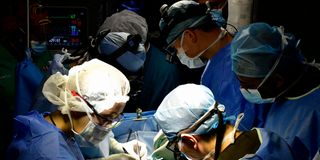
Surgeons performing an Off-Pump Coronary Artery Bypass surgery at Kenyatta National Hospital (KNH) on September 23, 2026.
"The duration really depends on the complexity of the case. We try to work fast and minimise disturbance to the heart. The shorter, the better — but the job has to be done well," he says.
Coronary artery bypass grafting has been studied extensively. Dr Nderitu says one long-term challenge is that the new vessels can become blocked.
"Veins are more likely to get blocked, which is why we prefer to use the patient's own arteries. In the long term, the success rate is very good, and it improves the patient's quality of life because the heart now gets more blood and can function better. People can go on with their lives for many years. They still need medication and regular check-ups, but the success rate is very good," he says.
He adds that the main side effect is the surgical wound, though some patients may also develop infections.
"There are many things we do to mitigate the potential hazards of an operation, such as bleeding or infection — or, in the worst case, complications that could prove fatal. We operate only when we are confident the benefits far outweigh the potential side effects," he says.
Surgeons performing an Off-Pump Coronary Artery Bypass surgery at Kenyatta National Hospital (KNH) on September 23, 2026.
Purity Anampiu, a critical care nurse, says five patients are already in the critical care unit, and by the fourth day after surgery, they should be moved to the general wards.
"Within 14 days, we should be able to discharge our patients through our special outpatient clinics," she says.
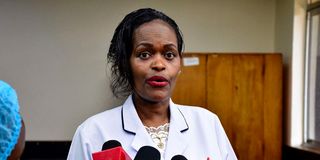
Kenyatta National Hospital (KNH) Critical Care Nurse Specialist, Cardiothoracic Unit Purity Anampiu, makes her remarks on the aftercare needed for patients recovering from heart surgery during an interview at the hospital on September 23, 2026.
Fredrik Holmner is a consultant cardiac surgeon and part of the team is also inside the operating room. He is explaining the procedure to students from around the world. The students are following along through a telemedicine platform called Proximie. He gives them a background on the patient and a detailed account of what Prof Hiroshi and his team are doing.
In an interview with Nation, he says heart complications are a common cause of sudden death, and that lifestyle changes are a major contributing factor.
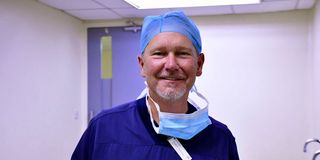
Dr Fredrik Holmner, a consultant cardiothoracic surgeon from Sweden, explains the process of performing an Off-Pump Coronary Artery Bypass surgery during the interview at KNH on September 23, 2026.
"We are seeing more people who are overweight and diabetic. We eat too much, drink too many sugary soft drinks, and we've stopped exercising. If you eat healthy food and keep yourself slim, you lower your risk of heart disease," he explains.
"I have been doing this for more than 30 years. When I started in Sweden, we rarely had a patient who weighed more than 100 kilos — maybe two a year. Now we get at least three every week. We are getting too heavy. We should run more and eat less," he says.
Benjamin Mwambu, Africa Deployment Specialist for Proximie, explains that the platform allows surgeons around the world to scrub in virtually.
"We are trying to take students from the operating room and let them learn virtually, using bi-directional communication so they can ask questions while the surgery is underway. This also helps reduce infections in operating rooms," he says.
Follow our WhatsApp channel for breaking news updates and more stories like this.