Inside Lamu's new hospital wing and the heated debate it sparked
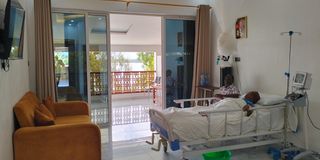
Stanley Makau with his wife at the Lamu King Fahd County Referral Hospital private wing dubbed 'Timamy Suite's' on November 16,2025.

What you need to know:
- The private section features five luxurious rooms equipped with modern amenities: private washrooms, showers, televisions, free Wi-Fi, and comfortable seating for visitors.
- Medical necessities such as oxygen points, nurse call systems, and handwashing sinks are also integrated.
The late afternoon sun warms Stanley Makau’s face as he sips his juice on a balcony. Seated on a deep, cushioned outdoor sofa piled with soft pillows, the 60-year-old watches the endless blue ocean, maintaining a state of calm meditation. One might think he is at a resort, enjoying a tranquil getaway. The truth, however, is that he is in a hospital.
This is the newly opened state-of-the-art private wing at King Fahd County Referral Hospital on Lamu Island.
The Lamu County government constructed and completed the private wing, named ‘Timamy Suites,’ ahead of its official inauguration by Health Cabinet Secretary Aden Duale in July 2025.
The wing became fully operational in October 2025, following a temporary closure. This pause allowed the hospital to redirect resources to general wards during a medics’ strike and to finalise preparations.
As the first-ever private wing at Lamu's main public health facility, the King Fahd County Referral Hospital, its construction and equipping cost the devolved government Sh22.5 million.
Now in its first three months of steady operation, ‘Timamy Suites’ has made significant strides, offering patients premium care within the public hospital system. For Makau, who has spent the past week there while his wife, Mariam Bakari, recuperates from surgery, the setting has been therapeutic.
“I’ve been enjoying the services provided here. A week ago, I brought my wife here while in a bad state of health. We chose to be booked at the private section. It’s well-designed, comfortable and supports quick patient-healing. The environment here is generally therapeutic,” said Mr Makau.
He added: “At times, I’ve assisted my wife to come and sit on this balcony, just to view nature, including the ocean over there. This has helped her heal faster. I am hopeful we shall be discharged soon. There’s great improvement.”
Lamu County government established the private wing with the goal of generating additional revenue. This income is intended to cross-subsidise public services and support low-income patients.
In an interview with the Nation, Lamu Deputy Governor Mbarak Bahjaj, who also serves as the Health executive, emphasised the strategy. He explained that drawing revenue from tourists, business tycoons, and other financially stable individuals seeking private care at the King Fahd County Referral Hospital directly helps improve the overall quality and accessibility of healthcare at the public facility.
By operating on a fee-for-service basis, the private wing attracts patients who can afford to pay out-of-pocket or use private insurance, thereby creating a vital stream of extra income for the hospital.
Stable patients
“We came up with the private wing to generate cash from financially stable patients. The revenue is reinvested into public wards and infrastructure, which in turn helps the disadvantaged access quality care,” Dr Bahjaj explained.
Since opening three months ago, the wing has already generated approximately Sh1.8 million. These funds are currently directed toward the main pharmacy’s medical supplies kitty.
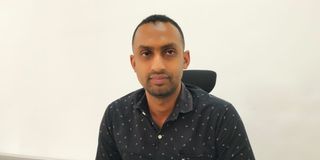
Dr Omar Abdulkadir, the Lamu County Health director, during the interview on November 16,2025.
In the meantime, general wards at King Fahd are also undergoing phased renovations funded by an additional Sh25 million county allocation, expected to be complete by June 2026, according to Dr Bahjaj.
The private section features five luxurious rooms equipped with modern amenities: private washrooms, showers, televisions, free Wi-Fi, and comfortable seating for visitors.
Medical necessities such as oxygen points, nurse call systems, and handwashing sinks are also integrated.
When asked if the private wing draws staff or attention from public patients, Dr Bahjaj clarified that while doctors serve both wings, the nursing and support staff for each are completely separate and independent.
According to the Health executive, the private wing has been receiving an average of three patients daily from across Kenya since it began operations.
“There’s no problem with attention. The private wing has a maximum of six patients at any given time but mostly, it receives an average of three per day. So, one nurse, one support staff is enough per shift,” he explained.
Unlike typical private hospital rates of Sh10,000–Sh20,000 per day, King Fahd’s private rooms cost Sh6,000 nightly, with the Social Health Authority (SHA) covering half for registered patients. Those with private insurance have their bills fully covered.
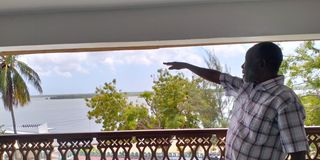
Stanley Makau enjoying the ocean view on a balcony of one of the private rooms at King Fahd Hospital.
Services at the King Fahad private wing range from high-dependency care to pharmacy and lab support, attracting patients from Nairobi, Mombasa, Kilifi, and beyond—many drawn by lower costs for procedures such as laser kidney stone removal, priced at Sh50,000 here compared to Sh350,000–Sh550,000 elsewhere.
Lamu County Health Director Omar Abdulkadir affirmed that the new wing, along with other recent upgrades like an ICU and CT scan unit, has reduced patient referrals outside Lamu and curbed exploitation by private facilities.
Yet, the project has not been without controversy.
Some patients in the general wards question the priority given to a luxury wing. Halima Sharishari, admitted after pregnancy-related surgery, acknowledged improvements in cleanliness and food, but noted she still buys most of her medication out-of-pocket despite being SHA-registered.
For Sharishari, her initial understanding was that enrollment with the SHA meant all her needs would be covered, especially as a patient at a government facility like King Fahd Hospital.
“You can imagine: three drugs are prescribed, and each costs Sh600,” she said. “I need to take them daily for five days. I’m told the SHA doesn’t cover this medication, which adds up to Sh1,800 per day. In a week, that’s a total of Sh9,000; money I simply don’t have.”
She went on to criticise the newly established private wing within the hospital, calling it a rushed project. “They should have first considered sponsoring these medications that the SHA doesn’t cover so that low-income patients like us could benefit directly,” said Sharishari. “Instead, the private wing serves just a few moneyed individuals.”
Bidii Kiponda, 38, who had travelled from Mokowe to visit his wife admitted in King Fahd’s general ward, argued that instead of funding a private wing, the county should prioritise improving public health centers and dispensaries at the grassroots level.
Kiponda pointed out that facilities like Mokowe Health Centre suffer from a shortage of medical staff and supplies. “Grassroots hospitals and dispensaries lack both drugs and personnel. Often, we’re forced to buy medicine out-of-pocket from private pharmacies,” he said. “Instead of rushing to introduce private wings, they should first address these basic issues.”
But for Ali Famau, a patient in the male general ward, the hospital’s upgrades are tangible and welcome. “Things were bad in 2021. Today, the rooms are clean, the food is good—we even eat chicken and pilau. I have no issue with the private wing. It means our hospital can accommodate anyone.”
When asked about the new luxury wing within the same public hospital, Famau expressed no objection, so long as it benefits everyone.
“Let the private wing exist. We must accept our different stations in life,” he remarked. “This way, our hospital can serve anyone. There are now options for people of all means—those with heavy pockets and those without. All can be cared for here. I think that’s a good thing.”
Healthcare analyst Ahmed Hassan, a physician with 38 years of experience, called the project “noble but misplaced.” He argued that King Fahd is inaccessible to most of Lamu’s population, particularly those on the mainland or remote islands, and that limited daily patient numbers—averaging three—make it economically unsustainable.
According to Dr Hassan, King Fahd Hospital remains geographically inaccessible to most of the county's population, meaning its private wing will primarily serve a small segment, largely residents of Lamu Island itself.
Lamu County is geographically vast, with a significant portion of its population residing on the mainland in areas such as Mokowe, Hindi, Mpeketoni, Witu, Bar’goni, Basuba, and Kiunga near the Kenya-Somalia border.
Others inhabit remote islands like Mtangawanda, Faza, Siyu, Pate, Kizingitini, Ndau, Kiwayu, and Mkokoni.
For anyone outside Lamu Island needing to access services at King Fahd Hospital, the journey is both lengthy and costly. It requires no less than Sh2,000 for road travel, followed by a boat crossing over the vast Indian Ocean to reach the island.
Dr Hassan said the devolved government should have first concentrated on improving essential services, particularly in all the areas where the common mwananchi lives.
“The mainland area has a huge population compared to a place like Lamu Island. The county misplaced this project. They needed to have done some research, examining data, analysing and assessing it before its implementation. But as it is currently, it’s just unsustainable,” said Dr Hassan.
He further explained that Mokowe hospital and many others at grassroots are still struggling as they have remained poorly equipped with drugs and the personnel to run them.
“The private wing at King Fahd is both an uneconomical and misplaced project. Instead of spending over Sh20 million in establishing a private wing that serves less than five patients per day, why don’t they have improved the general infrastructure and equipping of health centres like Mokowe, Hindi, Mpeketoni and the rest where the common man lives? These are facilities where more than 80 patients visit daily,” said Dr Hassan.
He challenged the Lamu County Government administration to benchmark against other Kenyan institutions such as Coast General Hospital in Mombasa and the Kenyatta National Hospital (KNH) in Nairobi, where multi-tier healthcare systems have proven effective.
He noted that most public hospitals in Lamu have yet to operate at Level 4 or 5, making the introduction of a private wing premature. “At KNH, the facility operates at the highest tier—Level 6. It’s advanced and well-equipped, so structuring even a six-tier system makes sense there,” he said.
Stacy Korir, a patients’ rights advocate, expressed concern over the establishment of a two-tier healthcare system within public facilities like King Fahd County Referral Hospital.
In such systems, patients can opt for private care within a public hospital to bypass standard waiting lists. Korir warned that even with careful management, this model presents significant risks, including increased healthcare inequality, staffing shortages in the public sector, and an overall decline in the quality of public services.
“A two-tier system inherently undermines the principles of universal access,” said Korir. “It creates inequality between those who can afford private care and those who cannot. Patients with higher socioeconomic status often receive quicker service and better access, while others face longer waits in the public queue.”
She added: “In some scenarios, medical professionals—particularly specialists—may be incentivised to devote less time to the public system in order to increase their earnings in the private sector. This kind of dual practice can lead to critical staffing shortages and a lower quality of services in public hospitals, especially in underserved rural areas like Lamu.”
Kenya Medical Practitioners and Dentists Council guidelines require private wings within public hospitals to be separately licensed and regulated, ensuring private practice does not undermine public service delivery.