Is your job making you sick? The hidden cost of heat stress for Kenyan workers

Workers at Busia County Aggregations and Industrial Park Nasewa. An International Labour Organization analysis estimates that by 2030, heat stress could result in the loss of over two per cent of total working hours worldwide—equivalent to 80 million full-time jobs. In agriculture and construction, the figure is far higher, particularly in countries across Africa.

What you need to know:
- While the challenge is global, manual laborers in sectors like construction, agriculture, and fisheries in low-income countries are most at risk.
In the scorching mid-day heat of Marsabit, the streets fall silent: shops close, boda bodas park in the shade, and farmers abandon their fields. On most days, the sun is too hot to bear by 11am. Locals retreat indoors, hibernating until late afternoon when temperatures ease and work can cautiously resume.
This daily pause has become a survival strategy in Kenya’s arid north, where climate change is pushing temperatures to punishing extremes. But while it saves lives, it is quietly bleeding away incomes and productivity.

A new report released by the European Union Copernicus revealed that January 2025 was the hottest January ever.
A report from the World Meteorological Organization (WMO) and the World Health Organization (WHO) titled ‘Climate Change and Workplace Heat Stress’ warns that billions of workers globally are already suffering from rising heat. The health risks include heat stroke, kidney failure, dehydration, and neurological damage, but the economic risks are only beginning to be counted.
“Billions of workers are already experiencing the harms of heat stress in their livelihoods and health, especially the most vulnerable populations,” said Dr Jeremy Farrar, WHO sssistant director-general for Health Promotion.
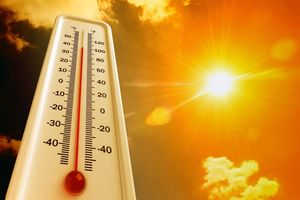
In Kenya’s arid and semi-arid lands (ASALs), which make up nearly 90 per cent of the country’s territory, this is a lived reality. In counties like Turkana, Garissa, and Isiolo, daily temperatures regularly push beyond 35°C. Here, mid-day outdoor work is dangerous, forcing residents to restructure their lives around the heat.
“After 11am we can’t be outside,” says Halima, a small-scale farmer who lives near Lodwar. “The sun burns, you get dizzy, your throat dries. We wait until 4pm, then rush to the fields before dark.”
But those lost hours add up. If a worker typically manages eight hours in a day but now can only work three in the cooler evening, that is nearly 40 per cent of potential labour time lost each week. For casual labourers paid by the load or by the day, it is a direct cut in income.
The WMO/WHO report highlights that worker productivity decreases by 2–3 per cent for every degree rise above 20°C in the wet-bulb globe temperature, a measure that accounts for both heat and humidity. In practice, this means that for much of Kenya, especially the north, productivity is falling steeply as global temperatures climb.
An International Labour Organization (ILO) analysis estimates that by 2030, heat stress could result in the loss of over two per cent of total working hours worldwide—equivalent to 80 million full-time jobs. In agriculture and construction, the figure is far higher, particularly in countries across Africa.
Kenya is already seeing signs. A 2022 study of firms with ISO certification found that workers reported “low productivity and income reduction” tied directly to heat exposure. On farms and informal sites in the north, the losses are even starker but remain undocumented.
Food budgets
The World Bank warns that without adaptation, Kenya could lose up to 7.25 per cent of its GDP by 2050 due to climate impacts, including extreme heat. Already, between 2010 and 2020, climate-related events—drought, floods, and rising temperatures—cost the economy an estimated 3–5 per cent of GDP annually.
"When incomes fall, families cut food budgets or pull children from school to help with work. Health expenses rise as more workers suffer dehydration, fainting spells or long-term kidney strain. For women, who make up a large share of agricultural labourers, the burden is often double—reduced income and increased caregiving when relatives fall ill from heat," says Halima.
And unlike wealthier nations, Kenya has little infrastructure to soften the blow. Few workplaces provide cooling, hydration stations, or regulated rest breaks. In rural ASAL communities, access to healthcare is already stretched.
Experts warn that adaptation is no longer optional.
“To manage workplace heat stress and mitigate its impacts on health and productivity, public health policymakers should collaborate with scientists, meteorological services, health service providers, as well as organisations of employers and workers," The WMO/WHO report says.
The WMO reported that 2024 was the hottest year on record, with global average temperatures reaching 1.45°C above pre-industrial levels.
The global picture
• 2.4 billion workers worldwide are exposed to excessive heat each year
• 22.85 million occupational injuries annually are linked to heat stress.
• Global productivity falls 2–3 per cent per degree rise above 20°C.
• By 2030, heat stress could wipe out the equivalent of 80 million full-time jobs worldwide.
• The worst-affected sectors are agriculture, construction, and fisheries, especially in low-income nations.
• Heatwaves are now more frequent and longer-lasting, with every 0.5°C rise in global warming making them more likely
Sources:
• World Meteorological Organization (WMO) / World Health Organization (WHO), Climate Change and Workplace Heat Stress, 2025.
• International Labour Organization (ILO), Working on a Warmer Planet: The Impact of Heat Stress on Labour Productivity and Decent Work, 2019.
• Intergovernmental Panel on Climate Change (IPCC), Sixth Assessment Report, 2021.