Justice for sale: Scandal of bribes to clear rogue doctors
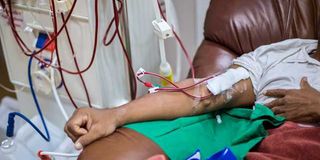
The recording has triggered more damning claims as several doctors, two of whom the ‘Nation’ interviewed, accuse KMPDC officers of soliciting bribes.


What you need to know:
- A recording of an official soliciting a bribe has led to further damning allegations, with several doctors accusing KMPDC officers of doing the same.
- An 11-minute audio recording confirms that the very institution tasked with protecting Kenyans from medical negligence has put justice on sale.
- A KMPDC official is heard demanding a Sh500,000 bribe in return for a slap on the wrist for a doctor who had been found guilty of negligence.
- Instead of the Disciplinary and Ethics Committee of the KMPDC imposing a one-year suspension and Sh1 million fine, the doctor only paid half the amount.
For close to three years, it was a best-kept secret. Until it wasn’t. An 11-minute audio recording, which would confirm that the very institution tasked with protecting Kenyans from medical negligence had put justice on sale, started to circulate in WhatsApp groups where doctors are the members.
In the recording, a Kenya Medical Practitioners and Dentists Council (KMPDC) official is heard demanding a Sh500,000 bribe in return for a slap on the wrist for a doctor who had been found guilty of negligence.
Instead of the Disciplinary and Ethics Committee of the KMPDC imposing a one-year suspension and Sh1 million fine, the doctor only paid half the amount. The suspension was omitted from the judgment.
The KMPDC official says he is the author of the judgment, and that the money must be released by the following morning, lest the punishment remain as it was.
Eventually, the two men agree on the Sh500,000 fine, shake hands and walk away.
The recording was shared with the KMPDC top brass. However, the officials did not share it with investigative agencies.
KMPDC Chief Executive Officer David Kariuki said in an interview that: “The Council (council members) are appointed by the Cabinet Secretary for Health, and as such, any alleged improper conduct is addressed through the appointing authority.”
By the time of going to press, Dr Kariuki had not confirmed whether the recording and the allegations were shared with Health Cabinet Secretary Aden Duale for investigation.
The Council CEO had also not responded to queries on whether the KMPDC has, in the past, referred graft allegations made by multiple doctors to the CS for investigations.
That recording has triggered more damning claims as several doctors, two of whom the Nation interviewed, accuse KMPDC officers of soliciting bribes.
In multiple interviews that the Nation conducted over three weeks claims emerged that the KMPDC Disciplinary and Ethics Committee has morphed into an open air market where doctors and complainants are the buyers, with favourable judgments the only merchandise up for sale.
Verdicts are bought, victims are ignored, and doctors are extorted.
Separately, the wheels of justice move exceptionally slowly in this quasi-judicial body, as some judgments are delivered up to five years after the hearing of cases is concluded.
This happens despite the legal requirement that judgments be delivered within 60 days after hearing is concluded.
“Disciplinary matters within the medical regulatory framework can be complex and often require multidisciplinary review before hearings are scheduled. Such cases demand careful consideration to ensure fairness to all parties and protection of patient safety,” Dr Kariuki said.
Under the Ethics and Anti-Corruption Commission Act, the anti-graft body has authority to investigate public offices and public officers accused of corruption.
Also Read: Court orders medical council to deliver ruling in case against doctor after patient’s death
“The Council is currently reviewing its processes to enhance efficiency, reduce backlog, and improve turnaround times while maintaining the integrity and quality of its decisions. All matters are dealt with fairly to preserve the trust that the public, practitioners and stakeholders place in the Council,” Dr Kariuki said.
Some of the victims narrated their experiences in an interview with the Nation.
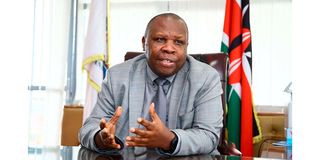
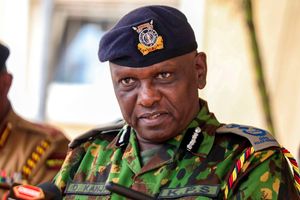
Kenya Medical Practitioners and Dentists Council (KMPDC) Chief Executive Officer, Dr David Kariuki, during an interview at his office in Nairobi on August 19, 2025.
Mr Brian Odhiambo's voice breaks as he recounts the night that changed his life forever. On October 31, 2023, his wife Wendy Amondi went into labour with their first child. It was supposed to be the happiest day of their lives.
But it became a nightmare due to medical negligence. What followed was an attempted cover-up, as the justice system looked away.
During Wendy’s antenatal clinic appointment, every scan came back normal. When her due date approached, the couple chose Juja Road Maternity Hospital for the delivery.
On that October evening, they arrived at the hospital at 7:30pm. Wendy was examined and found to be eight centimetres dilated. The medical team induced her to help her cervix dilate to the required 10 centimeters for delivery. She was admitted, and Mr Odhiambo was told to go home and wait.
His wife was in pain when Mr Odhiambo called at 5.30am the following morning, and there was still no news of delivery.
At 6:30pm, the hospital sent him a text message asking him to rush to the facility. There were no explanations or details. Mr Odhiambo arrived within an hour.
"First, they said Wendy couldn't deliver properly. Then they changed their story and said she had delivered, the baby was okay, but she was bleeding profusely. They told me that I needed to sign for a blood transfusion. It did not make sense to me. Why would they wait for me yet there was an emergency?” He asked.
The hospital demanded four pints of blood; if not, Mr Odhiambo would have to pay Sh5,000 per pint or source eight blood donors to replace what would be transfused.
"They brought me documents to sign. I didn't even ask about the baby at that point. They came with two pints of blood and told me the baby had come out shoulder-first, rupturing Wendy's cervix. That's why she was bleeding,” Mr Odhiambo said.
Wendy was rushed to the operating theatre. The baby was placed on oxygen.
Mr Odhiambo was told the blood transfusion was underway and doctors had repaired the ruptured cervix. But Wendy was still bleeding.
"They said her uterus had ruptured and they needed to remove it to stop the bleeding. I signed another set of consent forms,” Mr Odhiambo said.
In less than 30 minutes, hospital staff returned with devastating news: they had removed the uterus, but Wendy was still bleeding.
Next, Mr Odhiambo was told that his wife's blood pressure was dropping, and she was unresponsive. He was not allowed to see her. Instead, a doctor summoned him to his office.
"He looked down, flipped through the documents, and said, 'We tried everything we could, but she's gone.
“They did to give me the chance to accord her the last respect by removing the tubes,” Mr Odhiambo said.
When Mr Odhiambo later transferred his wife’s body to the mortuary, he saw a document indicating that she passed away at 11:45pm. But he wasn't informed until 1pm the following day.
"I signed the consent form for the uterus removal at 11am," Mr Odhiambo said."Was I signing documents for a woman who was already dead?"He wondered.
Even more suspicious, the discharge was done without Mr Odhiambo paying a single cent despite having a hospital bill of Sh150,000.
"They really wanted me out of that hospital. What surprised me most was that they even offered burial support. I have never heard of a hospital doing that. I could read the guilt on their faces,” he said.
Days after Wendy's burial, the doctor who attended to her called Mr Odhiambo and asked to meet him.
“He told me that even if I wanted to seek justice in court, it would take forever. He told me that it would be better to solve the issue amicably so that it doesn't go to the media,” Mr Odhiambo said.
He added that the hospital offered him Sh280,000 to keep quiet. Through their lawyer, he signed a non-disclosure agreement.
"I was vulnerable. I was grieving. I needed money to take care of my newborn child. I didn't have the financial muscle to fight them. So, I agreed,” Mr Odhiambo said.
"They warned me not to speak about the issue. I signed the document, but they didn't even give me a copy.”
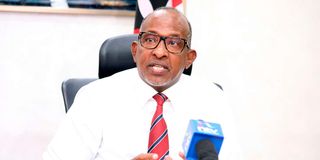
Health Cabinet Secretary Aden Duale during an interview in Nairobi on January 26, 2026.
Months passed. The grief didn't. The questions didn't. Mr Odhiambo realised that he had been silenced yet his wife's death had not been investigated.
He filed a complaint with KMPDC, the body mandated to investigate medical negligence and hold healthcare workers accountable. Nothing happened.
"They told me my case was waiting for review. When I asked for Wendy's medical records, they refused to give them to me,” Mr Odhiambo said.
Every time he followed up, KMPDC officials took him in circles. Mr Odhiambo said that some KMPDC officials suggested that he accepts the doctor’s offer then stay silent as the case would drag on.
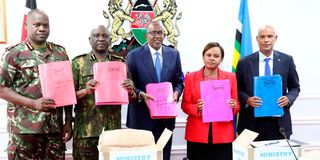
Health Cabinet Secretary Aden Duale (Centre) during the handover of 1,188 files from the Social Health Authority (SHA) and Kenya Medical Practitioners and Dentists Council (KMPDC) on September 1, 2025 at the Ministry of Health. With him are SHA CEO, Dr Mercy Mwangangi (2nd right), Inspector-General of Police Douglas Kanja (2nd left), his deputy Gilbert Masengeli (left), and Director of Criminal Investigations Mohamed Ibrahim Amin.
More than three years on, and the case is still pending. "I felt cheated twice," Mr Odhiambo said.
"First, I lost my rib, my partner, my love. Then the system that was supposed to give me answers betrayed me."
Kenya Medical Practitioners and Dentists Union (KMPDU), on February 17 wrote to CS Duale, stating that if the KMPDC Board is not dissolved within 14 days, then all doctors in Kenya will go on strike.
The ultimatum is based on what the union terms as runaway corruption, which involves extortion of doctors facing complaints.
“We do not make this request lightly," the union stated in the letter. "The KMPDC has ceased to be a regulatory body and has become a criminal enterprise that extorts doctors, ignores patients, and makes a mockery of medical ethics,” KMPDU Secretary-General Davji Atellah said in the letter.
The union said that legitimate complaints from patients are not investigated for years, cases are deliberately stalled or buried, and victims seeking justice are dismissed or told that their cases will "take forever".
“Council members solicit bribes from doctors facing disciplinary action, with the severity of punishment depending not on the offence, but on the ability to pay. The KMPDC Board has created a system where justice is purchased, not delivered,” Dr Atellah said, adding that doctors who can afford to pay bribes receive lenient treatment. “Those who cannot pay face career-ending punishments, regardless of the merits of their case."
In two other cases, it took the intervention of the High Court to force the KMPDC to address the complaints filed against doctors.
Ms Irene Muthoni Wanjau filed a complaint against Dr Bernard Ndung’u of Nairobi South Hospital on January 28, 2021. She accused the doctor of negligence during a surgery, which claimed her mother’s life.
On November 3, 2021 the matter was heard. One month later, everyone filed their written arguments for consideration by the committee. In May, 2023 the KMPDC responded to her inquiry on delay of the judgment, stating that it would be delivered the following month.
In March, 2024 the KMPDC made a similar promise. Ms Wanjau filed a case at the High Court in Nairobi on August 28, 2025 seeking to compel the KMDC committee to deliver the judgment.
The Council did not respond to the case, but contacted her in November, 2025 and promised to deliver judgment by the end of that month. Still, no judgment came. The court ordered the KMPDC to deliver judgment in the matter within 14 days on December 15, 2025.
Also Read: The frustrations of Kenya’s jobless doctors
In an interview with the Nation, Dr Kariuki said that the judgment in Ms Wanjau matter was delivered on January 6.
“The committee has faced exogenous challenges in the delivery of some rulings. However, we confirm that the rulings in the matters referenced were issued and that court directives were complied with on December 21, 2025 for Daniel Muriithi Mucheru and January 6, 2026 for Irene Muthoni Wanjau,” Dr Kariuki said.
“The challenges were not occasioned by willful disregard of court orders. They arose from administrative and operational challenges, including case backlog and the need to ensure that decisions are thorough, well-reasoned, and informed by appropriate professional input,” the CEO added.
And in another matter, Dr Alex (name withheld for safety) appeared before KMPDC's disciplinary committee to answer complaints filed against him. The experience, he said, opened his eyes to systematic corruption.
“Some of the people listening to my case were my peers, people I knew professionally,” he recalled. "After the hearing, they told me informally what the verdict would be and the amount I had been fined. Confident, Dr Alex waited for the formal verdict.
But one year later, he received a call from someone at the Council who told him about “a looming severe verdict”, which the official could help avert “by arranging for a meeting with the chair of the committee”.
“They were demanding over Sh1 million that they were going to share among themselves. They gave me a completely different version, a much more severe punishment. I called my friend from the committee who had spoken to me earlier and asked what was happening. He told me the original verdict hadn't changed,” the doctor said.
The implication was clear: pay up, and the punishment gets lighter.
“I reported this to the board, thinking that they would act on the corruption within their system. They did nothing,” Dr Alex said.
Eventually, Dr Alex received the verdict that the disciplinary committee had originally given.
"They wanted about Sh1 million. Not as an official fine to KMPDC, but as bribes to individual Council members. Without inside information, you wouldn't even know what the real verdict was,” he said.
Doctor Bernard (name withheld for safety), faced a similarly ordeal. He paid a bribe, but was still summoned by the disciplinary committee.
"When my case came up, the official resolution was that I pay Sh500,000 to the board as punishment for the complaint lodged against me. That was after the final verdict,” he said. But that wasn't the end.
"Individual board members demanded that I give them money so that they would ‘take care’ of my case. They told me the huge punishment could be reduced if I cooperated.”
Dr Bernard parted with the money, believing it would help.
"Later, I realised that they didn't help me at all. I paid the Sh500,000 official fine and the bribes. This is what normally happens. I have friends in this space who have been scammed and blackmailed by the Council to give bribes in exchange for favourable verdicts,” he said.
Follow our WhatsApp channel for breaking news updates and more stories like this