The country’s foreign debt grew by Sh233.4 billion across seven new loans in four months, according to a Treasury document tabled in the National Assembly.
This surge, recorded between May 1, and August 31, 2026 from multilateral and commercial creditors, compounds the country’s debt stock, which has already crossed the Sh13.2 trillion mark.
The mounting loans highlight severe debt service pressure amid depressed revenue streams and reduced donor support.
A breakdown of the contracted loans denominated in US dollars and euros translates to generally borrowing an average of Sh58.34 billion a month and Sh1.94 billion a day over the period.
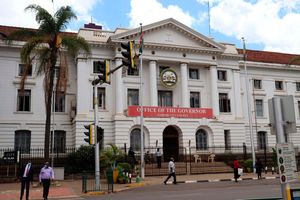
The National Treasury Building in Nairobi.
Photo credit: Pool
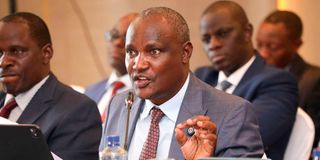
In a letter to MPs, National Treasury Cabinet Secretary John Mbadi revealed that the loans are for general budgetary support “against successful delivery of reforms”, to finance various consultancy works for government projects, supply water in Mombasa and Kwale and road infrastructure development.
“The National Treasury has prepared the report on new loans which contains details of all the new loans signed between the national government and various creditors from May 1, 2026 to August 31, 2026,” says CS Mbadi in the November 9, 2026 letter.
The letter adds: “The purpose of this letter is to forward the report to your office for tabling in the National Assembly,”
The last similar report covered the period January 1, 2026 to April 30, 2026 and included Sh416.2 billion in seven loans covering the period.
Section 31 (3) of the Public Finance Management (PFM) Act requires the Cabinet Secretary in charge of the National Treasury to update parliament on the loans procured by the government.
“At the end of every four months, the Cabinet Secretary shall submit a report to parliament stating the loan balances brought forward, carried down drawings and amortizations on new loans obtained from outside Kenya or denominated in foreign currency,” states the Act.
The PFM Act also mandates the CS, Treasury, to include information “as may be prescribed by regulations specifying the names of the parties to the loan and the amount of the loan and the currency in which it is expressed and in which it is repayable.”
The CS is further required to indicate the terms and conditions of the loan- interest and other charges payable, terms of repayment, the amount of the loan advanced at the time the report is submitted and the purpose for which the loan was used and the perceived benefits of the loan.
The hunger for loans comes as concerns grow over the sustainability of the country’s public debt amid depressed revenue streams as well as the unstable forex regime against the Kenyan shilling.
The new loans include Sh51.6 billion in the second Kenya Fiscal Sustainability and Resilient Growth Development Policy Operations project.
The loan was signed between the government and the International Development Association (IDA) in US dollars to be paid from December 15, 2031 through June 15, 2051.
The loan is meant for budgetary support against successful delivery of reforms that promote efficiency, transparency and equity of public finance, foster more competitive and inclusive product and labour markets and strengthen climate action.
The Sh44.13 billion procured from the International Bank for Reconstruction and Development is also meant for budgetary support against successful delivery of reforms that promote efficiency, transparency and equity of public finance, foster more competitive and inclusive product and labour markets and strengthen climate action.
This will be undertaken under the second Kenya fiscal sustainability and resilient growth development policy operation.
The Sh42.7 billion from the African Development Bank will also be channeled towards general budgetary support under the economic inclusion and green recovery support programme phase II.
To open up northern Kenya, the government borrowed an extra Sh35.7 billion from the IDA for the Horn of Africa Gateway Development Project, alongside Sh32.1 billion also from IDA for its second phase.
The combined Sh67.8 billion package will upgrade the Isiolo-Mandera corridor, speeding up the movement of goods and people, expanding digital access and improving social services while building capacity for transport institutions in the country.
The Thika and Githunguri water supply and sanitation improvement project will be financed by the Sh20.4 billion from the Kingdom of Denmark.
The loan will specifically finance consultancy services for design, procurement and institutional development for Athi Water Works Development Agency as well as the Thika and Githunguri water and sewerage companies.
A separate Sh13.63 billion IDA loan will tackle coastal water shortages by ramping up bulk supply to Mombasa and Kwale counties and connecting more residents in Kwale.
This will be implemented under the second additional financing for the Coastal region water security and climate resilience project.
A document presented to parliament in November 2025 by Central Bank of Kenya (CBK) Governor Dr Kamau Thugge showed that President Ruto’s Kenya Kwanza administration had borrowed at least Sh3 trillion within three years it had been in power following his election in August 2022.
The document presented to the National Assembly Committee on Public Debt and Privatisation by Dr Thugge indicates that in the financial year 2021/22, the period when President Ruto took power, the country’s debt stock stood at Sh8.7 trillion.
Central Bank of Kenya (CBK) Governor Kamau Thugge.
Photo credit: Dennis Onsongo | Nation Media Group
Although Dr Thugge says that the public debt remains sustainable to the economy, he admits that it faces “a high risk of debt distress.”
“Recent borrowing targets have been quite ambitious as the domestic market continues to support growing budgetary financing requirements,” the CBK document presented to the Public Debt and Privatization Committee chaired by Balambala MP Abdi Shurie, reads.
At the time, Dr Thugge warned that the government’s “recent” borrowing targets have been quite ambitious as the domestic market continues to support growing budgetary financing requirements.
The CBK document did not reveal the projects that were financed by the Sh3 trillion borrowed within the first three years of the Kenya Kwanza administration.
Nonetheless, the borrowing spree goes against the president’s own pledge during the 2022 campaigns, as he promised to focus more on investments and other revenue generation streams, including broadening the tax base.
This, as he set his sights on reducing the public debt, which he admitted was choking the country’s economic growth.
“We will change this tradition of applying for loans and be all about investments and labour-intensive programmes as opposed to capital intensive projects,” President Ruto, then Deputy President, spoke on June 3, 2022, at a campaign rally in Nairobi’s Kamulu area.
He made similar remarks in other events, including saying his main rival in the August 9, 2022, Presidential election — the Azimio candidate, Raila Odinga — was “planning to continue massive borrowing of loans.”
“Ours is about exploiting available local options to generate income to run the country,” he said.
According to the country’s annual borrowing plan for the financial year 2026/2027, the debt obligation is estimated at Sh1.1 trillion.
In October 2023, parliament passed an amendment to the PFM Act replacing the Sh10 trillion public debt numerical ceiling with a debt anchor set at 55 per cent of the GDP in net present terms.
This is projected to be achieved by 2029, with the current situation being about 62 per cent of GDP.
The increase in interest payments on domestic debt reflects Kenya’s growing reliance on domestic borrowing, which has crowded out Small and Medium-sized Enterprises (SMEs) from cheap credit.
For instance, in the 2020/2021 financial year, the government paid Sh388.8 billion in domestic interest, which increased to Sh456.8 billion in the 2021/2022 fiscal period, Sh533.1 billion in the 2022/2023 financial year, Sh622.5 billion in the 2023/2024 period, before hitting Sh776.3 billion in the 2024/2025 financial year.