Kajiado herders flee drought, sparking meat price crisis
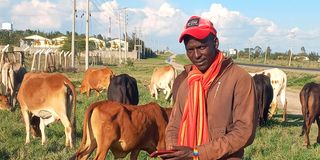
Raphael Teishi, a herder from Kajiado West, re-locating his cattle to the neighbouring Machakos County in search of pasture on November 11.

What you need to know:
- In September, the Kenya Meteorological Department (KMD) warned that most parts of the country would experience below-average rainfall between September and December.
- Charles Mugah, KMD deputy director, specifically cautioned that prolonged dry spells would continue to affect counties like Kajiado.
On November 11 at around 4pm, the Healthy Nation team found Raphael Teishi in Kisaju along Namanga Highway. The 30-year-old herder’s gait behind his cattle was even and measured, but his pace was determined to reach his destination before dusk.
A herder from drought-stricken Oloirien village in Kajiado West, Teishi had begun his 50-kilometre journey at 6am, headed to Katani area in Machakos County in search of pasture. He planned a stopover 15 kilometers further in Kitengela town before crossing into Machakos the following day.
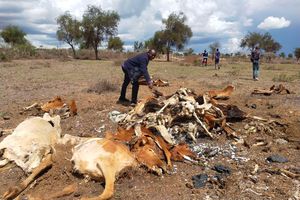
In most parts of the vast Kajiado County; including parts of Kajiado East, Central, South, and West sub-counties, pasture has vanished, leaving the ground bare but for a few shrubs. The parched rangelands are now stretches of cracked earth and withering plants, dotted with the aggressive flowering of the inedible Ipomea weed, a stark sign of the anxious wait for rains that have not come.
In September, the Kenya Meteorological Department (KMD) warned that most parts of the country would experience below-average rainfall between September and December. Charles Mugah, KMD deputy director, specifically cautioned that prolonged dry spells would continue to affect counties like Kajiado.
While parts of Loitoktok, Mashuru, Isinya, and Kitengela have received average rains, the relief has been sparse.
For Teishi, relocating his herd of 60 animals is a desperate bid to save them from the looming drought. On some, the effects of starvation were already visible. "The animals have started losing weight alarmingly. The prices for emaciated animals have dropped significantly in the market," said the father of two.
"With unpredictable rains, few customers are willing to stock their herds, fearing the drought will escalate." He remains optimistic his herd will persevere, expecting to return home at the beginning of March 2027 with the onset of seasonal rains."We are told the Katani area in Machakos has recently received ample rainfall. Depending on how many animals are relocated there, we might be forced to move further inland," he added.
Teishi's predicament is shared by hundreds of Kajiado herders who are still clinging to their animals. The relocation of livestock is now in high gear to neighbouring Machakos, Makueni, and Taita Taveta counties. In previous years, herders were restricted from moving animals to some counties over fears of spreading East Coast Fever common with relocating animals.
The desperation is pushing herders from Sholinke, Oloosirkon, and Tuala villages to slowly encroach on the neighbouring Nairobi National Park. James Legishon, 45, said the allure to enter the park is at a fever pitch as grass in the rangelands diminishes at an alarming rate. "We are currently grazing on the periphery of the park, to the chagrin of the rangers. If it doesn't rain soon, we might be forced to enter the park or watch our animals die of starvation," said Legishon, adding that feeding his animals on hay or pellets is financially untenable.
A spot check at Ilbisil, Sultan Hamud, and Sompole livestock markets revealed a low supply of animals, which has prompted prices to skyrocket. Farmers with fattened animals are fetching mouth-watering profits due to the beef quality, while emaciated livestock are absent as owners hold out hope for rain.
A mature, castrated fat bull now retails for between Sh150,000 and Sh180,000, with a medium bull going for Sh100,000 to Sh120,000. Owners are opting to withhold their healthy animals at slaughterhouses for a few days to secure the best offer.
The prices of sheep and goats also remain high, with a mature animal retailing for between Sh13,000 and Sh18,000—signaling an expensive Christmas festive season for meat lovers in Kajiado's satellite towns and neighbouring Nairobi .
Kajiado County boasts an annual livestock turnover of Sh3.2 billion. Beef wholesale prices per kilogramme now stand between Sh480 and Sh540. Just three months ago, a surplus supply saw quality beef wholesale for between Sh410 and Sh420.
James ole Nkapapa, chairman of Ilbisil slaughterhouse and livestock market, said prices are expected to climb further if the drought escalates. He also noted a reduction in the number of animals coming from neighbouring Tanzania. "Few farmers with fattened animals are fetching a fortune. Starving animals can hardly walk long distances.”
Vulnerable people and animals
In Kitengela town, a kilogramme of beef now sells at a wholesale price of Sh530, and up to Sh700 retail in most butcheries. High-end getaways are selling a cooked kilogramme of beef for between Sh1,000 and Sh1,300.
However, the State Department for Arid and Semi-Arid Lands and Regional Development has promised intervention. Principal Secretary Harsma Kello told Climate Action that the government is moving earnestly to protect vulnerable people and animals in regions likely to be affected by prolonged dry spells.
He said apart from providing relief food for Kenyans in drought-prone counties, the government is implementing strategic resilience projects in ASAL areas. "In collaboration with development partners, we are building community resilience in 23 drought-prone counties. We are constructing and rehabilitating water pans, boreholes, and dams. We are also promoting drought-tolerant crops and livestock breeds as mitigation measures," said PS Kello, noting that Kajiado Central has benefited from a major dam through the
National Drought Management Authority.
In addition, PS Kello said the ASAL state department has so far established 450 feedlots in 31 counties. Under this system, animals are confined to pens and fed a high-energy, grain-based diet for rapid weight gain before slaughter. "In feedlots, animals produce meat of consistent quality, meet market demands, and gain weight faster than grazing animals," he added. "The government is rooting for high-yielding animals as a yardstick for a better niche in the global livestock products market."