Sell livestock or watch them die? Kajiado herders’ dilemma as drought looms
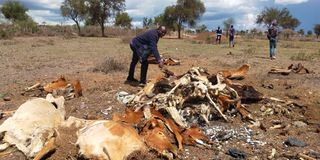
Simon Kisipan points at a heap of livestock carcases at Ekinye Village in Kajiado East on December 9, 2022.

What you need to know:
- The 2020-2022 drought saw the death of over one million animals - 400,000 cattle and 700,000 goats and sheep- and left 400,000 households dependent on relief food.
For John Kisimir, a 56-year-old herder in Kajiado County, a recent rainfall forecast from the Kenya Meteorological Department (KMD) shattered his hopes for the coming months.
The report, which was released on September 5 by KMD Deputy Director Charles Mugah, predicts below-average rainfall across most of the country until December, extending the prolonged dry spells that threaten semi-arid regions like Kajiado. This forecast is a nightmare for pastoralists here, where the scars of the devastating 2020-2022 drought are still fresh.
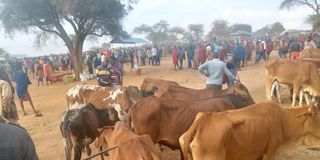
Livestock market day at the major Ilbisil town sale yard on September 12, 2025.Few animals are being witnessed contrary to a few months ago amid the looming drought.
That period saw the death of over one million animals - 400,000 cattle and 700,000 goats and sheep- and left 400,000 households dependent on relief food, according to the National Drought Management Authority.
Many herders who lost their livestock have yet to fully recover or have turned to crop farming. The price of a mature cow plummeted to as little as Sh500, crushing farmers' spirits.
Kisimir, who lives in Kajiado Central, and thousands of other herders across Kajiado West and East, are now staring at a new catastrophe.
The worst-hit areas include Mailua, Lorng'osua, Kumpa, and Maili 46 in Kajiado Central, as well as parts of Magadi region.
The landscape is already parched: the earth is cracked, plants are withering, and the invasive Ipomea weed, which has colonised more than three million acres of pasture in Kajiado County since 1997, according to data from the Department for Livestock Development, chokes the native grass.
The weed's heavy seeding ability, dense foliage, and aggressive root system allow it to outcompete and smother natural pastures, leaving little for livestock to graze on.
The economic toll is immediate. In some parts of the county, cases of animals being supported to be on their feet have been reported. At Ilbisil market, a healthy bull now sells for Sh150,000-180,000, while an emaciated one fetches less than Sh50,000, a sharp drop from Sh100,000 just six months ago. While the prices for goats and sheep remain relatively high for now, the future looks bleak.
"After the 2020-2022 drought, we have been trying to restock our herds. For the past two and half years, we have had enough rainfall. Now the adverse effects of erratic climate change are about to blow our livelihood—our animals—into the air,” said Kisimir on Tuesday.
The pastures are diminishing rapidly, and seasonal rivers are drying up.
Joel Nkapapa from Maili 46 told Climate Action that he and his brothers are considering relocating their animals to neighbouring counties in search of grazing land within the next two weeks. "If the situation persists, we will be forced to leave our families and move our animals to the neighbouring counties," he said. "Dry spells have always threatened our livelihood and food security. We were optimistic that we would continue re-stocking our animals, but it's not an ideal time for our goats and sheep to breed."
Herders traditionally avoid allowing their animals to give birth during the dry or rainy seasons to prevent high mortality rates among the young ones.
Goats and sheep have a gestation period of about three months and can give birth up to four times annually. However, herders typically limit this to a maximum of two times per year to coincide with periods of abundant fodder. They are now on high alert to ensure their animals do not give birth in late December or January 2026.
Last week during a Pre-Participatory Scenario Planning (PSP) forum, stakeholders and local administrators, led by Kajiado County Commissioner James Taari, advised herders to sell their livestock now to avoid mass deaths during the dry spell that might extend to February 2026.
PSP offers a collaborative approach to climate information services, co-producing actionable weather and climate information.
"Let our herders sell their livestock before they are emaciated and they watch them die. The county government ought to set aside some funds to mitigate the looming drought informed by climate change,” said John Kioli, chairman of the Climate Change Working Group Association.
Taari urged herders to take caution, stressing the local administration's commitment to mitigation efforts. He also urged chiefs to continue sensitising communities on climate change through public barazas in their areas of jurisdictions.
Avoid deforestation
He encouraged pastoralists to adopt modern farming practices and avoid deforestation.
"We are encouraging residents to stop cutting down indigenous trees and burning charcoal.”
Despite these warnings, many herders, like Kisimir, are still clinging to their animals, hoping they will survive the dry spell. Ironically, most did not make hay when pasture was plentiful. "We are still hopeful our animals will survive," said Stephen Nkabashi, a farmer from Maparasha village. "Pastoralists are so attached to their animals. It will be so hard for most of us to sell them. Traditionally, livestock remains a source of pride for a Maasai man."
Others are already spending heavily on supplemental feed.
Jackson Marashua,a herder from Mailua, said: “We are currently feeding our animals maize bran because the grazing fields are bare. "The drought is shaping up, leaving us on the edge," he said. "We will live for the day, hoping for the best.”
The drought is also expected to reduce milk production in the next four months. Kajiado County's 2024 records show an average annual milk production of 912,721 liters, which had grown by 50 per cent in the last two years due to abundant pasture. While this had led to a price drop to Sh30-35 per litre, the price has recently increased to Sh45 per litre.
In response, Environment, Climate Change and Natural Resources Executive James Ngugi said the devolved unit has organised a PSP forum for September. The event will bring together climate stakeholders and involve elders showcasing their indigenous weather forecasting prowess. The results will be compared with scientific forecasts recently released by the Met Department.
The event involves slaughtering a male goat and keenly examining its intestines, with the blood veins serving as a major facet of the forecast.
In addition to the elders, individuals with a "gift" for weather predictions are typically permitted to participate in the exercise, which usually lasts less than 30 minutes. In February, both scientific and indigenous forecasts aligned, predicting above-normal rainfall for parts of Kajiado County in April.
"Most parts of Kajiado County received below-average rainfall during the April rainy season," Ngugi said. "After the oncoming PSP forum, we will be able to advise residents, in all sectors, accordingly. We want herders to be cautious to avert animal deaths in the future."
Ngugi also noted that a Sh6 million rangelands reseeding programme launched in March failed in some regions due to harsh climate conditions. The programme, part of a larger Sh200 million World Bank-funded project under the Financing Locally-Led Climate Action Program (FLLoCA), aimed to reintroduce high-quality pasture species and reverse the damage caused by the fast-spreading Ipomea weed.
"The reseeding was hampered by climate headwinds. By now, most areas would have some grass that would see herders through the dry spell," Ngugi explained. "We are planning to continue with the ambitious programme during the April rainy season next year."
The FLLoCA programme focuses on building county-level capacity for planning and implementing local climate actions in partnership with communities. The reseeding initiative also aligns with Kajiado's core development pillar of "Modulated Pastoralism," which seeks to enhance sustainable livestock farming by improving pasture availability and resilience to climate shocks.
With an annual turnover of Sh3.2 billion, Kajiado's economy is heavily dependent on livestock, with thousands of cattle sold in its main markets of Ilbisil, Shompole, Kimana, and Emali. The looming drought threatens to undermine this vital economic engine.
For now, herders are caught between dire warnings and deep tradition, clinging to the animals that define their lives as another drought gathers strength.