Kala-azar still ravaging northern Kenya despite decades of warnings
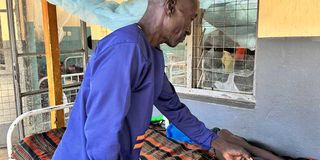
Charles Ekaru attend to his son, John Ekaru, at Lodwar Level Five Hospital. John, 11, was diagnosed with kala-azar.

What you need to know:
- Kala-azar is devastating Turkana families, with rising child deaths, malnutrition, and blood shortages worsening survival odds as climate change fuels the spread of sandflies.
- The region faces a crisis as misdiagnosis, poor health access, and malnutrition trap children in suffering, exposing gaps in the national health system.
Peter Akure sits at the edge of a hospital bed at the paediatric ward of Lodwar County Referral Hospital in Turkana County. From this point, he can see everything that’s happening outside. He clocks every movement with keen eyes, but it’s not doctors he watches, it’s everyone else.
A security officer, a cleaner, or a visitor. When they pass, he lights up. He is eager to talk to someone, perhaps about his past life as a former assistant chief. For over a week, his world has narrowed to this crowded ward, to his son’s sweat-drenched body, and a feature phone whose battery is almost dying.
In November 2024, Akure’s three-year-old son, Isaac Akure, fell sick. For nearly three months, the family struggled to care for him at home, unsure of what was ailing him. “Then he got worse. He had a fever, was coughing, vomiting and lost appetite for food”, he describes.
In his telling, the father of 45 children says he first sought treatment at a local dispensary, where health workers assumed it was malaria and prescribed drugs for it. However, his son’s condition continued to deteriorate. “When we sought help at another health facility, they referred us to Lodwar Level Five Hospital, about 125 kilometres from our home in Kang’risae Sub-location,” he says.
When Healthy Nation meets them, Isaac struggles to muster a smile. “We came here in the last week of March, and it’s been a week now. He is on treatment, though he still sweats profusely. I hardly sleep well at night,” he offers.
On a hospital bed placed outside the paediatric ward, Charles Ekaru gently shifts his son, John Ekaru, 11, into a new sleeping position and wipes away the beads of sweat trickling down his face. The heat inside is unbearable, so they have chosen to remain outside despite the scorching sun.
“I brought my son here because he has been sick for two weeks. I first tried treating him at home, thinking it was malaria, so I bought malaria drugs—but they didn’t help. His condition worsened; he developed a fever and started sleeping a lot,” he says. This prompted him to seek help at a health facility. “He was diagnosed with malaria, and we got some medication. Unfortunately, he didn’t get better.”
He would later learn that his son was actually suffering from kala-azar. The disease, also known as Visceral leishmaniasis, is among the neglected tropical diseases. According to experts, these diseases have been neglected for decades, receiving substantially less attention, research and funding than diseases like HIV/Aids.
The neglect is so severe that these diseases are routinely misdiagnosed or confused with more common conditions, condemning communities to silent suffering. Kennedy Wasilwa, a clinical officer and kala-azar focal person at the county referral hospital, says the first step is always to rule out malaria. "Most of these symptoms mirror those of malaria,” he explains.
This diagnostic challenge reflects a broader reality: for years, kala-azar has continued to shape the social, economic and health outcomes of marginalised communities across East Africa. A 2023 World Health Organization (WHO) update listed the region among those where the disease remains prevalent.
The impact is visible in the children themselves—their stomachs marked with traditional incisions, a desperate cultural practice that community members have adopted after decades of battling the disease with limited medical access. “This thing, this kala-azar, we call it 'etin',” Ekaru explains. “Because kala-azar causes swelling of the abdomen, we make these small incisions to let the disease out. It's because getting to hospital can be very difficult, depending on where you live.”
According to the WHO, leishmania parasites “are transmitted through the bites of infected female phlebotomine sand flies, which feed on blood to produce eggs”. The parasites can be hosted by around 70 different species, including humans. Once inside the body, Wasilwa explains, the parasite attacks the spleen, liver and bone marrow, leading to prolonged fever, drastic weight loss, anaemia and a swollen stomach.
For some parents at the facility, the source of infection seemed puzzling: they insisted they lived far from anthills and their children were too young to venture into bushes where sand flies might lurk. “The sand flies breed in cracks of mud walls, termite mounds and animal burrows,” Wasilwa clarifies. “They are also tiny—even smaller than mosquitoes. Because of their size, most people barely notice them.”
Left untreated, the WHO warns, 95 per cent of cases prove fatal. Between late 2024 and May 2025, Marsabit and Wajir counties, in the arid north-eastern region, reported more than 50 deaths collectively, with more than 1,000 cases being reported. In Turkana County, in just three months- January and March, the county had recorded 178 confirmed cases and 11 deaths.
According to Dr James Kidalio, Director of Medical Services in Turkana County, the situation reflects a “broken health system”—one where cases often go unreported and hence don’t make it into national databases, leaving entire communities invisible in the eyes of policy and intervention.
On April 9, when Healthy Nation visited Turkana’s largest referral hospital, the scale of the crisis became starkly visible. Inside the paediatric ward, around 10 children lay in varying stages of illness; outside, at least five more—including a woman with an eight-month-old baby wait under the scorching sun. It is here, within these crowded wards and makeshift outdoor spaces that the true burden of the disease unfolds. Every child tells a version of the same story. Delayed diagnosis. Improvised transport. Long journeys. Sleepless caregivers.
New faces
In April, Turkana’s largest health facility told us its kala-azar story through the eyes of the children. Four months later, on August 21, the script had barely changed. The patients admitted during our last visit had already been discharged. There were now new faces at the wards, burdened by the same disease.
The county is still experiencing many kala-azar cases, with Lodwar County and Referral Hospital being the main treatment facility. At a quick glance, the hospital’s paediatric ward has 11 patients while the medical ward has six, all in stable condition, the doctors later explained. Healthy Nation learned that one patient succumbed to the disease earlier in the month.
Inside the ward, 15-year-old Ekaale Edukon rests next to his mother. He manages a smile, but the incisions on his stomach speak of suffering that has lasted more than two months. Ms Edukon opens up about how kala-azar has affected her family twice this year. “In February, I was at this hospital for treatment. I stayed here for about a month and was discharged. Last month, my second-born son was diagnosed with the same disease, and that’s why we are here,” she offers.
Dr Gilchrist Lokoel, the county's medical services chief officer, says that of the 1,900 cases reported in the country between January and May, Turkana recorded around 276 cases with a case fatality rate of three per cent.
The referral hospital, he adds, admitted 240 kala-azar patients in 2024—the largest number since 2020. This year, between January and May alone, 183 cases have been managed at the facility. According to Dr Lokoel, all indications suggest that by year-end, the numbers will exceed those of previous years.
“In 2024, we recorded 24 deaths, and already 18 have been reported this year,” he says. “The surge came between October 2024 and January 2025, when mortality rates were high. Unlike in the past, cases were reported across the entire county, not just in the traditionally known visceral leishmaniasis-endemic areas. December was the peak, with 13 deaths.”
A walk through the hospital reveals patients crammed into every corner, due to limited space. The facility's Chief Executive Officer Nancy Nyanga explains why: “This is the only referral hospital, so we receive cases from across the county. However, because patients remain at the hospital for an average of 28 days, we are being overstretched in terms of space.”
The rising number of cases, Dr Lokoel explains, results from multiple outbreaks and new foci (newly identified transmission points) detected over the last three years. But these numbers tell only half the story. The other half reveals how malnutrition makes kala-azar even deadlier.
Multiple reports and studies show that malnutrition remains a critical issue in this arid and semi-arid (Asal) region. Malnutrition occurs when the body does not receive adequate nutrients to grow, stay healthy and fight infections. A Standardised Monitoring and Assessment of Relief and Transitions survey in June 2024 revealed a Global Acute Malnutrition rate of 21.8 per cent in Turkana County—well above the emergency threshold.
As of February 2025, close to one million children under five across Asal counties, including Turkana, required treatment for acute malnutrition. For those battling with kala-azar, this means their bodies have little strength to fight back. Doctors say the disease thrives in malnourished patients, significantly worsening survival odds.
“It's a vicious cycle,” explains Wasilwa, the kala-azar focal person. “Malnutrition weakens immunity, making children more susceptible to the disease. Most of these patients also arrive during the final stages of infection, when they are critically ill—presenting with jaundice, deranged liver function tests, and some are co-infected with tuberculosis.”
Addressing malnutrition, Wasilwa adds, offers a powerful shield against kala-azar. “With proper nutrition, the body builds stronger defences, giving it a better chance to resist the Leishmania parasite and recover from illness.”
Blood shortage
One of the biggest challenges for specialists and families here—a problem mirrored across health facilities nationwide—is the persistent and severe blood shortage. This stems largely from Kenya's struggle with low voluntary blood donations, which fall well below the WHO-recommended 15 donations per 1,000 people. Currently, the rate hovers between four and six per 1,000, leaving the country with an annual shortfall of around 200,000 units.
“Most patients arrive with severe anaemia, so we must transfuse first. But we face significant challenges with blood donation at the facility,” Wasilwa explains. “Sometimes relatives are willing to donate, but the distance from their homes makes it difficult to get here. Also, as a referral hospital, many other patients require the donated blood, not just kala-azar patients.”
While there has been significant progress in controlling and eliminating some neglected tropical diseases (NTDs), like the recently eradicated sleeping sickness in the country, recent data reveal a concerning trend of resurgence, fuelled by various crises. These diseases, which continue to affect over one billion people worldwide, have seen setbacks in the last few years.
According to WHO, Covid-19 caused a major disruption to global health programmes, leading to a substantial drop in the number of people reached by mass treatment interventions for NTDs. In 2020, this number fell from 1.164 billion to 762 million in 2019, WHO states. Though there has been some recovery since then, the levels are still not back to their pre-pandemic numbers, leaving a significant gap in treatment coverage. This trend, experts say, is not only a result of pandemics but is also exacerbated by other factors, including international funding cuts and climate change.
Climate change impact
The lives of at least three billion people are already living in areas susceptible to climate change, the WHO says. By 2050, multiple research predict that climate change will be responsible for 250,000 additional deaths per year, resulting from diarrhoea, undernutrition, malaria and heat stress alone.
Climate change is a significant and growing driver behind the resurgence of NTDs, particularly in vulnerable regions like Turkana County. “The rising temperatures, altered rainfall patterns, and more frequent extreme weather events directly impact the lifecycle of disease vectors and the human populations they affect, creating a 'perfect storm' that is undoing decades of progress in controlling these illnesses,” says the Lancet Global Health.
The link between climate change and NTDs is primarily driven by how environmental shifts favour disease vectors. The sand-fly, which is the primary vector in kala-azar is highly sensitive to climate conditions, multiple studies show. Prolonged droughts, a defining feature of climate change in Turkana, can initially suppress sand fly populations. However, the intermittent rainfall that often follows these droughts creates ideal breeding grounds in the cracked, dry earth and seasonal puddles. “These cases rise after the rains,” Wasilwa confirms.
Beyond vector ecology, WHO data show that climate change indirectly fuels NTD transmission by exacerbating social and economic vulnerabilities. In Turkana, for instance, prolonged droughts destroy the livestock upon which they depend. This leads to widespread food insecurity and severe malnutrition, particularly among children. “We are taking it as our initiative to ensure that we have enough blood at the health facility through blood drives,” Ms Nyanga said.
Dr Lukoel adds: We have enhanced priority activities that include Visceral Leishmaniasis risk mapping, training of healthcare workers on diagnosis and reporting of the disease, improved data management and surveillance, enhanced cross-border initiatives, community awareness and education, environmental interventions, resource mobilisation, and improved laboratory diagnostics.”
While lamenting over frequent stock outs of kala-azar commodities, Dr Lokoel calls for timely procurement and distribution of VL commodities by the Kenya Medical Supplies Authority, the state corporation mandated to procure, store and distribute drugs.