Kemsa owed Sh7.6 billion as Kenyans pay the price with empty public hospitals shelves
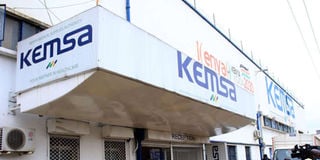
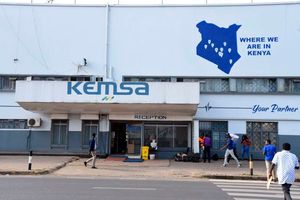
Kemsa offices in Industrial Area, Nairobi.

What you need to know:
Kemsa has been experiencing operational challenges including stocking due to financial constraints from inadequate budget allocation and huge debts.
The Kenya Medical Supplies Authority (Kemsa) is struggling to keep medicines on the shelves of public health facilities over a Sh7.6 billion debt, mostly owed by counties and the Ministry of Health.
Of the total debt, more than Sh5.6 billion has been outstanding for more than 90 days, pushing the agency into a liquidity crisis with direct consequences for ordinary Kenyans who depend on public health facilities.
"The prolonged delays in settling these bills have resulted in a sustained liquidity constraint, limiting the Authority's ability to meet suppliers' commitments amounting to Sh2.5 billion," said Dr Waqo Ejersa, KEMSA's Chief Executive Officer, while appearing before the National Assembly's Health Committee to present supplementary estimates for the 2025/2026 financial year.
The numbers he presented paint a picture of an institution being slowly hollowed out, not by mismanagement alone, but by a system in which the people who owe KEMSA money have been allowed to delay, defer, and ignore their obligations for years without consequence.
County governments carry the heaviest share of the debt at Sh3.66 billion, single facilities and referral hospitals owe Sh1.133 billion while the Ministry of Health owes Sh1.5 billion. Development partners account for a further Sh640 million with others being SSD customers (Sh640,000) and customer operations (Sh10 Million).
The Ministry of Health's debt of Sh1.9 billion has been accumulating for more than three years. Of this, Sh1.5 billion represents outstanding arrears, while Sh452 million covers products that have already been delivered and distributed under Ministry programmes but never paid for.
“These are not products sitting in a warehouse. They have already reached patients. KEMSA simply has not been paid for them,” Dr Ejersa said.
When development partners donate health commodities— including family planning supplies from United Nations Population Fund, oncology drugs from the Max Foundation and Covid-19 supplies from various sources— the Ministry Health signs an agreement with KEMSA to handle warehousing and distribution services.
“KEMSA does the work and the Ministry is supposed to pay the associated fees. For over a decade in some cases, it has not been paid for 10 years,” the statement said.
"We have been warehousing family planning commodities supported by UNFPA and oncology products supported by the Max Foundation. We have incurred distribution and handling costs for over ten years without reimbursement, forcing the Authority to utilise its appropriations-in-aid, further eroding liquidity and weakening its capacity to maintain adequate stock reserves," the report presented before the Health committee stated.
The World Bank's Covid-19 warehouse fees alone have gone unpaid for six years, amounting to Sh17.6 million. UNFPA's family planning products warehousing has run up a bill of Sh654 million while the Max Foundation's oncology products account for Sh403 million. Covid-19 supplies and donations add a further Sh375 million.
Among county governments, Nairobi leads the list of debtors with Sh254 million owed to KEMSA, followed by Kilifi at Sh234 million, Turkana at Sh229 million, and Tharaka Nithi at Sh186 million. Others are Marsabit (Sh138 million), Wajir (Sh131 million), Kakamega (Sh124million), Homa Bay (Sh122 million), Meru (Sh108 million), Bomet (Sh103 million) with Samburu owing Kemsa Sh101 million. In total, 11 counties owe more than Sh100 million each.
Also Read: Shock of expired drugs in public hospitals
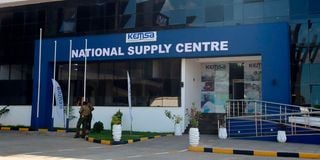
Kenya Medical Supplies Authority offices pictured in Embakasi, Nairobi, on December 10, 2024.
Counties with smaller debts are Nyeri (Sh12 million), Makueni (Sh14 million), Kisumu (Sh16 million), Mombasa (Sh17 million), Lamu (Sh19 million), Busia (Sh23 million), Kitui (Sh29 million) with Laikipia at Sh32 million. Kajiado and West Pokot counties owe nothing.
For a long time, Kemsa has been experiencing operational challenges including stocking essential health commodities due to financial constraints resulting from inadequate budget allocation and huge debts to counties and other clients.
While before the health Committee, Dr Ejersa said he had requested Sh3.7 billion in the supplementary budget for the 2025/26 financial year. Of that, only Sh135 million has been approved, leaving a funding gap of Sh3.1 billion.
“Kemsa is responsible for procuring, warehousing and distributing essential health products and technologies to public health facilities across the country. The proposed budgetary will allow Kemsa to remedy the cash constraints currently being experienced thereby reducing the prolonged delays in settlements of its obligations and hence achieve a sustainable 90 per cent of order fill rate for health products.
He adds: “This will help with the order turnaround time for products and seven days’ order turnaround time for hospitals. This persistent gap compels KEMSA to divert internally generated revenues from key operational priorities such as restocking and logistics to meet payroll obligations.”
He said presently, the agency cannot meet its supplier commitments and cannot fill orders. An agency that cannot fill orders cannot keep shelves stocked.
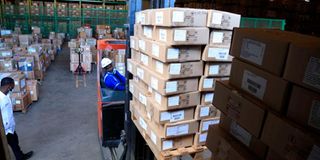
Kemsa staff packing HIV drugs before being dispatched to various counties at Kemsa warehouse in Embakasi, Nairobi, on April 22, 2021.
In 2020, at the height of the Covid-19 pandemic, the agency became the centre of a multi-billion-shilling procurement scandal that shocked the country and exposed deep vulnerabilities in how Kenya manages public health resources.
Investigations revealed that Sh7.8 billion worth of Covid-19 emergency supplies had been procured under questionable circumstances. Personal protective equipment, masks, gloves, and sanitisers were purchased at prices that investigators found to be massively inflated.
Suppliers with no prior experience in medical supplies were awarded multi-million-shilling contracts. The Ethics and Anti-Corruption Commission and the Directorate of Criminal Investigations both moved in to probe the deals. Senior officials were suspended. Parliament called for a complete overhaul of the agency's leadership and board.
Reforms were promised. Procurement processes were tightened. A new leadership team was brought in. But rebuilding an institution that has been looted takes time, and the financial wounds from 2020 have not fully healed.
Dr Ejersa requested the committee to compel the debtors to pay and pass the estimated budget.
“Without that, patients will keep arriving at clinics across the country only to be told that the medicine they need is not there yet they blame Kemsa for this. Behind every empty shelf is a debt that someone decided not to pay. And behind every unpaid debt is a patient who goes home without treatment,” he said.
Follow our WhatsApp channel for breaking news updates and more stories like this.
The writer is an Assistant Professor at the Department of Communication, Georgia State University, Atlanta.